


Diplomats from Taiwan and China keep each other at arm’s length while serving abroad, Representative to the US Shen Lyu-shun (沈呂巡) says.
“There is no personal relationship at all,” he told a conference on Taiwan at the Washington-based Center for Strategic and International Studies.
Shen was asked if Beijing diplomats in Washington — or London or Geneva, where Shen was previously stationed — ever offered to be friends “on a personal level.”
“No, never,” he said.
Shen said that his great-great-grandfather had served as the “top leader” in Taiwan from 1874 to 1875 and that a few years ago China published a paper about him.
He said that Chinese diplomats contacted him about the paper — “they were very polite” — and offered to send him a copy.
Shen said that he would very much like to have a copy of the paper and it arrived on Double Ten National Day.
He wrote to thank them for sending him a “National Day gift” and heard no more about it.
Shen said that as a result of Chinese objections, the nation had been “totally excluded” from some international organizations and “does not even know what it has missed.”
However, he said when an organizations shuts its door to Taiwan, the US “tries to open a window.”
A Taiwanese graduate student in the audience asked Shen what he could do — as a young person who loves his country — to preserve Taiwanese identity and culture, and traditional Chinese culture.
“What would you urge me to do?” the student asked.
“I think that is something you should ask yourself,” Shen said.
He said that the most practical thing the student could do would be to complete his degree, return to Taiwan and join the Ministry of Foreign Affairs.
Shen said that no matter who wins the next presidential election, China would remain a major issue.
“We have to minimize the threat and maximize opportunities,” he said.
Shen said that it took a lot of courage and a lot of skill to deal with China.
“We hope that we can pave a peaceful way for your generation, to make sure that any resolution is a peaceful resolution,” he said. “It will be up to your generation to manage the relationship and it will not be easy.”

LOUD AND PROUD Taiwan might have taken a drubbing against Australia and Japan, but you might not know it from the enthusiasm and numbers of the fans Taiwan might not be expected to win the World Baseball Classic (WBC) but their fans are making their presence felt in Tokyo, with tens of thousands decked out in the team’s blue, blowing horns and singing songs. Taiwanese fans have packed out the Tokyo Dome for all three of their games so far and even threatened to drown out home team supporters when their team played Japan on Friday. They blew trumpets, chanted for their favorite players and had their own cheerleading squad who dance on a stage during the game. The team struggled to match that exuberance on the field, with
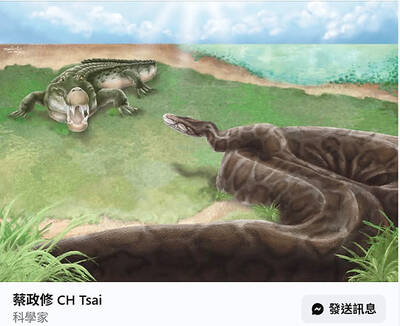
Taiwanese paleontologists have discovered fossil evidence that pythons up to 4m long inhabited Taiwan during the Pleistocene epoch, reporting their findings in the international scientific journal Historical Biology. National Taiwan University (NTU) Institute of Ecology and Evolutionary Biology associate professor Tsai Cheng-hsiu (蔡政修) led the team that discovered the largest snake fossil ever found in Taiwan. The single trunk vertebra was discovered in Tainan at the Chiting Formation, dated to between 400,000 and 800,000 years ago in the Middle Pleistocene, the paper said. The area also produced Taiwan’s first avian fossil, as well as crocodile, mammoth, saber-toothed cat and rhinoceros fossils, it said. Discoveries

Taiwanese paleontologists have discovered fossil evidence that pythons up to 4m long inhabited Taiwan during the Pleistocene epoch, reporting their findings in the international scientific journal Historical Biology. National Taiwan University (NTU) Institute of Ecology and Evolutionary Biology associate professor Tsai Cheng-hsiu (蔡政修) led the team that discovered the largest snake fossil ever found in Taiwan. A single trunk vertebra was discovered in Tainan at the Chiting Formation, dated to between 800,000 to 400,000 years ago in the Middle Pleistocene, the paper said. The area also produced Taiwan’s first avian fossil, as well as crocodile, mammoth, sabre-toothed cat and rhinoceros fossils, it said. Discoveries

Whether Japan would help defend Taiwan in case of a cross-strait conflict would depend on the US and the extent to which Japan would be allowed to act under the US-Japan Security Treaty, former Japanese minister of defense Satoshi Morimoto said. As China has not given up on the idea of invading Taiwan by force, to what extent Japan could support US military action would hinge on Washington’s intention and its negotiation with Tokyo, Morimoto said in an interview with the Liberty Times (sister paper of the Taipei Times) yesterday. There has to be sufficient mutual recognition of how Japan could provide


 RSS
RSS