


Fearing that his age and lack of students might cause the practice of fashioning the organs of sacrificial pigs into shapes during Pingtung’s Lantern Festival in the Liouduei region (六堆) to die out, 84 year-old Hsieh You-fa (謝有發) has commissioned the National Pingtung University of Science and Technology to document the practice.
Hsieh, from Sinpi Township (新埤), said that during the ceremony the intestines and inner organs of a sacrificed pig are molded into the shapes of a man or other animals. The practice, called Kan Wan (看碗), is aimed at propitiating the heavens and asking for a prosperous and peaceful year.
“I started learning the practice when I was 18,” Hsieh said, adding that he had been in charge of making Kan Wan for village ceremonies ever since.
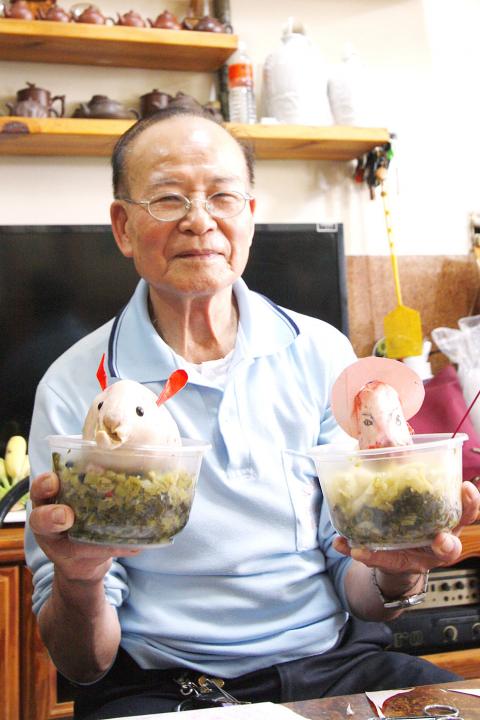
Photo: Chiu Chih-jou, Taipei Times
The practice sees a pig’s heart, liver, stomach, trachea and kidneys shaped into likenesses of familiar objects, such as pineapples, mountains, rabbits or rats, or into historical figures, such as Jiang Shang (姜尚) — more commonly known as Jiang Taigung (姜太公), Hsieh said.
Jiang was instrumental in aiding Ji Fa (姬發), also known as Zhou Wuwang (周武王), overthrow the Shang Dynasty and establish the Zhou Dynasty.
According to Hsieh, the Kan Wan ceremony reminds people to trust in life to provide their needs and the shapes were also didactic, reminding worshipers to be as smart as a rat, to be of good heart and loyal like a rabbit and to emulate Jiang Taigung’s philosophy that “those willing will bite” (願者上鉤).
The university said that Hsieh was the oldest Kan Wan master in the Liouduei area, adding that they first met Hsieh when the group visited Nanfeng Village (南豐) in September last year.
Hsieh told them that he was worried the practice would be forgotten and he was willing to teach anyone who was willing to learn, the group said, adding that they also hoped that by filming the process of making Kan Wan they would help the spread the practice, currently only seen in Hakka villages.

Considering that most countries issue more than five denominations of banknotes, the central bank has decided to redesign all five denominations, the bank said as it prepares for the first major overhaul of the banknotes in more than 24 years. Central bank Governor Yang Chin-lung (楊金龍) is expected to report to the Legislative Yuan today on the bank’s operations and the redesign’s progress. The bank in a report sent to the legislature ahead of today’s meeting said it had commissioned a survey on the public’s preferences. Survey results showed that NT$100 and NT$1,000 banknotes are the most commonly used, while NT$200 and NT$2,000

The Centers for Disease Control (CDC) yesterday reported the first case of a new COVID-19 subvariant — BA.3.2 — in a 10-year-old Singaporean girl who had a fever upon arrival in Taiwan and tested positive for the disease. The girl left Taiwan on March 20 and the case did not have a direct impact on the local community, it said. The WHO added the BA.3.2 strain to its list of Variants Under Monitoring in December last year, but this was the first imported case of the COVID-19 variant in Taiwan, CDC Deputy Director-General Lin Ming-cheng (林明誠) said. The girl arrived in Taiwan on

South Korea is planning to revise its controversial electronic arrival card, a step Taiwanese officials said prompted them to hold off on planned retaliatory measures, a South Korean media report said yesterday. A Yonhap News Agency report said that the South Korean Ministry of Foreign Affairs is planning to remove the “previous departure place” and “next destination” fields from its e-arrival card system. The plan, reached after interagency consultations, is under review and aims to simplify entry procedures and align the electronic form with the paper version, a South Korean ministry official said. The fields — which appeared only on the electronic form

The Ministry of Foreign Affairs (MOFA) is suspending retaliation measures against South Korea that were set to take effect tomorrow, after Seoul said it is updating its e-arrival system, MOFA said today. The measures were to be a new round of retaliation after Taiwan on March 1 changed South Korea's designation on government-issued alien resident certificates held by South Korean nationals to "South Korea” from the "Republic of Korea," the country’s official name. The move came after months of protests to Seoul over its listing of Taiwan as "China (Taiwan)" in dropdown menus on its new online immigration entry system. MOFA last week


 RSS
RSS