


Three-term Chinese Nationalist Party (KMT) Legislator Hsieh Kuo-liang (謝國樑) yesterday said he would not seek re-election, citing the results of the nine-in-one elections on Nov. 29 last year in Keelung.
“Since the KMT lost last year’s mayoral campaign, as someone who took on a heavy role in campaigning, I should not only humbly listen to the choice of city residents, but should also take appropriate responsibility and make good my promise,” Hsieh wrote in a Facebook post, referring to his promise not to seek re-election if KMT mayoral candidate Hsieh Li-kung (謝立功) lost.
Hsieh Kuo-liang said he would continue to help the KMT’s Keelung branch as a volunteer, leaving open the possibility for a campaign role in the next legislative election in January next year.
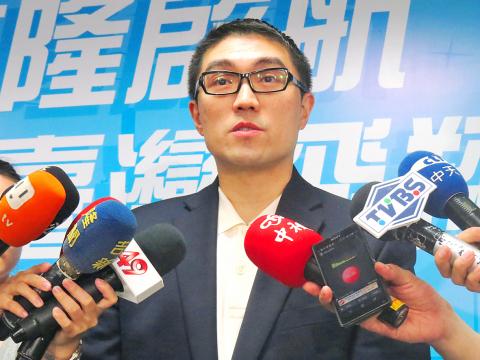
Photo: Yu Chao-fu, Taipei Times
Democratic Progressive Party (DPP) candidate Lin Yu-chang (林右昌) beat Hsieh Li-kung in the city, which had long been viewed as a KMT stronghold.
However, a corruption scandal that led to a split in the KMT camp, former Keelung city council speaker Huang Ching-tai (黃景泰) ran as an independent candidate after he was detained on suspicion of violating the Anti-Corruption Act (貪污治罪條例).
Lin won the mayor’s race with an increase of 10 percentage points over his previous campaign in 2012, when he ran against Hsieh Kuo-liang for Keelung’s single legislative seat.
Hsieh Kuo-liang’s announcement signals the end to a 10-year legislative career that saw him serve as the KMT caucus whip as well as cochairman of the Judiciary and Organic Laws and Statutes Committee.
Hsieh, who holds a master’s degree from the Massachusetts Institute of Technology and renounced his US citizenship to serve as a legislator, is the scion of a prominent Keelung political family.
The family also owns a number of businesses and schools such as the Sangong Group, the Second Credit Cooperative of Keelung and the Keelung Er Xin High School.
When he was first elected in 2004 on the People’s First Party’s (PFP) ticket, he became the youngest member of the legislature. He switched allegiance to the KMT in 2006.
DPP Keelung branch chairman Tsai Shih-ying (蔡適應) yesterday said that he will campaign for the party’s nomination for the seat. Lawyer Cheng Wen-ting (鄭文婷) announced her own candidacy for the nomination earlier this month.
Rumored pan-blue candidates include Hsieh Li-kung, KMT Legislator Hsu Shao-ping’s (徐少萍) son, Lin Pei-hsiang (林沛祥), and KMT Keelung City Councilor Han Liang-chi (韓良圻), as well as Liu Wen-hsiung (劉文雄) of the PFP, who represented the city in the Legislative Yuan for three consecutive terms.
Additional reporting by Yu Chao-fu

FUKUOKA SITUATION: Japanese media reported that the pathogen is expected to be identified by the summer, while the CDC downplayed the idea that it was hMPV A “mysterious cold-like illness” reported in Japan’s Fukuoka Prefecture does not seem to be a new disease, but Japanese authorities have been asked about the situation, the Centers for Disease Control (CDC) said yesterday. The Fukuoka Prefectural Medical Association on Wednesday told a news conference that a “mystery cold” that has become a hot topic on social media is “highly likely to be caused by some kind of viral infection,” Japan’s KBC News reported. “Many people are experiencing symptoms starting with a sore throat, followed by a runny nose, phlegm and a severe cough,” KBC News reported, citing association officials. Health authorities are

Nvidia Corp CEO Jensen Huang (黃仁勳) arrived in Taiwan yesterday ahead of upcoming AI and technology events, saying he plans to meet with clients and Taiwan Semiconductor Manufacturing Co Chairman C.C. Wei (魏哲家) during his visit. After landing at Taipei Songshan Airport, Huang posed for photos with fans and handed out Yakult drinks to reporters and supporters waiting at the scene, saying he has “a lot to do” during the trip. Asked about reports that Nvidia’s planned headquarters site in Taipei’s Beitou Shilin Technology Park could break ground on May 27, Huang said that if the company holds an event, he would

The Ministry of Finance this afternoon announced the winning numbers for the March-April uniform invoice lottery. The winning number for the NT$10 million (US$318,060) special prize is 19531471, and the winning number for the NT$2 million grand prize is 85941329. Three numbers were drawn for the NT$200,000 first prize: 07225810, 20231230 and 83518781. Those with receipts matching the last seven digits of any of the first-prize numbers will win the NT$40,000 second prize, while those matching the last six digits will win the NT$10,000 third prize. Those whose receipts match the last five digits of the first-prize numbers can claim the NT$4,000 fourth prize,

SIX SUBSIDIES: The monthly allowance for older farmers is to increase to NT$10,000, and NT$5,000 is to be given to homemakers under the national pension system, Lai said The government is to implement major welfare policies for disadvantaged groups, including raising the monthly allowance for older farmers to NT$10,000 and providing homemakers with NT$5,000 per month, President William Lai (賴清德) said yesterday. Lai made the remarks during a visit to Wangling Temple in Chiayi County, saying that the planned increases were being introduced amid economic growth and an increase in tax revenue. Touting a policy, in which the government plans to provide a monthly allowance of NT$5,000 for every child under the age of 18 in a bid to address Taiwan’s low birthrate, Lai said that if received for the


 RSS
RSS