


Taipei City Fire Department Captain Hsia Chih-chuan (夏志銓) is in love with dragons — not the fire-breathing kind, but bearded dragons, an agamid lizard native to Australia.
“I fell for the dumb-looking bearded dragons at first sight when I watched a Discovery Channel program introducing the species,” he said.
After the program ended, he spent the night researching the species over the Internet and bought his first bearded dragon the next day.
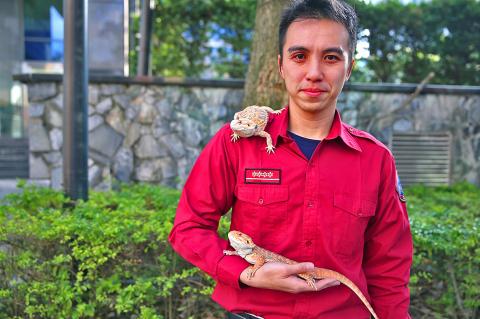
Photo: Yao Yueh-hung, Taipei Times
Hsia said he remembers being struck by the white nails of the bearded dragon when he first saw one, overturning his preconception that all reptiles had black nails.
Through more Internet research, he learned how the combinations of genes could result in the variants of the species in terms of appearance such as thin or thick scales, or scalelessness.
He has been deeply obsessed with the creatures ever since, he said.
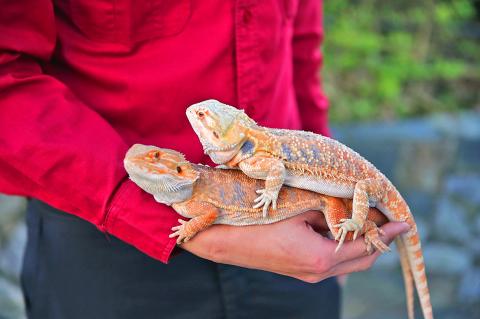
Photo: Yao Yueh-hung, Taipei Times
Admitting that the reptiles do not appear cuddly, especially given the fierceness with which they devour live insects, and their territorial aggressiveness, Hsia said that the reptiles could be very tame and close to human.
He now has 13 bearded dragons, some of which he bought at pet shops and others that he imported directly.
His most expensive purchase was a baby “stripeless” bearded dragon that cost him NT$28,000.
A mature stripeless bearded dragon costs between NT$70,000 and NT$80,000, he said, adding that he plans to buy more of them to breed.
“One has to keep cockroaches before keeping a lizard,” Hsia said with a laugh when asked what he feeds his lizards.
A bearded dragon eats five to six roaches a day, he said.
To keep down the costs of feeding his pets, he buys 4,000 Dubia roaches — which are also known as orange-spotted cockroaches — at a time, keeping them in a box and feeding them carrots, sweet potatoes and vegetables before giving them to his lizards, he said.
However, 4,000 roaches do not last long, and they do not reproduce fast enough to keep pace with his lizards’ appetites, so he has to buy a new batch every four months, he said.
“Large roaches are for large lizards, and small roaches for small lizards,” he added.
The veteran firefighter, who has served for more than 12 years, says the mental and physical stress of fighting fires and rescuing people are a burden, which his colleagues at the Chengde Fire Station relieve by jogging, biking, hiking and other activities, but he prefers spending time with his lizards.
He says he gets pleasure just from watching his bearded dragons and he can spend more than an hour at a time just looking at them.
“It is like fishing, which also allows you to enjoy a moment with yourself. It is very stress-relieving,” Hsia said.
Although he has kept lizards for years now, he says he always enjoys the balanced movements of the bearded dragons and their vibrant expressions, he said.
Sometimes his lizards look as if they are monarchs overseeing their kingdoms or philosophers in deep meditation, and the sight always refreshes him, he said.

The Centers for Disease Control (CDC) yesterday reported the first case of a new COVID-19 subvariant — BA.3.2 — in a 10-year-old Singaporean girl who had a fever upon arrival in Taiwan and tested positive for the disease. The girl left Taiwan on March 20 and the case did not have a direct impact on the local community, it said. The WHO added the BA.3.2 strain to its list of Variants Under Monitoring in December last year, but this was the first imported case of the COVID-19 variant in Taiwan, CDC Deputy Director-General Lin Ming-cheng (林明誠) said. The girl arrived in Taiwan on

South Korea is planning to revise its controversial electronic arrival card, a step Taiwanese officials said prompted them to hold off on planned retaliatory measures, a South Korean media report said yesterday. A Yonhap News Agency report said that the South Korean Ministry of Foreign Affairs is planning to remove the “previous departure place” and “next destination” fields from its e-arrival card system. The plan, reached after interagency consultations, is under review and aims to simplify entry procedures and align the electronic form with the paper version, a South Korean ministry official said. The fields — which appeared only on the electronic form

A bipartisan group of US senators has introduced a bill to enhance cooperation with Taiwan on drone development and to reduce reliance on supply chains linked to China. The proposed Blue Skies for Taiwan Act of 2026 was introduced by Republican US senators Ted Cruz and John Curtis, and Democratic US senators Jeff Merkley and Andy Kim. The legislation seeks to ease constraints on Taiwan-US cooperation in uncrewed aerial systems (UAS), including dependence on China-sourced components, limited access to capital and regulatory barriers under US export controls, a news release issued by Cruz on Wednesday said. The bill would establish a "Blue UAS

The Ministry of Foreign Affairs (MOFA) is suspending retaliation measures against South Korea that were set to take effect tomorrow, after Seoul said it is updating its e-arrival system, MOFA said today. The measures were to be a new round of retaliation after Taiwan on March 1 changed South Korea's designation on government-issued alien resident certificates held by South Korean nationals to "South Korea” from the "Republic of Korea," the country’s official name. The move came after months of protests to Seoul over its listing of Taiwan as "China (Taiwan)" in dropdown menus on its new online immigration entry system. MOFA last week


 RSS
RSS