


Controversy followed media coverage of the 14-hour hostage crisis at the Kaohsiung Prison in Daliao District (大寮), after the use of drones equipped with cameras to capture footage enraged the hostage-takers, who fired into the air — threatening the lives of the hostages and bystanders.
Meanwhile, the CTiTV News Tornado (新聞龍捲風) talk show was criticized for its live broadcast of an interview with prison warden Chen Shih-chih (陳世志) while he was still being held by the six convicts.
During the interview, program host James Tai (戴立綱) reportedly kept pressing Chen for details about events inside the prison. Tai was also accused of using overly dramatic tones in reaction to Chen’s responses.
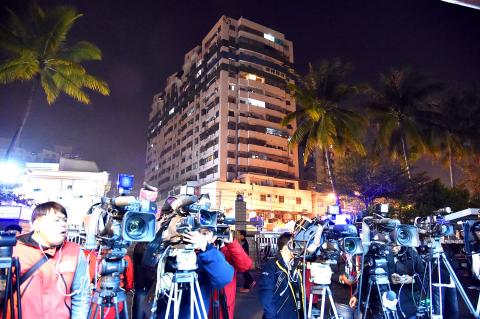
Photo: Chang Chia-ming, Taipei Times
However, netizens characterized the seven-minute interview as a farce, as it appeared as though nothing was happening in the prison.
CTiTV said in a statement that they originally wanted to interview the hostage negotiator, Kaohsiung City Councilor Lee Rong-tsung (李榮宗), but Lee gave his mobile phone to Chen instead, letting him speak for himself.
National Chengchi University journalism professor Lin Yuan-huei (林元輝) said that the convicts still had the hostages even as reporters sought updates. Therefore, the lives of the hostages could be in danger if anything went wrong, he said.

Photo: Huang Chih-yuen,Taipei Times
Reporters must consider whether using drones is necessary in such circumstances, Lin said.
“The purpose of using drones in this case was to get information more quickly,” he said. “However, one really has to question whether [drone] aerial photography could capture any meaningful images in this case, particularly in the dark.”
Lin said that he understands that reporters were under a lot of pressure and have to compete with each to get exclusive updates, but they can choose not to compete in emergency situations to avoid interfering in the rescue of hostages.
Even though CTiTV said that it did not intend to call the warden, Lin said that the interview should have been cut off as soon as the warden started speaking.
“The warden was taken hostage and was surrounded by armed individuals. How can you expect him to say anything meaningful in such a circumstance? Anything he said could have upset the convicts, and media outlets should do everything they can prevent the convicts from doing anything extreme,” Lin said.
May Chen (陳依玫), chairwoman of the self-disciplinary committee of the Satellite Television Broadcasting Association (STBA), said that association members would convene after the Lunar New Year holiday to discuss the proper use of drones in news reporting in light of yesterday’s event.
The association includes several large television networks.
May Chen said that the group’s self-disciplinary guideline stipulates that members cannot endanger the safety of hostages or interfere in official rescue operations when reporting the news.
She added that she had asked Deputy Minister of Justice Chen Ming-tang (陳明堂) to call her immediately if the ministry considered the media coverage disruptive to law enforcement officials.
“I think several issues can be open for further discussions, including whether media personnel can interview a mediator of the negotiation while hostages are yet to be rescued, or whether such an interview could potentially prevent the police from saving the hostages,” she said.
The National Communications Commission yesterday said that it would watch coverage by each network to see how they use drones before discussing the issue with the association.
As of yesterday, the commission received three complaints over the coverage of the crisis, it said.

NATIONAL SECURITY: Authorities are working to confirm the identities of the military personnel involved and investigating possible illegal conduct and regulatory violations Authorities are probing possible national security implications after Kinmen police and immigration officers on Sunday found a Chinese woman allegedly posing as a tourist while engaging in prostitution involving more than 10 military personnel. The woman, surnamed Chen (陳), has since been deported, authorities said, adding that investigators are still working to confirm the identities of those implicated, as the records only listed code names and aliases. The case stemmed from a report received by the Kinmen District Prosecutors’ Office on Friday last week from the Jinhu Precinct of the Kinmen County Police Bureau. On Sunday, police, along with the National Immigration

REASONS FOR TRAVEL: An assistant professor said that proposed amendments to penalize drivers if they used drugs overseas would not deter people from traveling People who operate a motor vehicle under the influence of marijuana would have their driver’s license revoked, even if they used the substance while overseas, the Ministry of Transportation and Communications said yesterday, citing proposed amendments to the Road Traffic Management and Penalty Act (道路交通管理處罰條例). The amendments would also authorize the government to revoke the licenses of people determined to have used Category 1 or Category 2 narcotics, even if they were not operating a vehicle while under the influence of drugs, as well as ban them from taking the license test for three years, the ministry said. People aged 18 or

GLOBALGIVING: ‘ Caving to external pressure is not acceptable for an organization that has cultivated justice reform and human rights for 30 years,’ one NGO said A slew of non-government organizations (NGOs) have withdrawn from the GlobalGiving fundraising platform after it announced it would use “Chinese Taipei” instead of “Taiwan” from next month. The Taiwan Good Rice Association wrote on Facebook on Friday that it was informed on April 28 via a teleconference call of the change, which was made because the platform wanted to operate in China. Taiwan Good Rice is to terminate all cooperative relationships with GlobalGiving in response to the platform’s “unilateral and non-negotiable” decision to remove references to Taiwan, the NGO said. “Taiwan is in the official name of Taiwan Good Rice Association and the

HEAVY WEATHER: Typhoon Jangmi is due to crash straight into the Ryukyus as airlines look to shift flights to larger aircraft or cancel flights to Okinawa entirely Taiwan’s international air carriers announced flight adjustments over the weekend as Typhoon Jangmi is forecast to hit the Ryukyu Islands today and tomorrow. The Central Weather Administration (CWA) upgraded Jangmi from a tropical storm to a typhoon at 8am yesterday, with the eye located 580km south of Naha city. It was moving north at 19kph. Today, China Airlines’ CI-120, CI-121, CI-122 and CI-123 flights between Taoyuan and Naha, Okinawa, have been canceled as well as CI-132 and CI-133 between Kaohsiung and Naha. EVA Air’s BR-112, BR-113, BR-186 and BR-185 flights between Taoyuan and Naha are also canceled. Low-cost carrier Tigerair Taiwan canceled IT-230,


 RSS
RSS