


Taipei Mayor Ko Wen-je (柯文哲), known for his off-the-cuff remarks to reporters, made news again yesterday after saying that he might pass a gift watch to a scrapyard because he had “no use for it.”
The pocket watch was given to him by British Minister of State for Transport Susan Kramer.
Giving clocks or watches as gifts is traditionally seen as taboo in Taiwanese and Chinese culture because the phrase “giving a clock” (送鐘) is pronounced the same as “bidding farewell” to the deceased (送終) at a funeral.

Photo: Chang Chia-ming, Taipei Times
After being asked by reporters whether he felt uncomfortable with the gift, Ko said he was not worried, because he and his wife were both doctors and were not superstitious.
He added that he lives on the fourth floor, considered unlucky by some people because the number four sounds similar to the word “death” (死).
However, the comment that drew the most media attention came as Ko laughed and said: “I can just give it to someone else or take it to a scrap metal dealer and sell it for cash.”
Taipei City Government spokesperson Lin Ho-ming (林鶴明) said that the mayor’s comment “was just a joke,” and that the gift had been stored in the city repository and would not be sold.
In his meeting with Kramer, Ko spoke in English as they discussed rail transport and urban renewal — important topics for Taipei as it prepares to host the 2017 Universiade.
The mayor presented Kramer with a miniature of Taipei 101. There was no word on what she thought of the gift.
Kramer was quoted by officials with the British Trade and Cultural Office in Taipei later in the day as saying that she had learned something about giving gifts.
“I’m sorry. We learn something new each day. I had no idea a gift like this could be seen as anything other than positive: In the UK a watch is precious — because nothing is more important than time,” she was quoted as saying. “The gift came from the House of Lords — which is only accessible to members of the UK’s upper parliament. It is a very unique item.”
“It was a huge honor to meet Mayor Ko. We look forward to working with him and his team in Taipei,” she added.

SECURITY: Starlink owner Elon Musk has taken pro-Beijing positions, and allowing pro-China companies to control Taiwan’s critical infrastructure is risky, a legislator said Starlink was reluctant to offer services in Taiwan because of the nation’s extremely high penetration rates in 4G and 5G services, the Ministry of Digital Affairs said yesterday. The ministry made the comments at a meeting of the legislature’s Transportation Committee, which reviewed amendments to Article 36 of the Telecommunications Management Act (電信管理法). Article 36 bans foreigners from holding more than 49 percent of shares in public telecommunications networks, while shares foreigners directly and indirectly hold are also capped at 60 percent of the total, unless specified otherwise by law. The amendments, sponsored by Chinese Nationalist Party (KMT) Legislator Ko

The military has spotted two Chinese warships operating in waters near Penghu County in the Taiwan Strait and sent its own naval and air forces to monitor the vessels, the Ministry of National Defense (MND) said. Beijing sends warships and warplanes into the waters and skies around Taiwan on an almost daily basis, drawing condemnation from Taipei. While the ministry offers daily updates on the locations of Chinese military aircraft, it only rarely gives details of where Chinese warships are operating, generally only when it detects aircraft carriers, as happened last week. A Chinese destroyer and a frigate entered waters to the southwest

The eastern extension of the Taipei MRT Red Line could begin operations as early as late June, the Taipei Department of Rapid Transit Systems said yesterday. Taipei Rapid Transit Corp said it is considering offering one month of free rides on the new section to mark its opening. Construction progress on the 1.4km extension, which is to run from the current terminal Xiangshan Station to a new eastern terminal, Guangci/Fengtian Temple Station, was 90.6 percent complete by the end of last month, the department said in a report to the Taipei City Council's Transportation Committee. While construction began in October 2016 with an
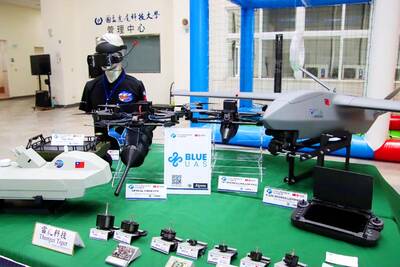
NON-RED SUPPLY: Boosting the nation’s drone industry is becoming increasingly urgent as China’s UAV dominance could become an issue in a crisis, an analyst said Taiwan’s drone exports to Europe grew 41.7-fold from 2024 to last year, with demand from Ukraine’s fight against Russian aggression the most likely driver of growth, a study showed. The Institute for Democracy, Society and Emerging Technology (DSET) in a statement on Wednesday said it found that many of Taiwan’s uncrewed aerial vehicle (UAV) sales were from Poland and the Czech Republic. These countries likely transferred the drones to Ukraine to aid it in its fight against the Russian invasion that started in 2022, it said. Despite the gains, Taiwan is not the dominant drone exporter to these markets, ranking second and fourth


 RSS
RSS