

At an Internet culture workshop attended by more than 100 government leaders yesterday, Premier Mao Chi-kuo (毛治國) said that the administration has yet to connect effectively with Internet-based communities to bring its policies closer to the public.
The seminar aimed to teach officials about online cultures and trends.
Having served as Taipei Mayor Ko Wen-je’s (柯文哲) Internet campaign advisers last year, workshop instructors Ben Jai (翟本喬), Tai Chi-chuan (戴季全) and Wang Ching-chiang (王景強) were lauded by Mao as “more than godlike figures” online.
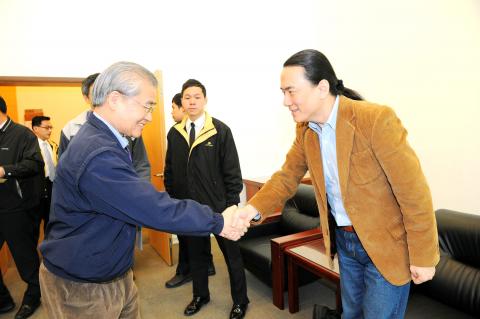
Photo: CNA, provided by the Executive Yuan
To respond to growing online communities, Mao said the government must make its data publicly available and develop relationships with digital communities to benefit from netizens’ experiences.
In response to an instructor’s suggestion that the government hire additional younger officials who are familiar with cyberculture, Vice Premier Simon Chang (張善政) said that he would look into a way to relax regulations for the employment of key officials.
Deputy Minister of the Interior Jonathan Chen (陳純敬) said the workshop was very effective at offering insight into cybercultures and a new way to advance policymaking and execution.
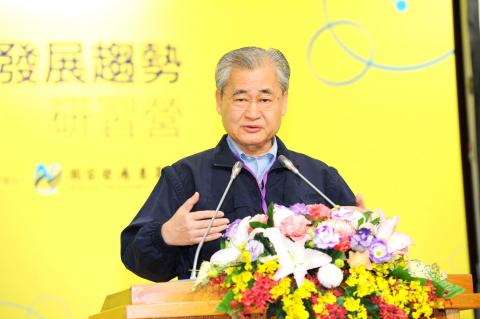
Photo: CNA, provided by the Executive Yuan
However, netizens said that holding a workshop that accentuated the importance of Internet campaigns showed that the Chinese Nationalist Party (KMT) misinterpreted its landslide failure in the nine-in-one elections last year.
The government has failed in its people and policies, they said.
“What the Internet has brought us is the replacement of the government’s unilateral indoctrination with a multidirectional, instantaneous communication among netizens” a netizen under the pseudonym “inlanyu” wrote.
One of the KMT’s misconceptions is that youth support for the Democratic Progressive Party is due to naivety, said Chou Wei-hang (周偉航), a Fu Jen Catholic University assistant professor known online as Ninjia Text (人渣文本).
However, it is very difficult to win over younger generations due to their information literacy, and if the KMT would like to attract them, it must avoid mudslinging opponents with lies that netizens can easily disprove, he added.

A Hualien pomelo farmer refused to sell to China after the country announced it would permit more Taiwanese pomelo imports, prompting widespread support from Taiwanese consumers, who rallied to buy his fruit. China’s Taiwan Affairs Office last month said that China’s General Administration of Customs registered an additional 79 Taiwanese pomelo orchards and packing facilities in Hualien County, allowing more Taiwanese producers to export pomelos to China. “I am a Hualien fruit farmer and I refuse to sell to China,” Liu Tzu-hao (劉子豪) from Ruisui Township (瑞穗) said in an online post. Liu is a well-known farmer in the community and has served

UPDATE: The submarine would need to undergo combined systems testing and crew training for navy personnel before it is ready for mission, an expert said Taiwan’s first domestically built submarine, the Hai Kun (Narwhal, 海鯤), could be delivered to the navy as early as next month, military expert and Taiwan Association for Security and Development chairman Chi Tung-yun (紀東昀) said yesterday. The submarine was yesterday morning observed departing for its 21st sea trial and its 15th submerged test. The vessel missed the initial delivery deadline of November last year due to “testing delays,” its primary contractor, shipbuilder CSBC Corp, Taiwan, said in June. The contractor also cited “political pressure from China” in procuring critical equipment. All testing operations are in the final stages, with the

OCT. 31: The antiviral drugs Tamiflu and Eraflu have been distributed to about 4,000 medical facilities nationwide for people in seven groups who develop flu-like symptoms As the domestic influenza epidemic enters its peak season and continues to escalate, the Centers for Disease Control (CDC) yesterday announced that publicly funded influenza antiviral drugs for seven eligible groups have been extended to Oct. 31, allowing those who develop flu-like symptoms to receive the medication without undergoing a rapid influenza test. The CDC has extended the expanded use of flu antiviral drugs to seven groups: healthcare and influenza-prevention personnel; residents and staff at nursing homes, long-term care facilities and similar institutions; kindergarten and daycare workers and home-based caregivers; students from kindergarten through high school, vocational high school and the
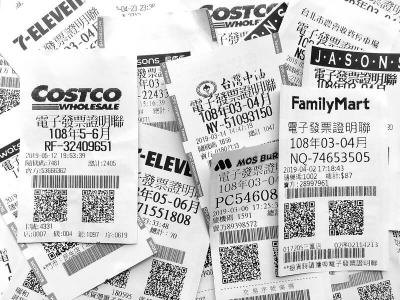
Six NT$10 million (US$315,527) special prizes and seven NT$2 million grand prizes in Taiwan's May-June uniform invoice lottery remained unclaimed as of today, including one NT$10 million winner who spent only NT$10 on an Uber Eats delivery order, the Ministry of Finance said. The ministry said the 13 winners need to claim their prizes by Nov. 5. The eight-digit serial number that won the NT$10 million special prize for May-June was 38548029, with 18 winning receipts in total. The NT$2 million grand prize number was 10138845, of which there were 22 winning receipts, the ministry said. In addition to the receipt issued for an


 RSS
RSS