


Amendments to the Water Pollution Control Act (水污染防治法) and the institution of the Act for Healthcare Services for the Yucheng Victims (油症患者健康照護服務條例) were approved by the legislature on Thursday.
The proposal to amend the Water Pollution Control Act was prompted by criticism of the fine given to Advanced Semiconductor Engineering Inc (ASE, 日月光半導體) after the corporation was found to have dumped massive amounts of wastewater into Kaohsiung’s Houjin River (後勁溪) last year.
The fine was said to be too low to deter companies from committing similar violations.
While existing regulations limit the punishment to a maximum of three years in prison and a fine of between NT$200,000 and NT$1 million (US$ 6,363 and US$31,815), the amended act would see those guilty of dumping wastewater judged potentially lethal to human life subject to life sentences and a possible fine of up to NT$30 million.
Those found to have dumped wastewater leading to serious illnesses and disabilities could face a prison sentence of between three and 10 years and a fine of up to NT$25 million, while those who have dumped wastewater leading to serious illness could be punished with a prison sentence of between one and seven years and a fine of up to NT$20 million.
If companies found dumping wastewater harmful to human health, agricultural and fishery production or the source of drinking water fail to take immediate responses or flout the competent authority’s order to halt operations, they are subject to up to three years in prison and a fine of between NT$200,000 and NT$5 million.
Under the amended act, whistle-blowers cannot be fired, demoted, subject to pay cuts or other punitive measures, and are to receive a proportion of any fine levied as reward for reporting illegal operations.
In related news, the Act for the Health Care Services for the Yucheng Victims was passed late on Thursday.
The victims of the disease are those who were poisoned by cooking oil contaminated with polychlorinated biphenyls (PCBs) in 1979.
More than 2,000 were intoxicated and suffered “chlorance,” a skin condition consisting of cysts and rashes, lasting damage to organs and immune and neural systems, and birth defects in children.
The statutes have been established to prohibit discrimination against the victims, 1,776 of whom are currently registered with the government, and to protect their rights to education, employment and medical treatment.
People with spouses, children or grandchildren who died of their injuires before the passage of the bill are each entitled to a solatium of NT$200,000.
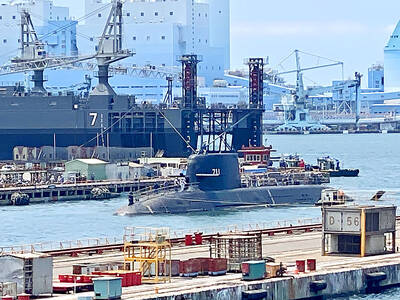
AGING: While Japan has 22 submarines, Taiwan only operates four, two of which were commissioned by the US in 1945 and 1946, and transferred to Taiwan in 1973 Taiwan would need at least 12 submarines to reach modern fleet capabilities, CSBC Corp, Taiwan chairman Chen Cheng-hung (陳政宏) said in an interview broadcast on Friday, citing a US assessment. CSBC is testing the nation’s first indigenous defense submarine, the Hai Kun (海鯤, Narwhal), which is scheduled to be delivered to the navy next month or in July. The Hai Kun has completed torpedo-firing tests and is scheduled to undergo overnight sea trials, Chen said on an SET TV military affairs program. Taiwan would require at least 12 submarines to establish a modern submarine force after assessing the nation’s operational environment and defense

Yangmingshan National Park authorities yesterday urged visitors to respect public spaces and obey the law after a couple was caught on a camera livestream having sex at the park’s Qingtiangang (擎天崗) earlier in the day. The Shilin Police Precinct in Taipei said it has identified a suspect and his vehicle registration number, and would summon him for questioning. The case would be handled in accordance with public indecency charges, it added. The couple entered the park at about 11pm on Thursday and began fooling around by 1am yesterday, the police said, adding that the two were unaware of the park’s all-day live
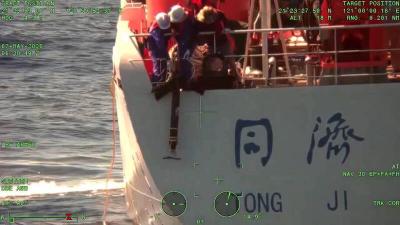
The coast guard today said that it had disrupted "illegal" operations by a Chinese research ship in waters close to the nation and driven it away, part of what Taipei sees a provocative pattern of China's stepped up maritime activities. The coast guard said that it on Thursday last week detected the Chinese ship Tongji (同濟號), which was commissioned only last year, 29 nautical miles (54km) southeast of the southern tip of Taiwan, although just outside restricted waters. The ship was observed lowering ropes into the water, suspected to be the deployment of scientific instruments for "illegal" survey operations, and the coast

A former soldier and an active-duty army officer were yesterday indicted for allegedly selling classified military training materials to a Chinese intelligence operative for a total of NT$79,440. The Taipei District Prosecutors’ Office indicted Chen Tai-yin (陳泰尹) and Lee Chun-ta (李俊達) for contravening the National Security Act (國家安全法) and the Anti-Corruption Act (貪污治罪條例). Chen left the military in September 2013 after serving alongside then-staff sergeant Lee, now an army lieutenant, at the 21st Artillery Command of the army’s Sixth Corps from 2011 to 2013, according to the indictment. Chen met a Chinese intelligence operative identified as “Wang” (王) through a friend in November


 RSS
RSS