


Education authorities plan to cut enrollment at universities and graduate institutes by about 35 percent over the next decade due to a shrinking population caused by a low birth rate.
Enrollment targets in undergraduate and doctoral programs are looking at 40 percent cuts, the Ministry of Education said at a recent conference of university presidents.
The nation only saw 1.06 births per woman in 2013 and experts say a rate of 2.1 births per woman is necessary to prevent the population from shrinking.
Ministry of Education Department of Higher Education director Huang Wen-ling (黃雯玲) said that she expects enrollment numbers to begin falling sharply next year.
Enrollment in the year 2023 could be 310,000 people fewer than the figures recorded in 2013, Huang said, adding that that would mean a NT$30 billion (US$953.41 million) reduction in tuition revenues.
In addition, teaching staff employed by higher education institutes are expected to decrease by 10,000 by 2023, Huang said.
Enrollment could plummet to 233,093 in 2023, a drop of 35.84 percent from 363,324 in 2013.
The number of bachelors degree students is expected to fall to 182,293 by 2023, a 39.6 percent drop from 301,820 in 2013.
Enrollment numbers for master’s degree programs are forecast to drop to 46,000, a 14.55 percent decrease from 53,834 in 2013, and for doctoral degrees the number is expected to decline to 4,800, down 37.4 percent from 7,670 in 2013.
Master’s students are expected to take up a higher relative proportion of higher education students in 10 years, while the proportion of bachelor’s and doctoral degree students are forecast to drop.
Bachelor’s degree students are set to make up 78 percent of all tertiary students, compared with 83.07 percent last year, while masters students could rise to 20 percent from 14.82 percent last year and doctoral degree student numbers are likely to account for 2 percent, down from 2.11 percent last year.
Huang said the Ministry of Education would seek to bolster the quality of higher education curricula by improving the teacher-to-student ratio from the current 32:1 for undergraduate programs and 12:1 for graduate programs, to 27:1 and 10:1 respectively.
National Taiwan University President Yang Pan-chyr (楊泮池) said that different guidelines should be set for different academic disciplines depending on societal needs.
For example, the enrollment targets for medical, accounting and other certifiable professions should not be reduced, he said.
He said the government should allow schools to carry out enrollment reductions at their own discretion and advised graduate degree holders to stay in academia, in addition to seeking careers in private industries.
Chinese Culture University President Lee Tien-rein (李天任) said that enrollment reductions and department closures might have a profound impact on the nation’s talent pool.

A magnitude 6.1 earthquake struck off the coast of Yilan County at 8:39pm tonight, the Central Weather Administration (CWA) said, with no immediate reports of damage or injuries. The epicenter was 38.7km east-northeast of Yilan County Hall at a focal depth of 98.3km, the CWA’s Seismological Center said. The quake’s maximum intensity, which gauges the actual physical effect of a seismic event, was a level 4 on Taiwan’s 7-tier intensity scale, the center said. That intensity level was recorded in Yilan County’s Nanao Township (南澳), Hsinchu County’s Guansi Township (關西), Nantou County’s Hehuanshan (合歡山) and Hualien County’s Yanliao (鹽寮). An intensity of 3 was

Instead of focusing solely on the threat of a full-scale military invasion, the US and its allies must prepare for a potential Chinese “quarantine” of Taiwan enforced through customs inspections, Stanford University Hoover fellow Eyck Freymann said in a Foreign Affairs article published on Wednesday. China could use various “gray zone” tactics in “reconfiguring the regional and ultimately the global economic order without a war,” said Freymann, who is also a nonresident research fellow at the US Naval War College. China might seize control of Taiwan’s links to the outside world by requiring all flights and ships entering or leaving Taiwan
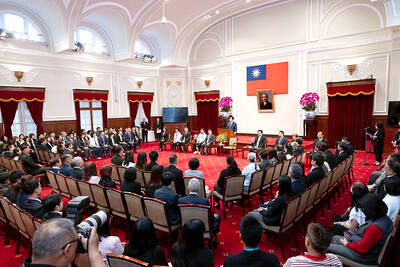
The next minimum wage hike is expected to exceed NT$30,000, President William Lai (賴清德) said yesterday during an award ceremony honoring “model workers,” including migrant workers, at the Presidential Office ahead of Workers’ Day today. Lai said he wished to thank the awardees on behalf of the nation and extend his most sincere respect for their hard work, on which Taiwan’s prosperity has been built. Lai specifically thanked 10 migrant workers selected for the award, saying that although they left their home countries to further their own goals, their efforts have benefited Taiwan as well. The nation’s industrial sector and small businesses lay
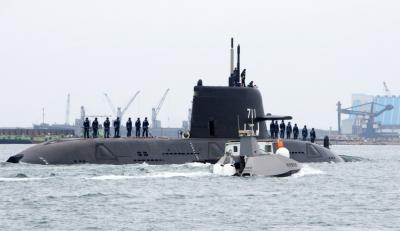
Taiwan's first indigenous defense submarine, the SS-711 Hai Kun (海鯤, or Narwhal), departed for its 13th sea trial at 7am today, marking its seventh submerged test, with delivery to the navy scheduled for July. The outing also marked its first sea deployment since President William Lai (賴清德) boarded the submarine for an inspection on March 19, drawing a crowd of military enthusiasts who gathered to show support. The submarine this morning departed port accompanied by CSBC Corp’s Endeavor Manta (奮進魔鬼魚號) uncrewed surface vessel and a navy M109 assault boat. Amid public interest in key milestones such as torpedo-launching operations and overnight submerged trials,


 RSS
RSS