


US Department of State officials have opened formal discussions with Taiwan on the raising of the Republic of China (ROC) flag over the Twin Oaks compound in Washington at a New Year’s Day celebration.
The talks are taking place in Taipei and Washington at what one source described as “a senior level.”
According to a US Congressional source not directly involved, the US is looking for a firm assurance that the incident will not be repeated.
For the third day in succession, the flag-raising was a central issue at the State Department press briefing on Wednesday.
Under strict protocols — developed after the US switched diplomatic recognition from Taipei to Beijing 36 years ago — Taiwan is not supposed to fly its flag above Twin Oaks, the residence of the nation’s official representative to the US.
However, last week, Representative to the US Shen Lyu-shun (沈呂巡) ignored the protocols and, without first clearing it with the US, had the flag raised at a private ceremony and released photographs of the event to the press.
Beijing was furious and made a formal protest to Washington.
Shen said in Taipei that the flag-raising was “not unprecedented” and that US officials made no protests when ROC flags were flown during a Double Ten National Day celebration at Twin Oaks in October last year.
Asked to comment on this development on Wednesday, State Department spokeswoman Jen Psaki said that she had no details about the October event, but that she would look into it.
She said that Twin Oaks was an official government facility and not a private home.
A reporter said that some in Taipei believed US concern about the flag-raising was not so much due to the event itself as to the protests from Beijing.
“It has to do with our consistent policy, that’s what it has to do with,” Psaki said.
Reporters pressed to know if there would be any repercussions as a result of the incident.
“We’re in discussions,” Psaki said.
“We continue to be in discussions with Taiwan authorities on this matter, but I don’t have any update,” she said.
Psaki said the flag had been taken down from the pole where it was hoisted above Twin Oaks, although the US had not actually asked for it to be lowered.
A reporter said that the Palestinians did not have a sovereign state and yet the US had no objection to them flying the Palestinian flag at their representative office.
“Why are you taking the stand that you’re taking now with Taiwan?” the reporter asked.
“We have strong cultural ties with Taiwan, and that hasn’t changed,” Psaki said. “Obviously, we look at every situation and every relationship differently. And I think that’s what every country, what every entity, what every relationship we have in the world expects.”
Asked if the expression of “disappointment” about the flag-raising would be the only consequence, Psaki said: “There are ongoing discussions. I have nothing else to read out for you.”
Psaki was asked about reports that the US had not been informed in advance about the flag-raising, giving it the ability to deny knowledge of the event when Beijing complained.
“I think we’re kind of 40 questions past where I have something to offer you on this particular line of questioning,” Psaki said.
“I would just convey that people were asking whether we knew in advance. We did not know in advance. I don’t have any speculation for you on what we would have preferred either way,” she added.
She was asked if there would be any restrictions imposed on the use of Twin Oaks as a result of the flag-raising.
“I wouldn’t make a prediction of that,” Psaki said. “We’re in discussions with authorities both in Taipei and in Washington. I don’t have anything to read out about those discussions. We continue to have an important cultural relationship — a relationship that I think both sides enjoy. And obviously, we expressed our view on this particular incident.”

FUKUOKA SITUATION: Japanese media reported that the pathogen is expected to be identified by the summer, while the CDC downplayed the idea that it was hMPV A “mysterious cold-like illness” reported in Japan’s Fukuoka Prefecture does not seem to be a new disease, but Japanese authorities have been asked about the situation, the Centers for Disease Control (CDC) said yesterday. The Fukuoka Prefectural Medical Association on Wednesday told a news conference that a “mystery cold” that has become a hot topic on social media is “highly likely to be caused by some kind of viral infection,” Japan’s KBC News reported. “Many people are experiencing symptoms starting with a sore throat, followed by a runny nose, phlegm and a severe cough,” KBC News reported, citing association officials. Health authorities are

Nvidia Corp CEO Jensen Huang (黃仁勳) arrived in Taiwan yesterday ahead of upcoming AI and technology events, saying he plans to meet with clients and Taiwan Semiconductor Manufacturing Co Chairman C.C. Wei (魏哲家) during his visit. After landing at Taipei Songshan Airport, Huang posed for photos with fans and handed out Yakult drinks to reporters and supporters waiting at the scene, saying he has “a lot to do” during the trip. Asked about reports that Nvidia’s planned headquarters site in Taipei’s Beitou Shilin Technology Park could break ground on May 27, Huang said that if the company holds an event, he would

The Ministry of Finance this afternoon announced the winning numbers for the March-April uniform invoice lottery. The winning number for the NT$10 million (US$318,060) special prize is 19531471, and the winning number for the NT$2 million grand prize is 85941329. Three numbers were drawn for the NT$200,000 first prize: 07225810, 20231230 and 83518781. Those with receipts matching the last seven digits of any of the first-prize numbers will win the NT$40,000 second prize, while those matching the last six digits will win the NT$10,000 third prize. Those whose receipts match the last five digits of the first-prize numbers can claim the NT$4,000 fourth prize,
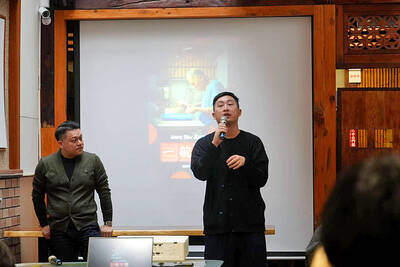
Taiwan Travelogue (臺灣漫遊錄), which earlier this week became the first Taiwanese novel to win the International Booker Prize, is to be adapted into a television series through a Taiwan-Japan coproduction, producer Chang Chen-yu (張辰漁) said yesterday. Chang, a producer at World Softest Production Film Co, wrote on Facebook that the company had been searching for projects with international appeal that retain a strong Taiwanese identity after colleagues and Japanese partners strongly recommended the novel. After reading the book, Chang said he immediately decided to pursue the screen rights. “A great story has the power to transcend time and borders, and connect countless people,”


 RSS
RSS