


The medical team formed to assess jailed former president Chen Shui-bian’s (陳水扁) health scheduled a third round of re-evaluation of Chen’s condition for Monday after visiting Chen yesterday without concluding a report for the Ministry of Justice’s Agen++cy of Correction.
Chen, on charges of corruption, has been imprisoned since late 2008 and his health is steadily worsening.
Former Vice President Annette Lu (呂秀蓮),who served as vice president under Chen’s administration from 2000 to 2008, said yesterday that she would launch a hunger strike beginning tomorrow at 4pm if the government does not release Chen on medical parole by tonight and would continue until Chen’s release for medical treatment is approved.

Photo: CNA
Lu visited Greater Kaohsiung to congratulate new Council Speaker Kang Yu-cheng (康裕成) and called for city councilors from her party, the Democratic Progressive Party (DPP), to join her planned hunger strike.
Lu requested that the city council set up a designated location for councilors to participate in the strike, suggesting that they rotate on six-hour shifts.
According to previous medical examinations, Chen was diagnosed with serious sleep apnea, major depressive disorder, prostatitis, delusional disorder and a stammer. Chen’s previous medical team suggested that he be released for home care, but the ministry turned down the suggestion and allegedly postponed appropriate treatment for Chen.
Lu cited Article 58 of the Prison Act (監獄行刑法) for legal basis of Chen’s release on medical parole, adding that she believed there were more prisoners who were not receiving adequate healthcare.
The ministry has neglected its duty, Lu said in a statement, adding a call for the Control Yuan to conduct further investigations.
Article 58 of the Prison Act says: “If inmates suffering from diseases cannot receive appropriate treatment in prison, it may be taken into account to release them on bail for medical treatment, transferring them to relevant prisons or hospitals with the permission of a supervisory authority.”
Lu called on the government to adhere to both the International Covenant on Civil and Political Rights and the Standard Minimum Rules for the Treatment of Prisoners, both of which call for humane treatment to protect prisoners’ human rights. Taiwan’s Legislative Yuan had ratified the former in 2009, while the latter is still being pushed for ratification.
The hunger strike hopes to help secure the release of Chen for appropriate medical treatment and to reconcile the pan blue-pan green political standoff, Lu said.
Meanwhile, the Agency of Correction said that Chen had undergone X-ray examinations and blood tests, as well as undergoing MRI scans at the Greater Taichung General Veteran’s Hospital on Wednesday, while having a sleep apnea risk assessment on Thursday.
The re-evaluation was headed by the hospital’s deputy director Hsu Hui-heng (徐惠恒) and was concluded, but the results are unknown, the agency said.
Additional reporting by Yang Cheng-chun

The military has spotted two Chinese warships operating in waters near Penghu County in the Taiwan Strait and sent its own naval and air forces to monitor the vessels, the Ministry of National Defense (MND) said. Beijing sends warships and warplanes into the waters and skies around Taiwan on an almost daily basis, drawing condemnation from Taipei. While the ministry offers daily updates on the locations of Chinese military aircraft, it only rarely gives details of where Chinese warships are operating, generally only when it detects aircraft carriers, as happened last week. A Chinese destroyer and a frigate entered waters to the southwest
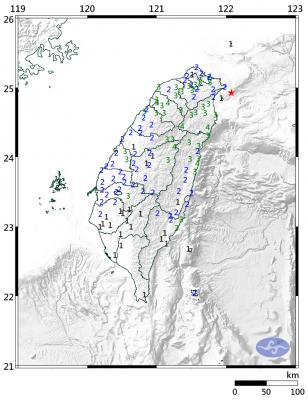
A magnitude 6.1 earthquake struck off the coast of Yilan County at 8:39pm tonight, the Central Weather Administration (CWA) said, with no immediate reports of damage or injuries. The epicenter was 38.7km east-northeast of Yilan County Hall at a focal depth of 98.3km, the CWA’s Seismological Center said. The quake’s maximum intensity, which gauges the actual physical effect of a seismic event, was a level 4 on Taiwan’s 7-tier intensity scale, the center said. That intensity level was recorded in Yilan County’s Nanao Township (南澳), Hsinchu County’s Guansi Township (關西), Nantou County’s Hehuanshan (合歡山) and Hualien County’s Yanliao (鹽寮). An intensity of 3 was

Japanese Prime Minister Sanae Takaichi’s comment last year on Tokyo’s potential reaction to a Taiwan-China conflict has forced Beijing to rewrite its invasion plans, a retired Japanese general said. Takaichi told the Diet on Nov. 7 last year that a Chinese naval blockade or military attack on Taiwan could constitute a “survival-threatening situation” for Japan, potentially allowing Tokyo to exercise its right to collective self-defense. Former Japan Ground Self-Defense Force general Kiyofumi Ogawa said in a recent speech that the remark has been interpreted as meaning Japan could intervene in the early stages of a Taiwan Strait conflict, undermining China’s previous assumptions
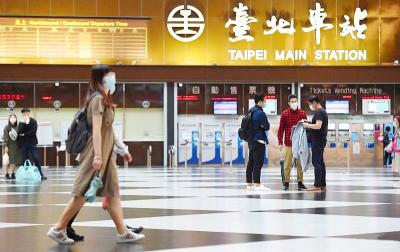
Taiwan Railways Corp (TRC) today announced that Shin Kong Mitsukoshi has been selected as the preferred bidder to operate the Taipei Railway Station shopping mall, replacing the current operator, Breeze Development Co Ltd. Among eight qualified firms that delivered presentations and were evaluated by a review committee, Shin Kong Mitsukoshi was ranked first, while Breeze was named the runner-up, the rail company said in a statement. Contract negotiations are to proceed in accordance with regulations, it said, adding that if negotiations with the top bidder fail, it could invite the second-ranked applicant to enter talks. Breeze in a statement today expressed doubts over


 RSS
RSS