


City mayors and and county commissioners elected to head 22 local governments in the Nov. 29 polls were sworn in yesterday.
New Taipei Mayor Ko Wen-je (柯文哲) — the first-ever independent mayor since Taipei was designated a special municipality in 1967 — vowed to make a change for the next generation.
Ko called on all the city government’s employees to work with him, while promising that the city’s residents would feel something different within 100 days of his inauguration.
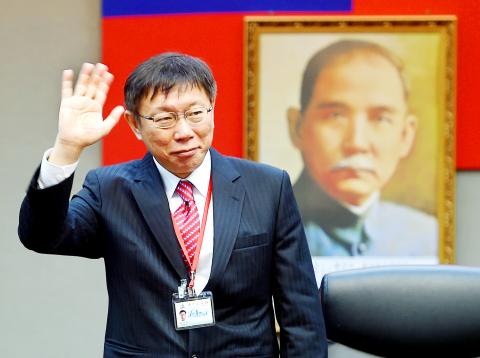
Photo: Fang Pin-chao, Taipei Times
“During the 25 days between my election and inauguration, my team and I have worked hard to learn to take over all the city government’s business,” Ko said during his inaugural speech. “I’ve been a surgeon, and my leadership style is to face the problem, have evidence-based discussions and make efficient decisions to solve the problem in the easiest, yet most effective way.”
“As long as it’s good for the people of the city, I would like to urge all my colleagues at the city government to forget all that bureaucracy, just do as much as you can, and I will be a mayor to shoulder all the responsibilities,” Ko added.
He said that he is not only eyeing the next four years of his term, but hopes to accomplish something that will fuel sustainable development of the city for the next 50 years.
“The present that we’re changing will the future of the next generation,” Ko said. “I would like to thank all the people of the city for trusting me and my team. The progress of Taipei will bring about development of Taiwan as a whole — we’re getting to work now, let’s work together.”
After the inaugural ceremony, Ko escorted outgoing mayor Hau Lung-bin (郝龍斌) out of Taipei City Hall, and the two were greeted by hundreds of people — including supporters of both Hau and Ko, as well as city government employees — who crowded inside the lobby and outside the main entrance, waiting to welcome the new mayor and bid an emotional farewell to Hau.
Many city employees rushed to give bouquets of flowers to Hau.Some of them — including Hau — were in tears.
After attending the inaugural ceremony for city councilors, Ko returned to the city hall to sign personnel appointment orders and to preside over the inaugural ceremony of his own city government team.
When invited to deliver his remarks at the end of the ceremony, Ko only simply said: “So let’s get to work now.”
Although the remark triggered a round of laughter, Ko meant what he said, as he immediately asked Deputy Mayor Charles Lin (林欽榮) to call a meeting, and quickly made the decision to begin the work to demolish the exclusive bus lanes on Zhongxiao W Road in front of Taipei Railroad Station.
While walking from the city hall to the city council, Ko asked Xinyi Police Precinct Chief Lee Teh-wei (李德威), who escorted him, to better protect the Falun Gong practitioners who regularly demonstrate outside Taipei 101.
“If any Falun Gong practitioner is beaten again, I will fire you,” Ko told Lee.
Ko had promised that he would strive to protect Falun Gong practitioners and fire the police precinct chief if necessary during an online meeting with netizens during the mayoral campaign, since members of the Concentric Patriotism Association of the Republic of China, an extremely nationalistic pro-unification organization, have often verbally or physically attacked Falun Gong practitioners outside the Taipei landmark.
In Chiayi City, Mayor Twu Shiing-jer (涂醒哲) said he hoped to lead Chiayi City to a better future by dint of democratic spirit and scientific methods.
Twu promised to turn Chiayi City into the leading city of Taiwanese democracy by offering residents participation in city government policymaking by holding local referendums every six months, adding that direct democracy would return the glory of the “city of democracy” to Chiayi.
In Greater Kaohsiung, the National Association for Firefighters’ Rights, the Kaohsiung Teachers’ Union, the People are the Boss and other student organizations protested against the Greater Kaohsiung Fire Department’s suspension of firefighter Hsu Kuo-yao (徐國堯) at Kaohsiung Mayor Chen Chu’s (陳菊) swearing-in ceremony yesterday.
Hsu was suspended with two greater demerits, six minor demerits and six warnings in September.
The fire department said Hsu was given two greater demerits for working a side job when on duty and for calling in sick when he was actually attending a class.
Hsinchu County Commissioner Chiu Ching-chun (邱鏡淳), beginning his second term in office yesterday, made a high-profile entrance to the ceremony.
Chiu said the election was one of the hardest-fought of his career, adding that being able to continue his second term in office was significant to him personally.
Meanwhile, Cheng Wen-tsan (鄭文燦) became the first mayor of Greater Taoyuan as the county was upgraded to special municipality status yesterday.
Cheng encouraged his administrative team to work hard to create a better future, adding that serving as the gate to Taiwan, Greater Taoyuan should seek to lead Taiwan’s development.
Cheng expressed his thanks for his being elected into office and said it was the herald for the city and the beginning of the fulfillment of the “Taoyuan Dream.”
Additional reporting by Hung Ting-hung, Huang Mei-chu, and CNA

NATIONAL SECURITY: Authorities are working to confirm the identities of the military personnel involved and investigating possible illegal conduct and regulatory violations Authorities are probing possible national security implications after Kinmen police and immigration officers on Sunday found a Chinese woman allegedly posing as a tourist while engaging in prostitution involving more than 10 military personnel. The woman, surnamed Chen (陳), has since been deported, authorities said, adding that investigators are still working to confirm the identities of those implicated, as the records only listed code names and aliases. The case stemmed from a report received by the Kinmen District Prosecutors’ Office on Friday last week from the Jinhu Precinct of the Kinmen County Police Bureau. On Sunday, police, along with the National Immigration

REASONS FOR TRAVEL: An assistant professor said that proposed amendments to penalize drivers if they used drugs overseas would not deter people from traveling People who operate a motor vehicle under the influence of marijuana would have their driver’s license revoked, even if they used the substance while overseas, the Ministry of Transportation and Communications said yesterday, citing proposed amendments to the Road Traffic Management and Penalty Act (道路交通管理處罰條例). The amendments would also authorize the government to revoke the licenses of people determined to have used Category 1 or Category 2 narcotics, even if they were not operating a vehicle while under the influence of drugs, as well as ban them from taking the license test for three years, the ministry said. People aged 18 or

GLOBALGIVING: ‘ Caving to external pressure is not acceptable for an organization that has cultivated justice reform and human rights for 30 years,’ one NGO said A slew of non-government organizations (NGOs) have withdrawn from the GlobalGiving fundraising platform after it announced it would use “Chinese Taipei” instead of “Taiwan” from next month. The Taiwan Good Rice Association wrote on Facebook on Friday that it was informed on April 28 via a teleconference call of the change, which was made because the platform wanted to operate in China. Taiwan Good Rice is to terminate all cooperative relationships with GlobalGiving in response to the platform’s “unilateral and non-negotiable” decision to remove references to Taiwan, the NGO said. “Taiwan is in the official name of Taiwan Good Rice Association and the

HEAVY WEATHER: Typhoon Jangmi is due to crash straight into the Ryukyus as airlines look to shift flights to larger aircraft or cancel flights to Okinawa entirely Taiwan’s international air carriers announced flight adjustments over the weekend as Typhoon Jangmi is forecast to hit the Ryukyu Islands today and tomorrow. The Central Weather Administration (CWA) upgraded Jangmi from a tropical storm to a typhoon at 8am yesterday, with the eye located 580km south of Naha city. It was moving north at 19kph. Today, China Airlines’ CI-120, CI-121, CI-122 and CI-123 flights between Taoyuan and Naha, Okinawa, have been canceled as well as CI-132 and CI-133 between Kaohsiung and Naha. EVA Air’s BR-112, BR-113, BR-186 and BR-185 flights between Taoyuan and Naha are also canceled. Low-cost carrier Tigerair Taiwan canceled IT-230,


 RSS
RSS