


The new line connecting Taipei’s MRT metropolitan railway system to Taoyuan International Airport is to be operational by the end of next year, Minister of Transportation and Communications Yeh Kuang-shih (葉匡時) said yesterday.
“We will absolutely keep our promise to officially open the line by the end of next year,” Yeh said, while briefing President Ma Ying-jeou (馬英九), who was inspecting the Taipei terminus of the Taoyuan International Airport MRT.
The line was originally scheduled to open this year.
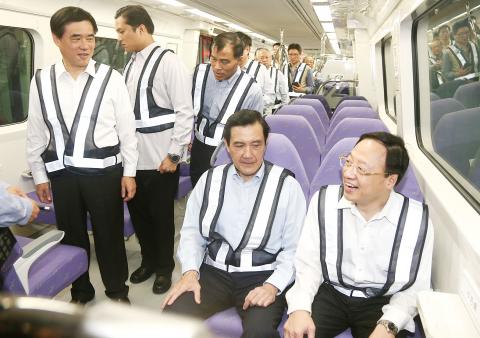
Photo: CNA
Ma stepped inside one of the cars to be used on the 51km line to check its interior design and try out one of the seats.
The line to the airport would allow Taipei’s transportation network to be more extensive, Ma said, adding that it would also help reduce the nation’s carbon emissions.
“I’m very glad and relieved to finally see the light at the end of the tunnel for the opening of the airport MRT,” Ma said.
The line has been under construction since 2006, but progress was held up by engineering difficulties on the Taipei section of the track, Yeh said, adding that the Taipei City Government amended the original plans for an overland track, requiring the section between Taipei Main Station and New Taipei City’s Sanchong District (三重) to be laid underground.
With the construction phase of the project completed, the line is now to be put through mechanical and electrical testing to allow for its full automation, said the Bureau of High Speed Rail, which is to take charge of the line before turning it over to Taoyuan Metro Corp.
While testing for the Taipei section is just beginning, testing on the other sections is well under way, Bureau of High Speed Rail Director-General Hu Hsiang-lin (胡湘麟) said.
The bureau estimates that mechanical and electrical testing on the Taipei section could be completed as soon as April, leaving plenty of time for additional inspections before the line’s official opening.
However, some bureau officials acknowledged privately that a number of unknown variables make it impossible to absolutely guarantee a date for the project’s completion.
Ma said the line, once completed, would reduce congestion caused by the rapid increase in tourists arriving at the Taoyuan airport.
There is to be a direct train between the airport and Taipei Main Station every 10 minutes, with an estimated transit time of 35 minutes. Customers taking flights will be able to check luggage in at Taipei Main Station, from where it is to be taken to the airport and loaded onto planes. Other than the direct service, there are to be trains every five minutes stopping at stations in New Taipei City and Taoyuan.
Additional reporting by CNA

SPACE VETERAN: Kjell N. Lindgren, who helps lead NASA’s human spaceflight missions, has been on two expeditions on the ISS and has spent 311 days in space Taiwan-born US astronaut Kjell N. Lindgren is to visit Taiwan to promote technological partnerships through one of the programs organized by the US for its 250th national anniversary. Lindgren would be in Taiwan from Tuesday to Saturday next week as part of the US Bureau of Educational and Cultural Affairs’ US Speaker Program, organized to celebrate the 250th anniversary of the signing of the Declaration of Independence, the American Institute in Taiwan (AIT) said in a statement yesterday. Lindgren plans to engage with key leaders across the nation “to advance cutting-edge technological partnerships and inspire the next generation of scientists and engineers,”

UNREASONABLE SURVEILLANCE: A camera targeted on an road by a neighbor captured a man’s habitual unsignaled turn into home, netting him dozens of tickets The Taichung High Administrative Court has canceled all 45 tickets given to a man for failing to use a turn signal while driving, as it considered long-term surveillance of his privacy more problematic than the traffic violations. The man, surnamed Tseng (曾), lives in Changhua County and was reported 45 times within a month for failing to signal while driving when he turned into the alley where his residence is. The reports were filed by his neighbor, who set up security cameras that constantly monitored not only the alley but also the door and yard of Tseng’s house. The surveillance occurred from July

A Japan Self-Defense Forces vessel entered the Taiwan Strait yesterday, Japanese media reported. After passing through the Taiwan Strait, the Ikazuchi was to proceed to the South China Sea to take part in a joint military exercise with the US and the Philippines, the reports said. Japan Self-Defense Force vessels were first reported to have passed through the strait in September, 2024, with two further transits taking place in February and June last year, the Asahi Shimbun reported. Yesterday’s transit also marked the first time since Japanese Prime Minister Sanae Takaichi took office that a Japanese warship has been sent through the Taiwan
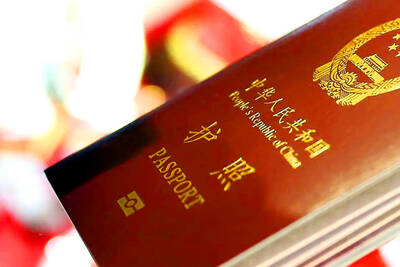
ANOTHER OPTION: The 13-year-old, whose residency status was revoked for holding a Chinese passport, could still apply for residency on humanitarian grounds, the government said The Executive Yuan has rejected an appeal from a 13-year-old Chinese student surnamed Lu (陸), whose permanent residency was revoked after immigration officers discovered he held a Chinese passport. Lu in December 2023 applied to settle in Taiwan to be with his mother, surnamed Lin (林), who is a Taiwan resident, an appeal decision released this month by the Executive Yuan showed. Lin settled in Taiwan after marrying a Taiwanese man in 2003, but the two divorced in 2011, and after marrying a Chinese man, she had Lu, the Executive Yuan’s appeals committee said. Lu’s application was approved in December 2024, and in


 RSS
RSS