


While all appears calm on the surface of cross-strait relations, both Taiwan and China are “paddling like hell underneath,” according to a new study released this week by the Hoover Institution.
Analyzing the current political situation, Alan Romberg, director of the East Asia Program at the Stimson Center think tank, said everyone seems to see advantage “in staying steady on course and avoiding high-profile adjustments.”
He said examples can be found in China recalculating its tactics in light of the Sunflower movement and in the Democratic Progressive Party (DPP) putting off reconsideration of its policy toward Beijing until after the Nov. 29 elections.
The former state department official said it is “obvious” that China was “surprised” by the breadth of support in Taiwan for the Sunflower movement and by the widespread lack of trust and apparent depth of public anxiety about “possibly falling into a PRC [People’s Republic of China] reunification trap.”
However, Beijing has sought to portray its policy toward Taiwan as consistent and has claimed steady progress, he said.
At the same time, President Ma Ying-jeou’s (馬英九) administration has been generally upbeat, Romberg said.
“Still, it was clear that the Mainland Affairs Council felt it needed to proceed prudently in ongoing negotiations so as not to create misunderstandings and suspicions among the Taiwan public,” he said.
Romberg said the PRC would continue its efforts to win hearts and minds, but how it would do that is “a work in progress.”
He said: “To some extent, the mainland may have reverted to the view that people in Taiwan really only care about their pocketbooks.”
Beijing seems to have discounted any significant benefit from greater flexibility on such issues as international space, Romberg said.
He said that while some observers think Chinese President Xi Jinping (習近平) is more open-minded than his predecessor, “there were instances of retrograde and ham-fisted PRC behavior that reinforced Beijing’s image of small-mindedness.”
Romberg said that DPP chair Tsai Ing-wen (蔡英文) has engaged in a relentless attack on the Ma administration’s capabilities and performance.
“Tsai continued to deflect consideration of the party’s cross-strait policy until a more propitious moment, presumably after the November elections and perhaps even further, until after, as she clearly hopes, she locks up the DPP presidential nomination,” he said.
He said that China seems to be genuinely asking itself whether the DPP is holding to its cross-strait line simply as part of its effort to resume office or is instead seeking to position things to eventually achieve independence.
Romberg quoted a senior Chinese expert on Taiwan as saying that the DPP remains the biggest obstacle to the peaceful development of cross-strait relations.
He said that Ma’s backing of the Economic Coperation Framework Agreement agenda to gain Beijing’s support for broader economic and trade diversification showed he recognizes the reality of Beijing’s sway over many trading partners.

Chinese spouse and influencer Guan Guan’s (關關) residency permit has been revoked for repeatedly posting pro-China videos that threaten national security, the National Immigration Agency confirmed today. Guan Guan has said many controversial statements in her videos posted to Douyin (抖音), including “the red flag will soon be painted all over Taiwan” and “Taiwan is an inseparable part of China,” and expressing hope for expedited reunification. The agency last year received multiple reports alleging that Guan Guan had advocated for armed reunification. After verifying the reports, the agency last month issued a notice requiring her to appear and explain her actions. Guan

GIVE AND TAKE: Blood demand continues to rise each year, while fewer young donors are available due to the nation’s falling birthrate, a doctor said Blood donors can redeem points earned from donations to obtain limited edition Formosan black bear travel mugs, the Kaohsiung Blood Center said yesterday, as it announced a goal of stocking 20,000 units of blood prior to the Lunar New Year. The last month of the lunar year is National Blood Donation Month, when local centers seek to stockpile blood for use during the Lunar New Year holiday. The blood demand in southern Taiwan — including Tainan and Kaohsiung, as well as Chiayi, Pingtung, Penghu and Taitung counties — is about 2,000 units per day, the center said. The donation campaign aims to boost

The Kaohsiung Tourism Bureau audited six hotels in an effort to prevent price gouging ahead of Korean band BTS’ concert tour in the city scheduled for Nov. 19, 21 and 22 this year. The bureau on Friday said that the audits — conducted in response to allegations of unfair pricing posted on social media — found no wrongdoing. These establishments included the local branches of Chateau de Chine, Hotel Nikko, My Humble House, and Grand Hai Lai, it said, adding that the Consumer Protection Commission would have penalized price gougers had the accusations been substantiated. The bureau said the Tourism Development Act
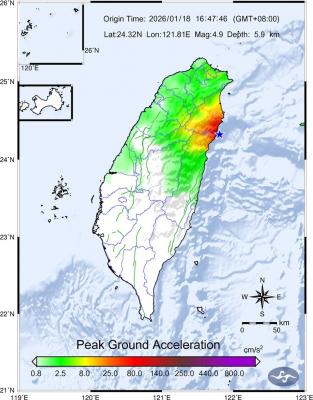
The Central Weather Administration (CWA) said a magnitude 4.9 earthquake that struck off the coast of eastern Taiwan yesterday was an independent event and part of a stress-adjustment process. The earthquake occurred at 4:47pm, with its epicenter at sea about 45.4km south of Yilan County Hall at a depth of 5.9km, the CWA said. The quake's intensity, which gauges the actual effects of a temblor, was highest in several townships in Yilan and neighboring Hualien County, where it measured 4 on Taiwan's seven-tier intensity scale, the CWA said. Lin Po-yu (林柏佑), a division chief at the CWA's Seismological Center, told a news conference


 RSS
RSS