


Premier Jiang Yi-huah (江宜樺) yesterday proposed that Taipei should work to sign a fishery agreement with Beijing to address the problem of rampant poaching by Chinese fishermen in Taiwanese waters.
Jiang directed the Mainland Affairs Council (MAC) and the Council of Agriculture to conduct a feasibility study on such an agreement, which he said would help maintain good maritime order and stabilize the fishing industries on both sides of the Taiwan Strait.
Before such a pact is signed, the MAC should try to draw Beijing’s attention to the problem to avoid conflict, he added.
Jiang made the remarks during a weekly Cabinet meeting after hearing a report by the Coast Guard Administration on the issue.
According to Coast Guard Administration Minister Wang Ginn-wang (王進旺), a large number of Chinese fishing boats have been caught poaching off Kinmen County since earlier this month.
With the help of the MAC, the situation was reported to the Chinese side via the semi-official Straits Exchange Foundation on Oct. 9, Wang said.
Since Wednesday, about 20 Chinese fishing boats have been captured in waters near Kinmen in a joint crackdown operation between the CGA and the China Marine Surveillance service, he said.
In the past, the trespassing Chinese fishermen would use various means, including attacking Taiwanese officers with wooden clubs, to block them from boarding their boats for inspection, Wang said.
However, such incidents have decreased recently due to increased law enforcement presence, he said.
According to the administration, Chinese fishing boats are most often seen trespassing in Taiwan’s northern waters and in the waters around Penghu, Kinmen and Matsu.
During the first nine months of the year, the administration expelled 1,183 Chinese fishing boats and detained 542, with fines totaling NT$39.09 million (US$1.28 million) issued to 225 of them.
From Oct. 3 until Monday this week, 453 Chinese boats were expelled and 15 others detained. In addition, nine Chinese boats were expelled for allegedly extracting sand during the time period, the administration said.
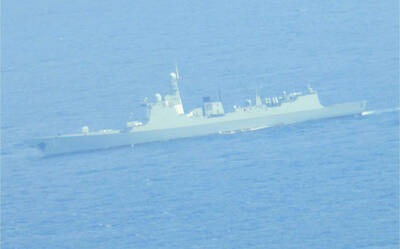
The military has spotted two Chinese warships operating in waters near Penghu County in the Taiwan Strait and sent its own naval and air forces to monitor the vessels, the Ministry of National Defense (MND) said. Beijing sends warships and warplanes into the waters and skies around Taiwan on an almost daily basis, drawing condemnation from Taipei. While the ministry offers daily updates on the locations of Chinese military aircraft, it only rarely gives details of where Chinese warships are operating, generally only when it detects aircraft carriers, as happened last week. A Chinese destroyer and a frigate entered waters to the southwest
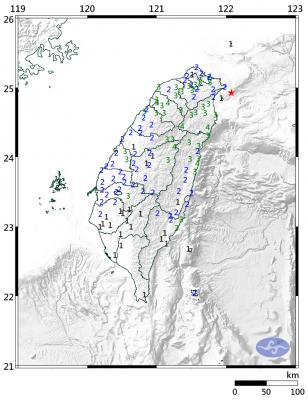
A magnitude 6.1 earthquake struck off the coast of Yilan County at 8:39pm tonight, the Central Weather Administration (CWA) said, with no immediate reports of damage or injuries. The epicenter was 38.7km east-northeast of Yilan County Hall at a focal depth of 98.3km, the CWA’s Seismological Center said. The quake’s maximum intensity, which gauges the actual physical effect of a seismic event, was a level 4 on Taiwan’s 7-tier intensity scale, the center said. That intensity level was recorded in Yilan County’s Nanao Township (南澳), Hsinchu County’s Guansi Township (關西), Nantou County’s Hehuanshan (合歡山) and Hualien County’s Yanliao (鹽寮). An intensity of 3 was
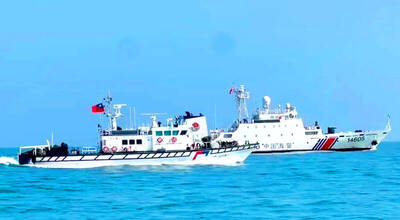
Instead of focusing solely on the threat of a full-scale military invasion, the US and its allies must prepare for a potential Chinese “quarantine” of Taiwan enforced through customs inspections, Stanford University Hoover fellow Eyck Freymann said in a Foreign Affairs article published on Wednesday. China could use various “gray zone” tactics in “reconfiguring the regional and ultimately the global economic order without a war,” said Freymann, who is also a nonresident research fellow at the US Naval War College. China might seize control of Taiwan’s links to the outside world by requiring all flights and ships entering or leaving Taiwan
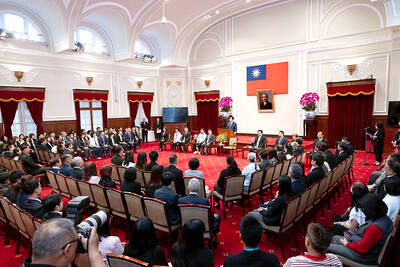
The next minimum wage hike is expected to exceed NT$30,000, President William Lai (賴清德) said yesterday during an award ceremony honoring “model workers,” including migrant workers, at the Presidential Office ahead of Workers’ Day today. Lai said he wished to thank the awardees on behalf of the nation and extend his most sincere respect for their hard work, on which Taiwan’s prosperity has been built. Lai specifically thanked 10 migrant workers selected for the award, saying that although they left their home countries to further their own goals, their efforts have benefited Taiwan as well. The nation’s industrial sector and small businesses lay


 RSS
RSS