


Taiwan Power Co’s (Taipower) monopoly on electricity production must be ended if the nation is to develop green energy production, representatives of the Renewable Energy Coalition (再生能源聯盟) said yesterday.
The remarks were made at a press conference at which commentators criticized what was described as lack of government action on pushing renewable energy sources.
At the conference, Democratic Progressive Party Legislator (DPP) Tien Chiu-ching (田秋堇) said that despite several reports and pieces of legislation, substantive promotion of renewable energy has yet to be implemented.
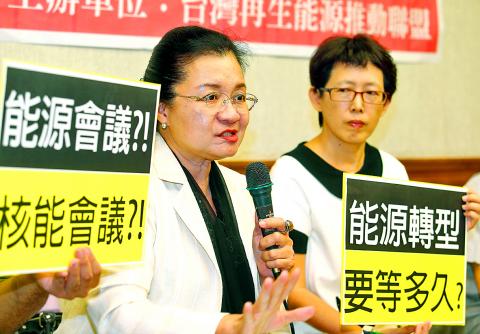
Photo: Fang Pin-chao, Taipei Times
“Taiwan has already held numerous energy conferences — from 1998 to 2005 to 2009 — but their consensus for the proactive promotion of renewable energy development remains largely unimplemented” National Taipei University economics professor Wang Tu-fa (王塗發) said.
Wang criticized the government’s policy of setting quotas for renewable energy production as inefficient and insufficient.
According to the Ministry of Economic Affairs’ Bureau of Energy, this year’s quota for renewable energy production is 270 megawatts (MW), equal to 1.1 percent of total national energy consumption.
Production of renewable energy is hampered by the system for selling electricity, which prevents the direct purchase of energy produced with renewable sources, Taiwan NGO Social Enterprise Co Ltd general manager Kao Ru-ping (高茹萍) said.
For example, even though Google Inc has committed to obtaining all of its energy from renewable sources, its data centers in Taiwan only use 4.8 percent, due to regulations granting Taipower a monopoly over the electricity market, she said.
While the law allows firms to produce their own green energy on-site, this is not feasible on a large scale for most companies due to the space required, Wang said.
Any electricity produced off-site cannot be bought directly, even if it is produced by the company itself, he said. Instead, any electricity that enters the national grid must be sold to Taipower, which possesses a monopoly on all electricity sales, he said.
Because companies cannot choose the source of the electricity Taipower provides, the monopoly denies firms the option of purchasing green energy, he said.
He said that the government must open up the electricity market to allow direct sales between green energy producers and consumers.
Combined with green energy markets and a system of taxes and subsidies reflecting the externalities of different fuel sources, this measure could easily increase renewable energy’s proportion of electricity production to between 5 and 6 percent, he said.

FUKUOKA SITUATION: Japanese media reported that the pathogen is expected to be identified by the summer, while the CDC downplayed the idea that it was hMPV A “mysterious cold-like illness” reported in Japan’s Fukuoka Prefecture does not seem to be a new disease, but Japanese authorities have been asked about the situation, the Centers for Disease Control (CDC) said yesterday. The Fukuoka Prefectural Medical Association on Wednesday told a news conference that a “mystery cold” that has become a hot topic on social media is “highly likely to be caused by some kind of viral infection,” Japan’s KBC News reported. “Many people are experiencing symptoms starting with a sore throat, followed by a runny nose, phlegm and a severe cough,” KBC News reported, citing association officials. Health authorities are

Nvidia Corp CEO Jensen Huang (黃仁勳) arrived in Taiwan yesterday ahead of upcoming AI and technology events, saying he plans to meet with clients and Taiwan Semiconductor Manufacturing Co Chairman C.C. Wei (魏哲家) during his visit. After landing at Taipei Songshan Airport, Huang posed for photos with fans and handed out Yakult drinks to reporters and supporters waiting at the scene, saying he has “a lot to do” during the trip. Asked about reports that Nvidia’s planned headquarters site in Taipei’s Beitou Shilin Technology Park could break ground on May 27, Huang said that if the company holds an event, he would

The Ministry of Finance this afternoon announced the winning numbers for the March-April uniform invoice lottery. The winning number for the NT$10 million (US$318,060) special prize is 19531471, and the winning number for the NT$2 million grand prize is 85941329. Three numbers were drawn for the NT$200,000 first prize: 07225810, 20231230 and 83518781. Those with receipts matching the last seven digits of any of the first-prize numbers will win the NT$40,000 second prize, while those matching the last six digits will win the NT$10,000 third prize. Those whose receipts match the last five digits of the first-prize numbers can claim the NT$4,000 fourth prize,

Former president Ma Ying-jeou (馬英九) yesterday expressed “shock and regret” over a statement issued by his wife without his consent, and rejected her assertion that his eldest sister, Ma Yi-nan (馬以南), would manage his medical care or act as his spokesperson amid an ongoing embezzlement probe into his foundation. Ma Ying-jeou in a statement said he was shocked by a statement by his wife, Chou Mei-ching (周美青), regarding his affairs. Ma Yi-nan “must not” be in charge of his healthcare and other personal affairs, nor can she be allowed to represent the Ma family, the former president said. He said he was also


 RSS
RSS