


A Taipei city councilor candidate yesterday accused Chinese Nationalist Party (KMT) Legislator Lo Shu-lei (羅淑蕾) of bribing her KMT colleagues to revise the Accounting Act (會計法) and of tax evasion.
Lo denied the charges, saying she was not a lawmaker at the time.
“We have received reports from a member of the Taipei Certified Public Accountants’ Association that when Lo served as the public relations director of the association in 2007 and president of the National Federation of Certified Public Accountants, Lo gave NT$250,000 [US$6,574] per month to select lawmakers in the Finance Committee to sponsor salaries for their aides and to facilitate the revision of the Accounting Act,” Taiwan Solidarity Union (TSU) Taipei city councilor candidate Chien Sheng-che (簡聖哲) told a news conference at the Legislative Yuan.
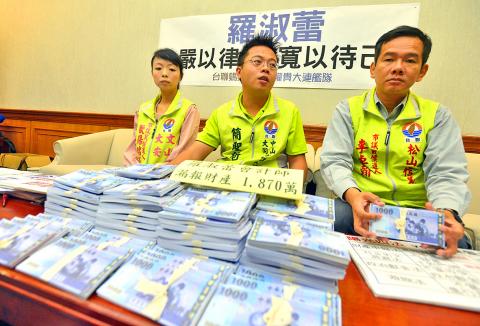
Photo: Wang Yi-sung, Taipei Times
“Many of the lawmakers are KMT heavyweights who are still in the legislature; it may be the end of their political career if I publicize the list.”
Besides illegal lobbying, Chien said the reports he received also accuse Lo of using a false diploma and of illegally using public funds to pay for overseas trips for reporters.
Chien said his allegations are based on hard evidence, and challenged Lo to sue him for defamation if she thinks what he said was false.
“I will give the court everything I have. Let’s just meet in court,” Chien said.
Another TSU city councilor candidate, Hsieh Chien-ping (謝建平), said that Lo may rebut the accusations, but it would not mean she is clean.
“A couple of weeks back, we accused her of taking NT$200,000 per month from a private business, and serving on its board of directors to solve problems that the business may encounter,” Hsieh said.
“Lo said the accusations were groundless, but she still resigned as a member of the board,” Hsieh said.
Dismissing the allegations, Lo said she was not a legislator when the Accounting Act was revised.
“I had no power, and it took more than one person to revise the law,” Lo said.
“Actually, TSU Secretary-General Lin Chih-chia (林志嘉), who was a legislator at the time, also supported the revisions,” Lo said.
She added that there was nothing illegal for a non-governmental organization to give political donations to lawmakers.
“If you think I’ve done anything illegal, go ahead and forward whatever you have to prosecutors,” Lo said.

LOUD AND PROUD Taiwan might have taken a drubbing against Australia and Japan, but you might not know it from the enthusiasm and numbers of the fans Taiwan might not be expected to win the World Baseball Classic (WBC) but their fans are making their presence felt in Tokyo, with tens of thousands decked out in the team’s blue, blowing horns and singing songs. Taiwanese fans have packed out the Tokyo Dome for all three of their games so far and even threatened to drown out home team supporters when their team played Japan on Friday. They blew trumpets, chanted for their favorite players and had their own cheerleading squad who dance on a stage during the game. The team struggled to match that exuberance on the field, with
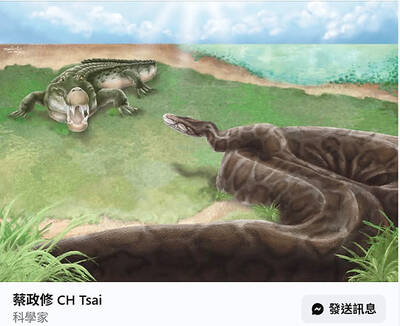
Taiwanese paleontologists have discovered fossil evidence that pythons up to 4m long inhabited Taiwan during the Pleistocene epoch, reporting their findings in the international scientific journal Historical Biology. National Taiwan University (NTU) Institute of Ecology and Evolutionary Biology associate professor Tsai Cheng-hsiu (蔡政修) led the team that discovered the largest snake fossil ever found in Taiwan. The single trunk vertebra was discovered in Tainan at the Chiting Formation, dated to between 400,000 and 800,000 years ago in the Middle Pleistocene, the paper said. The area also produced Taiwan’s first avian fossil, as well as crocodile, mammoth, saber-toothed cat and rhinoceros fossils, it said. Discoveries

Taiwanese paleontologists have discovered fossil evidence that pythons up to 4m long inhabited Taiwan during the Pleistocene epoch, reporting their findings in the international scientific journal Historical Biology. National Taiwan University (NTU) Institute of Ecology and Evolutionary Biology associate professor Tsai Cheng-hsiu (蔡政修) led the team that discovered the largest snake fossil ever found in Taiwan. A single trunk vertebra was discovered in Tainan at the Chiting Formation, dated to between 800,000 to 400,000 years ago in the Middle Pleistocene, the paper said. The area also produced Taiwan’s first avian fossil, as well as crocodile, mammoth, sabre-toothed cat and rhinoceros fossils, it said. Discoveries

Whether Japan would help defend Taiwan in case of a cross-strait conflict would depend on the US and the extent to which Japan would be allowed to act under the US-Japan Security Treaty, former Japanese minister of defense Satoshi Morimoto said. As China has not given up on the idea of invading Taiwan by force, to what extent Japan could support US military action would hinge on Washington’s intention and its negotiation with Tokyo, Morimoto said in an interview with the Liberty Times (sister paper of the Taipei Times) yesterday. There has to be sufficient mutual recognition of how Japan could provide


 RSS
RSS