


Democratic Progressive Party (DPP) Legislator Lee Ying-yuan (李應元) yesterday accused the National Taxation Bureau of Taipei of breaking the law in its investigation of alleged tax evasion by independent Taipei mayoral candidate Ko Wen-je (柯文哲).
Following a report published on Tuesday by the Chinese-language Apple Daily, the bureau held a press conference on Tuesday afternoon and confirmed that, after being tipped off by an informant, it had ordered several institutions to explain payments they had made to Ko for giving speeches between 2011 and last year.
While the press conference was ongoing, DPP Legislator Chao Tien-lin (趙天麟) questioned Premier Jiang Yi-huah (江宜樺) in the legislature about the motive behind the investigation, with Jiang replying that “an investigation is launched whenever there is a tipoff.”
Lee said Jiang’s reply implied that the order issued by the bureau was to clarify the issue after a tip-off.
“However, this move clearly violates the Ministry of Finance’s regulations on handling tax evasions and tip-offs,” Lee said.
According to the regulations, the informant “must provide concrete evidence substantiating allegations of tax evasion for possible investigation, or the case will be closed and not accepted,” Lee said.
In other words, the bureau cannot demand that other parties provide relevant documents to substantiate claims made by an informant.
The regulations also state that the bureau has to close the case if the informant cannot present substantive evidence within 10 days, he added.
Lee accused the Chinese Nationalist Party (KMT) of working behind the scene and exerting pressure on the bureau.
The investigation was not launched by the bureau on its own initiative, so it could not invoke Article 30 of the Tax Collection Act (稅捐稽徵法) to ask that these institutions provide relevant information, Lee said.
The bureau “should not degrade itself and become a hatchet person out of fear of the informant’s political power,” he said.
KMT Legislator Liao Cheng-ching (廖正井) — who was accused on Tuesday by Taiwan Solidarity Union Legislator Yeh Chin-ling (葉津鈴) of being the “informant” — yesterday said he supported “the integrity and confidentiality of investigation.”
“All Taiwanese nationals should pay taxes according to the law, regardless of who they are. No one should be privileged just because of the election,” Liao said.
He denied that he was targeting anyone in particular when he urged the bureau to investigate Ko about possible tax evasion during a meeting of the legislature’s Finance Committee last week.
Liao said he was only voicing misgivings based on his expertise, since income from speeches are subject to a 10 percent tax if it exceeds NT$200,000, adding that Ko’s earnings from giving speeches did not seem to have been taxed accordingly.
Liu Lin Wei (柳林瑋), a former National Taiwan University Hospital physician and a cofounder of Watchout (沃草), an online media platform aiming for broader civic participation, called the tax investigation a travesty.
“I have plenty of experience of being invited to give speeches. Almost all the payments were taxed in advance and [the tax information] would be automatically documented by the system when filing tax. Talks about tax investigation [targeting speech earnings] is utter nonsense,” he wrote on Facebook.
Meanwhile, Clara Chou (周玉蔻), a media personality and political pundit, yesterday accused KMT Taipei mayoral candidate Sean Lien (連勝文) of tax evasion. She said Lien should have filed his NT$160 million overseas income from Evenstar Sub Fund, the hedge fund he set up in Hong Kong, for 2010 to last year, but failed to do so.
She posted the “public tip-off” that she made via the bureau’s Web site on Facebook and said she is now “doing a countdown and waiting for the agency to investigate the case.”

LOUD AND PROUD Taiwan might have taken a drubbing against Australia and Japan, but you might not know it from the enthusiasm and numbers of the fans Taiwan might not be expected to win the World Baseball Classic (WBC) but their fans are making their presence felt in Tokyo, with tens of thousands decked out in the team’s blue, blowing horns and singing songs. Taiwanese fans have packed out the Tokyo Dome for all three of their games so far and even threatened to drown out home team supporters when their team played Japan on Friday. They blew trumpets, chanted for their favorite players and had their own cheerleading squad who dance on a stage during the game. The team struggled to match that exuberance on the field, with
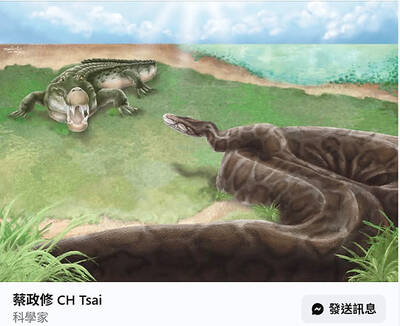
Taiwanese paleontologists have discovered fossil evidence that pythons up to 4m long inhabited Taiwan during the Pleistocene epoch, reporting their findings in the international scientific journal Historical Biology. National Taiwan University (NTU) Institute of Ecology and Evolutionary Biology associate professor Tsai Cheng-hsiu (蔡政修) led the team that discovered the largest snake fossil ever found in Taiwan. The single trunk vertebra was discovered in Tainan at the Chiting Formation, dated to between 400,000 and 800,000 years ago in the Middle Pleistocene, the paper said. The area also produced Taiwan’s first avian fossil, as well as crocodile, mammoth, saber-toothed cat and rhinoceros fossils, it said. Discoveries

Taiwanese paleontologists have discovered fossil evidence that pythons up to 4m long inhabited Taiwan during the Pleistocene epoch, reporting their findings in the international scientific journal Historical Biology. National Taiwan University (NTU) Institute of Ecology and Evolutionary Biology associate professor Tsai Cheng-hsiu (蔡政修) led the team that discovered the largest snake fossil ever found in Taiwan. A single trunk vertebra was discovered in Tainan at the Chiting Formation, dated to between 800,000 to 400,000 years ago in the Middle Pleistocene, the paper said. The area also produced Taiwan’s first avian fossil, as well as crocodile, mammoth, sabre-toothed cat and rhinoceros fossils, it said. Discoveries
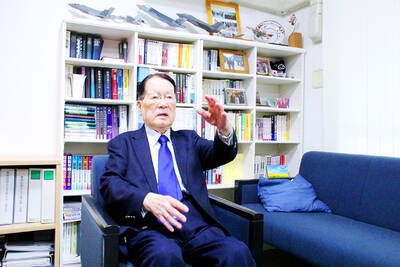
Whether Japan would help defend Taiwan in case of a cross-strait conflict would depend on the US and the extent to which Japan would be allowed to act under the US-Japan Security Treaty, former Japanese minister of defense Satoshi Morimoto said. As China has not given up on the idea of invading Taiwan by force, to what extent Japan could support US military action would hinge on Washington’s intention and its negotiation with Tokyo, Morimoto said in an interview with the Liberty Times (sister paper of the Taipei Times) yesterday. There has to be sufficient mutual recognition of how Japan could provide


 RSS
RSS