


Accompanied by fellow members of political group Flanc Radical, Yen Ming-wei (顏銘緯), the college freshman who hurled a copy of Formosa Betrayed at President Ma Ying-jeou (馬英九) last month, reported to the police yesterday afternoon amid cheers of encouragement from supporters.
Police summoned Yen for questioning following two lawsuits filed separately against him, including one by the head of the Shilin military police station for allegedly obstructing officers, and another by a man surnamed Lee (李), who claimed the book hit his stomach.
Yen first gained attention after he mobilized a large number of students from southern Taiwan to join the Sunflower movement in Taipei earlier this year.
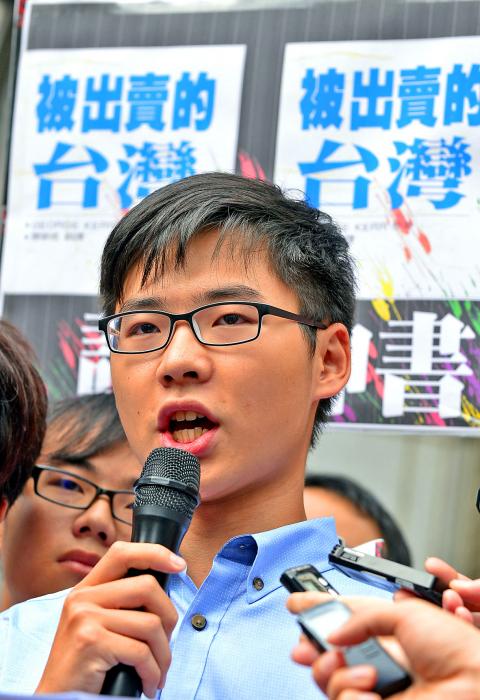
Photo: Wang Yi-sung, Taipei Times
He also made headlines when he threw a copy of Formosa Betrayed, a book written by former US diplomat George Kerr, at Ma.
Dressed in formal attire and accompanied by all five candidates nominated by Flanc Radical, Yen, director of Flanc Radical’s electoral campaign in Kaohsiung, staunchly defended his actions and accused the Ma administration of “judicial prosecution.”
“People have condemned throwing a book as an act of violence. However, the Ma administration still holds in its hands the power of state violence,” Yen said. “For me to throw a book is like hitting a stone with an egg. How can this be an act of violence?”
Yen said that in his view, Ma was the one enacting violence on Taiwanese by aggressively pursuing stronger ties with China.
Yen also urged the public not to dismiss him as a child, saying: “My student status is only a sideline, as I am first and foremost the director of Flanc Radical’s electoral campaign.”
Nearly a dozen members of the pro-independence Taiwan National Congress (TNC) waited in front of the office in support of Yen before his arrival, wielding large black flags attached to flagpoles more than two stories tall.
One supporter, TNC member Lin Xin-kai (林新凱), said the group rallied to offer their support to Yen and Flanc Radical, saying that the groups shared similar goals.
Other groups also showed up to express their support, including the Alliance of Referendum for Taiwan and Taiwan Youth Against Communism.
Before entering the police office for questioning, Yen led his supporters in chanting: “Without the fall of the Chinese Nationalist Party [KMT], Taiwan will never get better.”
As Yen was speaking to reporters and his supporters, a man who was apparently against Yen’s views interrupted loudly and accused him of promoting violence, before being pulled aside.

LOUD AND PROUD Taiwan might have taken a drubbing against Australia and Japan, but you might not know it from the enthusiasm and numbers of the fans Taiwan might not be expected to win the World Baseball Classic (WBC) but their fans are making their presence felt in Tokyo, with tens of thousands decked out in the team’s blue, blowing horns and singing songs. Taiwanese fans have packed out the Tokyo Dome for all three of their games so far and even threatened to drown out home team supporters when their team played Japan on Friday. They blew trumpets, chanted for their favorite players and had their own cheerleading squad who dance on a stage during the game. The team struggled to match that exuberance on the field, with
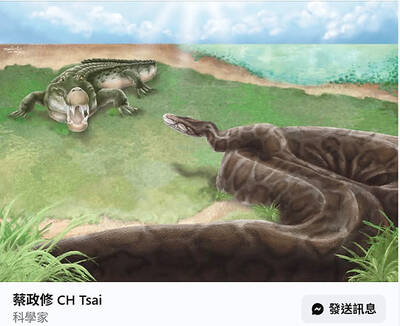
Taiwanese paleontologists have discovered fossil evidence that pythons up to 4m long inhabited Taiwan during the Pleistocene epoch, reporting their findings in the international scientific journal Historical Biology. National Taiwan University (NTU) Institute of Ecology and Evolutionary Biology associate professor Tsai Cheng-hsiu (蔡政修) led the team that discovered the largest snake fossil ever found in Taiwan. The single trunk vertebra was discovered in Tainan at the Chiting Formation, dated to between 400,000 and 800,000 years ago in the Middle Pleistocene, the paper said. The area also produced Taiwan’s first avian fossil, as well as crocodile, mammoth, saber-toothed cat and rhinoceros fossils, it said. Discoveries

Taiwanese paleontologists have discovered fossil evidence that pythons up to 4m long inhabited Taiwan during the Pleistocene epoch, reporting their findings in the international scientific journal Historical Biology. National Taiwan University (NTU) Institute of Ecology and Evolutionary Biology associate professor Tsai Cheng-hsiu (蔡政修) led the team that discovered the largest snake fossil ever found in Taiwan. A single trunk vertebra was discovered in Tainan at the Chiting Formation, dated to between 800,000 to 400,000 years ago in the Middle Pleistocene, the paper said. The area also produced Taiwan’s first avian fossil, as well as crocodile, mammoth, sabre-toothed cat and rhinoceros fossils, it said. Discoveries

Whether Japan would help defend Taiwan in case of a cross-strait conflict would depend on the US and the extent to which Japan would be allowed to act under the US-Japan Security Treaty, former Japanese minister of defense Satoshi Morimoto said. As China has not given up on the idea of invading Taiwan by force, to what extent Japan could support US military action would hinge on Washington’s intention and its negotiation with Tokyo, Morimoto said in an interview with the Liberty Times (sister paper of the Taipei Times) yesterday. There has to be sufficient mutual recognition of how Japan could provide


 RSS
RSS