


A new autopsy report on the death of army corporal Hung Chung-chiu (洪仲丘), released by the military-affiliated Tri-Services General Hospital (TSGH) in Taipei on Monday, has cast doubt on earlier findings by the court-appointed forensic doctor, Shih Tai-ping (石台平).
The report by the hospital concluded that the effects of heat exhaustion accumulated over several days, leading to Hung’s death.
The Taiwan High Court mandated that the hospital carry out the report, because Hung’s family appealed the first ruling by a lower court.
According to the latest autopsy report, Hung was taken to a solitary confinement room on June 28 last year, where military officers forced him and other conscripts under confinement to perform severe physical exercise drills as punishment.
As Hung was punished with the physical drills daily, performed in hot and humid conditions, his body overheated.
This overheating accumulated over several days and led to heat exhaustion that was not properly treated, and the continual physical drills eventually resulted in his death from heatstroke and multiple organ failure, the report said.
The report also identified other factors contributing to the corporal’s death, including Hung’s body having a high BMI (body mass index), lack of rest, the high number of physical drill sessions and the conditions of the confinement room.
The initial coroner report by Shih said the heat exhaustion and its effects on the body did not accumulate, thus leading to the conclusion that Hung’s death by heatstroke was “an accident.”
The 24-year-old was serving in the army’s 542nd Armored Brigade in Hsinchu County. He died on July 4 last year while detained in the unit’s solitary confinement room, where he was subjected to several days of physical drills.
The case sparked widespread public outrage and protests were held against the military over perceived widespread abuse by commanding officers against conscripts and over the army’s attempt to cover up the cause of death to protect the officers who ordered the excessive punishment.
After the release of the new report, the court sent an official request to the Ministry of National Defense for details of the 542nd Brigade confinement room’s conditions.
Judicial officials said they are still waiting for the ministry to reply, and the court will have another hearing on the case on Nov. 3.
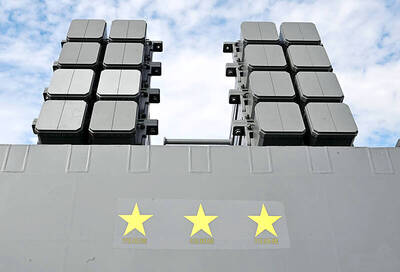
UPGRADE: The Kang Ding-class frigate is replacing its Chaparall missiles with Tien Chien II and Hua Yang VLS, which would provide it with long-range, 360° air defense Taiwan plans to produce 1,200 to 1,376 Hai Chien II missiles (海劍二, Sea Sword II) — also known as TC-2N — to serve as the standard air defense system of the navy’s surface combatant fleet, a source said yesterday. Last week, the Hai Chien II, the naval version of the Tien Kung II missile (天劍二, Sky Sword II), completed a live-fire test in waters off the National Chungshan Institute of Science and Technology’s Jiupeng facility (九鵬) in Pingtung County’s Manjhou Township (滿州). The MIM72 Chaparral and other dated air defense missiles that currently arm Taiwanese ships have inadequate range to combat Chinese

REASONS FOR TRAVEL: An assistant professor said that proposed amendments to penalize drivers if they used drugs overseas would not deter people from traveling People who operate a motor vehicle under the influence of marijuana would have their driver’s license revoked, even if they used the substance while overseas, the Ministry of Transportation and Communications said yesterday, citing proposed amendments to the Road Traffic Management and Penalty Act (道路交通管理處罰條例). The amendments would also authorize the government to revoke the licenses of people determined to have used Category 1 or Category 2 narcotics, even if they were not operating a vehicle while under the influence of drugs, as well as ban them from taking the license test for three years, the ministry said. People aged 18 or

HEAVY WEATHER: Typhoon Jangmi is due to crash straight into the Ryukyus as airlines look to shift flights to larger aircraft or cancel flights to Okinawa entirely Taiwan’s international air carriers announced flight adjustments over the weekend as Typhoon Jangmi is forecast to hit the Ryukyu Islands today and tomorrow. The Central Weather Administration (CWA) upgraded Jangmi from a tropical storm to a typhoon at 8am yesterday, with the eye located 580km south of Naha city. It was moving north at 19kph. Today, China Airlines’ CI-120, CI-121, CI-122 and CI-123 flights between Taoyuan and Naha, Okinawa, have been canceled as well as CI-132 and CI-133 between Kaohsiung and Naha. EVA Air’s BR-112, BR-113, BR-186 and BR-185 flights between Taoyuan and Naha are also canceled. Low-cost carrier Tigerair Taiwan canceled IT-230,
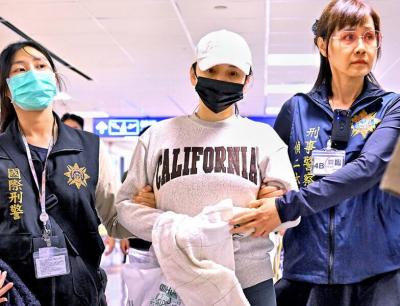
Johanne Liou (劉喬安), a Taiwanese woman who shot to unwanted fame during the Sunflower movement protests in 2014, returned to Taiwan last night after being deported from the US. She is to stand trial in Taiwan for charges involving embezzlement, fraud and drug crimes. The Criminal Investigation Bureau (CIB) said it took her into custody at Taiwan Taoyuan International Airport and would first question her before transferring her to the New Taipei District Prosecutors’ Office. She was arrested upon disembarking a flight from San Francisco that landed shortly before 7pm. Liou absconded to the US in 2019 after jumping bail


 RSS
RSS