


The establishment of the Sunflower movement earlier this year signified not only the public’s dissatisfaction with how the ruling Chinese Nationalist Party (KMT) handled a controverial cross-strait agreement; it also revealed the currently unbridgeable gap between the nation’s anticipation of what a democratically elected legislature should do and its failure to meet the expectation, academics said in Taipei yesterday.
As Hong Kong is facing off against Chinese authorities in demonstrations for full suffrage and real democracy, the Youth Synergy Taiwan Foundation has organized a series of forums spanning the month of October to discuss the predicament of Taiwan’s representational democracy and the role referendums could play to either supplement or, on certain issues, replace representational politics.
Broadening civic participation, in the form of public deliberation and referendums, is the aim of much-called-for constitutional reforms, which are expected to alleviate the dissonance in the interactions between, and the respective expectations of, the government, the representational system and the public, according to the academics whose backgrounds are in law, sociology and public administration.
National Taiwan University law professor Yeh Jiunn-rong (葉俊榮) trumpeted civic constitutionalism as the approach the nation should adopt, referring to the book New Democracies in Crisis, which says that overdependence on courts and rigid constitutions creates estranged democratic engagement of citizens in public affairs.
“A constitution is sure to have content, spirit, values and culture; it has to engage in conversation with people democratically. It could lead or sometimes restrain democracy. In a transitional democracy, it could draw up a schedule for democratic reforms,” Yeh said. “This is what [Jurgen] Habermas underlines in his Between Facts and Norms, which acknowledges the conflicts, but strives to find harmony between the two.”
National Taiwan University associate professor of sociology Lin Kuo-min (林國民) said the predicament of representational democracy is made possible by two political phenomena: the lure of modern authoritarianism and the lure of majoritarianism.
“We can call the first one the ‘China factor,’ which has affected the world, not in the direct way it has influenced Taiwan, but with a mode of development the Chinese government has been touting that is authoritarian and removes transparency and democracy from the decisionmaking process,” he said. “The other is believing that a majority in congress could trump the minority’s opinions.”
“The Sunflower movement embodied this crisis of democracy: The cross-strait service trade agreement was negotiated clandestinely, and the majority party tried to ram it through in the legislature,” Lin said.
People need to have access to political participation other than elections, and referendums might be a way to complement representational democracy, but the nation’s rights to referendum have been restricted by the president-nominated “referendum review committee,” he said.
“And even if we have referendums, a more progressive institution cannot be created if people fail to have sufficient knowledge in and debate over the public issues,” he added. “This is where civic deliberation comes in.”
National Taipei University professor Chen Yao-hsiang (陳耀祥) said that what the nation needs now is the construction of substantive democracy — as opposed to having only a form of it — that is predicated on the deconstruction of the party-state residues not only in political structure, but also in social, economic and cultural realms.
Academia Sinica research fellow Huang Kuo-chang (黃國昌), who had an active role in the Sunflower movement and is now petitioning for an amendment to the Referendum Act (公民投票法), said the check and balance mechanism that is guaranteed by the Constitution has been proved a failure in Taiwan’s democracy.

LOUD AND PROUD Taiwan might have taken a drubbing against Australia and Japan, but you might not know it from the enthusiasm and numbers of the fans Taiwan might not be expected to win the World Baseball Classic (WBC) but their fans are making their presence felt in Tokyo, with tens of thousands decked out in the team’s blue, blowing horns and singing songs. Taiwanese fans have packed out the Tokyo Dome for all three of their games so far and even threatened to drown out home team supporters when their team played Japan on Friday. They blew trumpets, chanted for their favorite players and had their own cheerleading squad who dance on a stage during the game. The team struggled to match that exuberance on the field, with
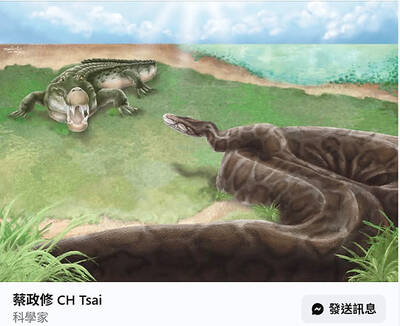
Taiwanese paleontologists have discovered fossil evidence that pythons up to 4m long inhabited Taiwan during the Pleistocene epoch, reporting their findings in the international scientific journal Historical Biology. National Taiwan University (NTU) Institute of Ecology and Evolutionary Biology associate professor Tsai Cheng-hsiu (蔡政修) led the team that discovered the largest snake fossil ever found in Taiwan. The single trunk vertebra was discovered in Tainan at the Chiting Formation, dated to between 400,000 and 800,000 years ago in the Middle Pleistocene, the paper said. The area also produced Taiwan’s first avian fossil, as well as crocodile, mammoth, saber-toothed cat and rhinoceros fossils, it said. Discoveries

Taiwanese paleontologists have discovered fossil evidence that pythons up to 4m long inhabited Taiwan during the Pleistocene epoch, reporting their findings in the international scientific journal Historical Biology. National Taiwan University (NTU) Institute of Ecology and Evolutionary Biology associate professor Tsai Cheng-hsiu (蔡政修) led the team that discovered the largest snake fossil ever found in Taiwan. A single trunk vertebra was discovered in Tainan at the Chiting Formation, dated to between 800,000 to 400,000 years ago in the Middle Pleistocene, the paper said. The area also produced Taiwan’s first avian fossil, as well as crocodile, mammoth, sabre-toothed cat and rhinoceros fossils, it said. Discoveries
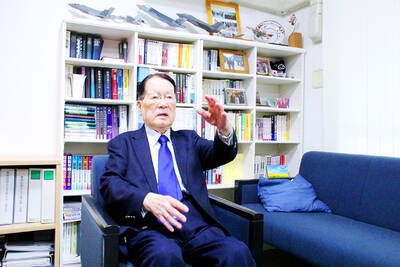
Whether Japan would help defend Taiwan in case of a cross-strait conflict would depend on the US and the extent to which Japan would be allowed to act under the US-Japan Security Treaty, former Japanese minister of defense Satoshi Morimoto said. As China has not given up on the idea of invading Taiwan by force, to what extent Japan could support US military action would hinge on Washington’s intention and its negotiation with Tokyo, Morimoto said in an interview with the Liberty Times (sister paper of the Taipei Times) yesterday. There has to be sufficient mutual recognition of how Japan could provide


 RSS
RSS