


The rent of housing units in civil servants’ dormitories is exceedingly low, with the cheapest being let for a mere NT$20 a month, Democratic Progressive Party (DPP) Legislator Lee Ying-yuan (李應元) said yesterday, which is extremely ironic given that a group of “snails without shells” housing activists is planning to sleep out overnight in front of The Palace (帝寶) luxury residential complex in Taipei today to protest the nation’s unaffordable housing prices.
The nation’s civil servants are only responsible for paying management fees if they stay in public dormitories. The Council of Agriculture’s dormitory costs are the lowest, with every tenant paying NT$20 to NT$150 a month, Lee said, citing the Legislative Yuan’s Budget Center’s central government budget report.
The dormitories of other public ministries and departments similarly cost far less than school dormitories and housing for rent in general, Lee said.
According to a report provided by the budget center, housing in the dormitory of the Ministry of Finance costs NT$200 to NT$600 per household per month, that of the Ministry of the Interior NT$100 to NT2,200 per household per month, and in Academia Sinica’s dormitories NT$175 to NT$250 per ping (3.3m2).
While the total management fees received last year was NT$47.63 million (US$1.56 million), the costs of the dormitories’ renovation and maintenance was NT$53.55 million and those of utilities and cleaning came to NT$8.3 million, Lee said.
“The numbers show that what the civil servants paid could not even meet the basic costs of maintenance, which is highly unreasonable,” he said.
Lee added that, according to statistical data provided by the National Property Administration, as of June this year 10,905 units of the 38,292 state-owned civil servant housing units were underused, the use of 2,678 was abolished and 45 were idle.
Most of the units belong to the Ministry of Education, the Veterans Affairs Council, the Council of Agriculture, the Ministry of Transportation and Communications, and the Ministry of Science and Technology, Lee said.
“[I] urge the government to transform these underused public dormitories into social housing for the consolidation of residential justice,” he said.
The “sleepout” that will have protesters gather from 5pm today to camp out overnight on Ren ai Road is a protest initiated and organized by the Housing Movement (巢運), who said the activism is to wage war against the nation’s skyrocketing housing prices and the collusion between politicians and businesspeople that lurks behind the phenomenon.
The sleepout is also to commemorate the 25th anniversary of the landmark Snails Without Shells movement on Aug. 26, 1989, which saw more than 50,000 protesters sleep overnight on Zhongxiao E Road — one of the most expensive areas of Taipei, the group said.

LOUD AND PROUD Taiwan might have taken a drubbing against Australia and Japan, but you might not know it from the enthusiasm and numbers of the fans Taiwan might not be expected to win the World Baseball Classic (WBC) but their fans are making their presence felt in Tokyo, with tens of thousands decked out in the team’s blue, blowing horns and singing songs. Taiwanese fans have packed out the Tokyo Dome for all three of their games so far and even threatened to drown out home team supporters when their team played Japan on Friday. They blew trumpets, chanted for their favorite players and had their own cheerleading squad who dance on a stage during the game. The team struggled to match that exuberance on the field, with
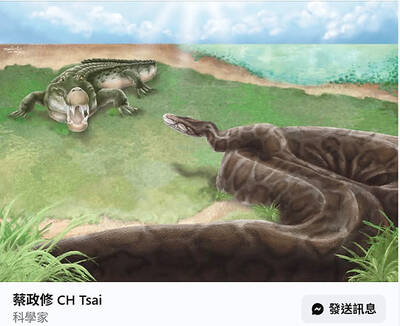
Taiwanese paleontologists have discovered fossil evidence that pythons up to 4m long inhabited Taiwan during the Pleistocene epoch, reporting their findings in the international scientific journal Historical Biology. National Taiwan University (NTU) Institute of Ecology and Evolutionary Biology associate professor Tsai Cheng-hsiu (蔡政修) led the team that discovered the largest snake fossil ever found in Taiwan. The single trunk vertebra was discovered in Tainan at the Chiting Formation, dated to between 400,000 and 800,000 years ago in the Middle Pleistocene, the paper said. The area also produced Taiwan’s first avian fossil, as well as crocodile, mammoth, saber-toothed cat and rhinoceros fossils, it said. Discoveries

Taiwanese paleontologists have discovered fossil evidence that pythons up to 4m long inhabited Taiwan during the Pleistocene epoch, reporting their findings in the international scientific journal Historical Biology. National Taiwan University (NTU) Institute of Ecology and Evolutionary Biology associate professor Tsai Cheng-hsiu (蔡政修) led the team that discovered the largest snake fossil ever found in Taiwan. A single trunk vertebra was discovered in Tainan at the Chiting Formation, dated to between 800,000 to 400,000 years ago in the Middle Pleistocene, the paper said. The area also produced Taiwan’s first avian fossil, as well as crocodile, mammoth, sabre-toothed cat and rhinoceros fossils, it said. Discoveries

Whether Japan would help defend Taiwan in case of a cross-strait conflict would depend on the US and the extent to which Japan would be allowed to act under the US-Japan Security Treaty, former Japanese minister of defense Satoshi Morimoto said. As China has not given up on the idea of invading Taiwan by force, to what extent Japan could support US military action would hinge on Washington’s intention and its negotiation with Tokyo, Morimoto said in an interview with the Liberty Times (sister paper of the Taipei Times) yesterday. There has to be sufficient mutual recognition of how Japan could provide


 RSS
RSS