


The annual debate of the 69th session of the UN General Assembly concluded on Tuesday, during which 16 of Taiwan’s diplomatic allies spoke out for the country, the same number as last year.
Taiwan should be allowed to participate in UN specialized organizations, said the heads of state, high-ranking government officials and representatives from the allies during the assembly, which began on Sept. 24.
The international organizations include the International Civil Aviation Organization (ICAO), the UN Framework Convention on Climate Change (UNFCCC) and the WHO, they said, recognizing the contributions Taiwan has already made.
Belizean Minister of Foreign Affairs Wilfred Elrington said on Tuesday that his country has benefited from Taiwan’s help and urged that Taipei be permitted to participate in the specialized agencies.
“In this modern day and age, it is incomprehensible that we should want to deny ourselves the benefit of their [Taiwan’s] expertise in dealing with global issues,” Elrington said.
Solomon Islands permanent representative to the UN Collin Beck cited the 45 million passengers who passed through Taiwan in 2012 as a reason to include the country in the ICAO.
“We just do not have the luxury of time to turn a blind eye to needed cooperation. The global challenges before us are too big for narrow interests to take a wait and see approach, and keep postponing needed action,” Beck said.
Beck described Taiwan as the 27th-largest economy in the world with “experience, technology and capability that our shared agenda can benefit from.”
“We have all to gain and nothing to lose by inviting the Republic of China [to become the] 195th member of the UNFCCC, 192nd member of ICAO and the 195th member of WHO,” Beck said, according to a UN transcript of the speech.
Among others who spoke for Taiwan were Saint Lucia Minister of External Affairs Alva Baptiste, Nicaraguan Minister of Foreign Affairs Samuel Santos Lopez and Paraguayan permanent representative to the UN Jose Antonio Dos Santos.

Taiwanese paleontologists have discovered fossil evidence that pythons up to 4m long inhabited Taiwan during the Pleistocene epoch, reporting their findings in the international scientific journal Historical Biology. National Taiwan University (NTU) Institute of Ecology and Evolutionary Biology associate professor Tsai Cheng-hsiu (蔡政修) led the team that discovered the largest snake fossil ever found in Taiwan. The single trunk vertebra was discovered in Tainan at the Chiting Formation, dated to between 400,000 and 800,000 years ago in the Middle Pleistocene, the paper said. The area also produced Taiwan’s first avian fossil, as well as crocodile, mammoth, saber-toothed cat and rhinoceros fossils, it said. Discoveries

Taiwanese paleontologists have discovered fossil evidence that pythons up to 4m long inhabited Taiwan during the Pleistocene epoch, reporting their findings in the international scientific journal Historical Biology. National Taiwan University (NTU) Institute of Ecology and Evolutionary Biology associate professor Tsai Cheng-hsiu (蔡政修) led the team that discovered the largest snake fossil ever found in Taiwan. A single trunk vertebra was discovered in Tainan at the Chiting Formation, dated to between 800,000 to 400,000 years ago in the Middle Pleistocene, the paper said. The area also produced Taiwan’s first avian fossil, as well as crocodile, mammoth, sabre-toothed cat and rhinoceros fossils, it said. Discoveries
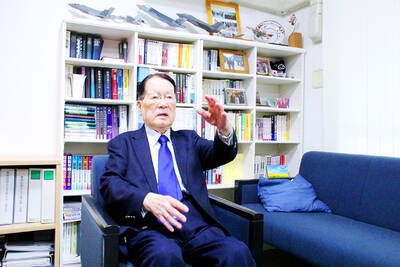
Whether Japan would help defend Taiwan in case of a cross-strait conflict would depend on the US and the extent to which Japan would be allowed to act under the US-Japan Security Treaty, former Japanese minister of defense Satoshi Morimoto said. As China has not given up on the idea of invading Taiwan by force, to what extent Japan could support US military action would hinge on Washington’s intention and its negotiation with Tokyo, Morimoto said in an interview with the Liberty Times (sister paper of the Taipei Times) yesterday. There has to be sufficient mutual recognition of how Japan could provide
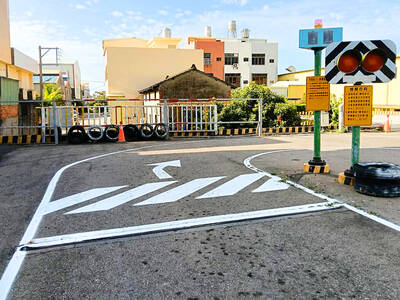
UPDATED TEST: The new rules aim to assess drivers’ awareness of risky behaviors and how they respond under certain circumstances, the Highway Bureau said Driver’s license applicants who fail to yield to pedestrians at intersections or to check blind spots, or omit pointing-and-calling procedures would fail the driving test, the Highway Bureau said yesterday. The change is set to be implemented at the end of the month, and is part of the bureau’s reform of the driving portion of the test, which has been criticized for failing to assess whether drivers can operate vehicles safely. Sedan drivers would be tested regarding yielding to pedestrians and turning their heads to check blind spots, while drivers of large vehicles would be tested on their familiarity with pointing-and-calling


 RSS
RSS