


The Ministry of Foreign Affairs yesterday dismissed concern that a ban on imports of US pork containing the feed additive ractopamine was a major trade irritant that could affect the US’ position on Taiwan’s membership in the nascent Trans-Pacific Partnership (TPP).
“Pork is not a priority issue to be discussed between Taiwan and the US,” Deputy Minister of Foreign Affairs Andrew Kao (高振群) said at a meeting of the legislature’s Foreign Affairs and National Defense Committee.
Chinese Nationalist Party (KMT) Legislator Johnny Chiang (江啟臣) told Kao that the government’s perception that the US has a favorable opinion of Taiwan’s attempts to join the TPP could just be wishful thinking.
Chiang asked Kao if he had heard of the saying “no pork, no talk” that is said to be circulating in Washington — meaning that the US would not start negotiations with Taiwan over its TPP bid unless Taipei agrees to lift the ractopamine ban.
Rumors of “no pork, no talk” did not come from Washington officials, Kao said, but added that the ministry was well aware of the US government’s position that Taiwan should allow imports of US pork containing ractopamine residues.
Kao said the ministry had expressed its wish to the US side that the pork issue should not top the list of trade issues between the two countries.
“There are other issues to talk about. We know how to respond to the US whenever the issue is brought up,” Kao said.
Earlier in the day, Minister of Foreign Affairs David Lin (林永樂) told the committee that the nation’s relations with its 22 diplomatic allies remain stable.
Lin was responding to Democratic Progressive Party Legislator Tsai Huang-liang’s (蔡煌瑯) statement that six of the 22 countries — Vatican City, Sao Tome and Principe, Panama, Honduras, Nicaragua and El Salvador — are on the verge of cutting ties with Taiwan.
Instead of sticking with President Ma Ying-jeou’s (馬英九) “diplomatic truce” strategy, which hinges on China’s willingness to “give alms” to Taiwan by not luring away the nation’s diplomatic allies, the ministry should take steps to persuade the international community to recognize both Taiwan and China simultaneously, Tsai said.
“I would like to see the Holy See establish diplomatic ties with China as well, but on the condition that it does not sever relations with Taiwan,” Tsai said.
Lin said he disagreed with Tsai’s statement that the nation’s diplomatic relationships with the 22 countries were dependent on Beijing’s “almsgiving” to Taiwan.
“I cannot accept such a characterization. The ministry has been working hard to maintain the status of Taiwan and its dignity,” Lin said.
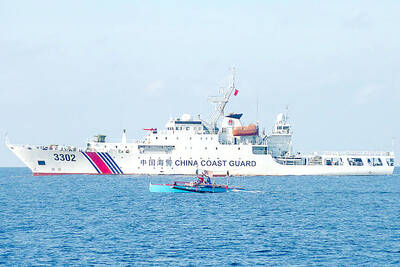
EXPANSIONIST: China deploys an average of 40 to 50 warships and coast guard vessels daily in the South China Sea, despite pledges not to militarize the region, an official said China is attempting to expand its influence across the First Island Chain and increase pressure on Japan by sending coast guard vessels into waters off of Taiwan under the pretext of maritime negotiations with Japan and the Philippines, a national security official said yesterday. China’s recent actions in the waters east of Taiwan and Japan and the Philippines’ exclusive economic zones (EEZ) are attempts to establish dominance in First Island Chain waters, said the official who declined to be named, adding that this is “expansion disguised as law enforcement.” Framing China’s actions solely as a cross-strait issue is a serious misjudgment that
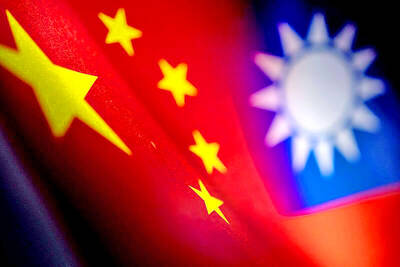
BAIT AND SWITCH: Allowing KMT-run counties to sell to China while the threat of abrupt cancelations hangs overhead is another form of coercion, officials said Beijing is using agricultural purchase offers announced during the Straits Forum to deepen Taiwan’s dependence on the Chinese market, a Taiwanese official said yesterday as they criticized the Taitung County commissioner’s participation in the initiative. During the Straits Forum held in Xiamen on Saturday, Chinese officials announced a sales and purchase agreement for agricultural products from some counties led by the Chinese Nationalist Party (KMT). Taitung County Commissioner Yao Ching-ling (饒慶鈴), who was barred from attending the event in person by the Mainland Affairs Council, participated via video. Under the agreement, China would purchase atemoyas, pomeloes, tea and grouper harvested in Taitung,
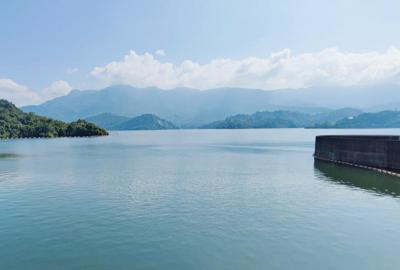
Several major reservoirs are estimated to have received 590 million tonnes of water inflow from June 4 to this morning, with storage levels at Wushantou Reservoir exceeding 50 percent and Zengwen Reservoir approaching 30 percent as of 9am today, data from the Water Resources Agency showed. Of the estimated 590 million tonnes, 450 million have already been stored in reservoirs, the data showed. As of 9am today, Baoshan Reservoir storage levels reached 100 percent, while Baoshan Second Reservoir, Yongheshan Reservoir and Techi Reservoir all exceeded 90 percent, data on the Water Resources Agency’s Web site showed. In addition, the Shimen Reservoir is at
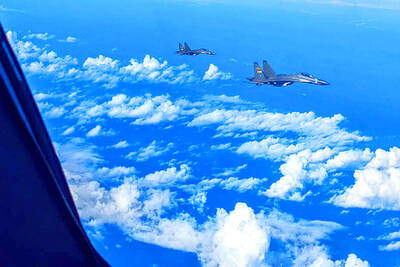
SHIFTING FIRE: While the tempo of purely military exercises around Taiwan has gone down somewhat, Beijing is working to isolate Lai diplomatically from support abroad Chinese President Xi Jinping (習近平) is shifting tactics in his campaign to pressure Taiwan, ramping up diplomatic isolation of the nation while dialing down provocative displays of military aggression. Taiwan recorded a daily average of five Chinese military aircraft crossing the Taiwan Strait’s buffer line with China through May this year — half the number logged in the same period last year. In March, Beijing did not send a single fighter jet near Taiwan for seven days, the longest absence on record outside of typhoon season. In comparison, China sent 153 planes near Taiwan during one day at its peak in


 RSS
RSS