


The Taipei Rapid Transport Corp (TRTC) in December introduced Hello Kitty-themed cable cars to Taipei’s Maokong Gondola in a bid to increase the popularity of a line that has bled money for years, but the line will still lose over NT$79 million (US$2.62 million) this year and next year, the company said.
When the cartoon character is removed, the company added, the gondola could lose up to NT$96 million a year.
The gondola has been criticized as a bottomless pit for city funds, losing between NT$80 million and NT$100 million annually since 2010.

Photo: Wu Liang-i, Taipei Times
Even when the Taipei City Government capitalized on the popularity of a panda cub born at the Taipei Zoo last year by using a panda theme to promote the gondola, the line still lost NT$80 million to NT$90 million.
Taipei City Councilor Chen Yen-po (陳彥伯) of the New Party castigated the city government for legally designating the gondola as public transportation when it was built, avoiding rigorous environmental review.
This ensures the gondola’s cheap ticket price cannot be easily adjusted, he said.
In comparison, tickets for a similar gondola at Sun Moon Lake (日月潭) are more than five times as expensive, even though the line is shorter, Chen said.
“Former mayor Ma Ying-Jeou (馬英九) left behind an absolute mess,” Chen said. “As long as Maokong Gondola tickets cost only NT$50, there’s no way to make a profit.”
In response, TRTC general manager Tan Gwa-guang (譚國光) said the Hello Kitty cars do boost the ridership of the gondola and that it has spurred the TRTC to extend its one-year contract with the Taiwan representative of the Japanese cartoon character producer Sanrio until June next year.
Past research by the city government’s transportation department has found that the gondola tickets’ ideal price point would be NT$70, an increase of NT$20.
However, this increase would only raise NT$20 million in new revenue, far short of the annual losses, the research found.
The research also suggested that if the ticket price increases, the gondola’s passenger load would drop, limiting the amount of new funds which could be raised.

LOUD AND PROUD Taiwan might have taken a drubbing against Australia and Japan, but you might not know it from the enthusiasm and numbers of the fans Taiwan might not be expected to win the World Baseball Classic (WBC) but their fans are making their presence felt in Tokyo, with tens of thousands decked out in the team’s blue, blowing horns and singing songs. Taiwanese fans have packed out the Tokyo Dome for all three of their games so far and even threatened to drown out home team supporters when their team played Japan on Friday. They blew trumpets, chanted for their favorite players and had their own cheerleading squad who dance on a stage during the game. The team struggled to match that exuberance on the field, with
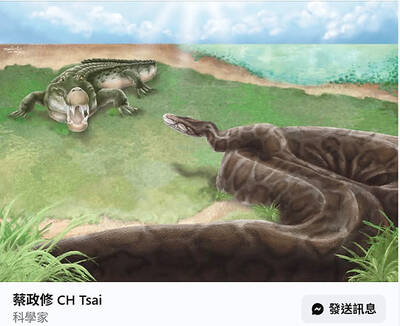
Taiwanese paleontologists have discovered fossil evidence that pythons up to 4m long inhabited Taiwan during the Pleistocene epoch, reporting their findings in the international scientific journal Historical Biology. National Taiwan University (NTU) Institute of Ecology and Evolutionary Biology associate professor Tsai Cheng-hsiu (蔡政修) led the team that discovered the largest snake fossil ever found in Taiwan. The single trunk vertebra was discovered in Tainan at the Chiting Formation, dated to between 400,000 and 800,000 years ago in the Middle Pleistocene, the paper said. The area also produced Taiwan’s first avian fossil, as well as crocodile, mammoth, saber-toothed cat and rhinoceros fossils, it said. Discoveries

Taiwanese paleontologists have discovered fossil evidence that pythons up to 4m long inhabited Taiwan during the Pleistocene epoch, reporting their findings in the international scientific journal Historical Biology. National Taiwan University (NTU) Institute of Ecology and Evolutionary Biology associate professor Tsai Cheng-hsiu (蔡政修) led the team that discovered the largest snake fossil ever found in Taiwan. A single trunk vertebra was discovered in Tainan at the Chiting Formation, dated to between 800,000 to 400,000 years ago in the Middle Pleistocene, the paper said. The area also produced Taiwan’s first avian fossil, as well as crocodile, mammoth, sabre-toothed cat and rhinoceros fossils, it said. Discoveries

Whether Japan would help defend Taiwan in case of a cross-strait conflict would depend on the US and the extent to which Japan would be allowed to act under the US-Japan Security Treaty, former Japanese minister of defense Satoshi Morimoto said. As China has not given up on the idea of invading Taiwan by force, to what extent Japan could support US military action would hinge on Washington’s intention and its negotiation with Tokyo, Morimoto said in an interview with the Liberty Times (sister paper of the Taipei Times) yesterday. There has to be sufficient mutual recognition of how Japan could provide


 RSS
RSS