

President Ma Ying-jeou (馬英九) has been named this year’s recipient of the Eisenhower Medallion for his efforts to promote regional peace, according to the US-based People to People International (PTPI) organization.
The award, presented by the organization founded in 1956 by then-US president Dwight D. Eisenhower, recognizes Ma’s East China Sea peace initiative that seeks to resolve territorial disputes in the area through peaceful means.
The 2012 initiative advocates that all claimants to disputed areas refrain from antagonistic actions; set aside their controversies and engage in dialogue; observe international law and resolve disputes through peaceful means; seek consensus on a code of conduct in the region; and establish a mechanism for the joint exploration and development of resources.
Ma, 64, was nominated by the PTPI’s Greater Tainan chapter and is to receive the award on Friday at the PTPI’s 21st worldwide conference that is being held from today until Sunday in Greater Tainan.
Tainan PTPI official Chang Fu-chuan (張富全) said Ma’s peace initiative, which urges trilateral discussions among Taiwan, Japan and China to reach an agreement on territorial disputes, was recognized and praised at a PTPI board meeting.
The award is presented to an internationally known individual or organization in recognition of their exceptional contribution to world peace during a period of at least five years, according to PTPI’s Web site.
Ma is the second Taiwanese to receive the honor, after Master Cheng Yen (證嚴法師), founder of the Buddhist Compassion Relief Tzu Chi Foundation, in 1994.
Past Eisenhower Medallion recipients include former South African president Nelson Mandela (2010), tenor Luciano Pavarotti (2004), King Hussein I of Jordan (2002), archbishop emeritus Desmond Tutu (2000), Medecins Sans Frontieres (1992), Mother Teresa (1988) and Neil Armstrong (1969).
PTPI promotes international understanding and world peace through cultural, educational and humanitarian activities.
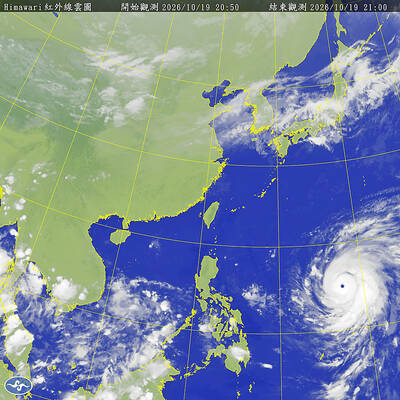
Typhoon Champi is forecast to turn northward earlier than previously expected, sparing Taiwan a direct hit but still bringing heavy rain to the north of the country on Friday and Saturday, the Central Weather Administration (CWA) said yesterday. Typhoon Champi had strengthened and increased in size over the past 12 hours, and as of yesterday afternoon, was packing sustained winds of 198kph near its center, CWA forecaster Cheng Chieh-jen (鄭傑仁) said. However, due to the weakening of a Pacific high-pressure system the storm is now expected to turn northward earlier than initially forecast, likely around Japan’s Ishigaki Island, Cheng said. As Champi brushes
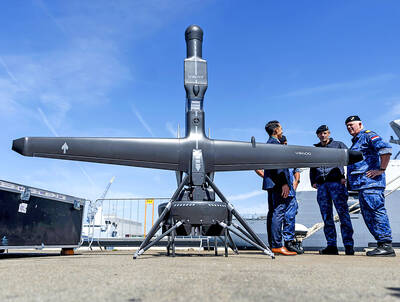
DEFENSE PROCUREMENT: Taiwan could become the largest operator of V-BAT drones outside the US once they are delivered, the Ministry of National Defense said The navy and the coast guard are acquiring 292 units of MQ-35A V-BAT vertical takeoff and landing (VTOL) surveillance drones manufactured by US-based defense technology company Shield AI, making Taiwan one of the largest buyers of the drone. The Coast Guard Administration budgeted NT$1.2 billion (US$37.1 million) to buy 12 drones, which have been delivered, Shield AI said in a report on Oct 13. The navy is planning to spend NT$36 billion under a four-year program code-named Project Yuan Xiao (遠鴞) to acquire 280 V-BAT drones, the Ministry of National Defense’s fiscal 2027 report showed. The combined procurement is expected

MAYORAL RACE: Su Chiao-hui made gains by persuading undecided voters and winning over voters in KMT-leaning districts, a pollster said Legislator Su Chiao-hui (蘇巧慧), the Democratic Progressive Party’s (DPP) candidate for New Taipei City mayor, has a 13.1 percentage point lead over her Chinese Nationalist Party (KMT) rival Lee Shu-chuan (李四川), a poll released yesterday showed. The poll, commissioned by the Taipei Trust in Democracy Association, showed that 43.1 percent of respondents said they would vote for Su, up 7.9 percentage points from a poll conducted in late August, while support for Lee was at 30 percent, down 4.7 percentage points. It showed that 48.6 percent of respondents thought Su would make a suitable mayor, compared with 35.9 percent for Lee. Independent candidate
A Chinese People's Liberation Army (PLA) Navy aircraft carrier group was being monitored after entering the western Pacific, the Ministry of National Defense said today, after Beijing yesterday criticized Taiwan for using a water cannon against a Chinese fishing boat near the Pratas Islands (Dongsha Islands, 東沙群島). A Chinese naval task group led by the aircraft carrier Liaoning (遼寧) yesterday sailed to the western Pacific for training, Chinese state-run Xinhua news agency quoted the PLA Navy as saying. “The drill is part of the annual routine training plan aimed at testing and improving the troops’ combat readiness and enhancing their ability to


 RSS
RSS