


A number of Taipei city councilors have called on Xinyi Precinct police to patrol areas near Taipei 101 after reported incidents of alleged assault involving members of the pro-unification Patriot Association.
Taipei City Councilor Hsu Shu-hua (許淑華) of the Democratic Progressive Party (DPP) told people to mind their personal safety, citing statistics produced by the precinct, which showed that 12 scuffles have taken place at the plaza in front of the skyscraper between January and last month.
Some of the scuffles involved members of the association physically attacking Falun Gong supporters, she said.
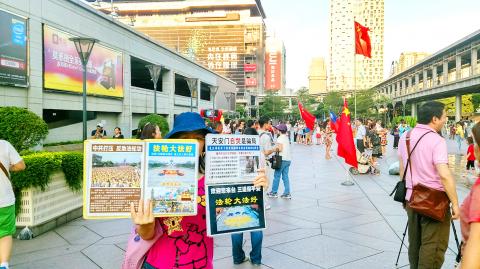
Photo: Chen Yen-chun, Taipei Times
DPP Taipei City Councilor Yeng Sheng-kuan (顏聖冠) said the Taipei City Government tolerated the association’s alleged acts of violence by turning a blind eye to the reports of attacks on Falun Gong supporters and continuing to allow the association to spread its propaganda.
The association’s members are known for their outspokenness over the unification of Taiwan and China, often being seen in public places waving the five-star red flag of the People’s Republic of China (PRC) and shouting chants.
In contrast, supporters of the Falun Gong, which is banned in China as an “evil cult,” can be seen at sit-ins, protesting silently against what they say is the Chinese government’s persecution.
Sanjhangli Police Station Director-General Hsiao Chien-hung (蕭建宏) said that since the reports of sporadic violence in the Taipei 101 plaza, officers have patrolled the site and its surroundings on a daily basis and banned the use of loudspeakers.
Falun Gong supporter Tsai Shou-jen (蔡守仁) said he and his fellow members chose Taipei 101 as a venue to promote their appeal with the hope of telling people about the Chinese government’s oppressive ways with people’s freedom of speech and religious groups.
Members of the Patriot Association usually rally near the plaza from 5pm to 7pm, Monday to Friday, Tsai said.

The Centers for Disease Control (CDC) yesterday reported the first case of a new COVID-19 subvariant — BA.3.2 — in a 10-year-old Singaporean girl who had a fever upon arrival in Taiwan and tested positive for the disease. The girl left Taiwan on March 20 and the case did not have a direct impact on the local community, it said. The WHO added the BA.3.2 strain to its list of Variants Under Monitoring in December last year, but this was the first imported case of the COVID-19 variant in Taiwan, CDC Deputy Director-General Lin Ming-cheng (林明誠) said. The girl arrived in Taiwan on

South Korea is planning to revise its controversial electronic arrival card, a step Taiwanese officials said prompted them to hold off on planned retaliatory measures, a South Korean media report said yesterday. A Yonhap News Agency report said that the South Korean Ministry of Foreign Affairs is planning to remove the “previous departure place” and “next destination” fields from its e-arrival card system. The plan, reached after interagency consultations, is under review and aims to simplify entry procedures and align the electronic form with the paper version, a South Korean ministry official said. The fields — which appeared only on the electronic form

The Ministry of Foreign Affairs (MOFA) is suspending retaliation measures against South Korea that were set to take effect tomorrow, after Seoul said it is updating its e-arrival system, MOFA said today. The measures were to be a new round of retaliation after Taiwan on March 1 changed South Korea's designation on government-issued alien resident certificates held by South Korean nationals to "South Korea” from the "Republic of Korea," the country’s official name. The move came after months of protests to Seoul over its listing of Taiwan as "China (Taiwan)" in dropdown menus on its new online immigration entry system. MOFA last week

A bipartisan group of US senators has introduced a bill to enhance cooperation with Taiwan on drone development and to reduce reliance on supply chains linked to China. The proposed Blue Skies for Taiwan Act of 2026 was introduced by Republican US senators Ted Cruz and John Curtis, and Democratic US senators Jeff Merkley and Andy Kim. The legislation seeks to ease constraints on Taiwan-US cooperation in uncrewed aerial systems (UAS), including dependence on China-sourced components, limited access to capital and regulatory barriers under US export controls, a news release issued by Cruz on Wednesday said. The bill would establish a "Blue UAS


 RSS
RSS