


GOVERNMENT
Professor joins council
A National Dong Hwa University assistant professor has been named the new deputy head of the Cabinet-level Council of Indigenous Peoples, the Cabinet said in a statement yesterday. Chen Chang Pei-lun (陳張培倫), who works in the university’s Department of Indigenous Development and Social Work, will assume the post that former council deputy head Kao Yang-sheng (高揚昇) left on July 31 to take over as Deputy Taoyuan County Magistrate. Chen Chang, a member of the Bunun group whose Aboriginal name is Tunkan Tansikian, has spent many years researching the rights of indigenous peoples and served as a consultant to the council, the Cabinet said.
TECHNOLOGY
Taipei inks city domain deal
The Taipei City Government yesterday signed a registry agreement with the Internet Corp for Assigned Names and Numbers (ICANN) to open the top-level domain suffix “.taipei” for registration in November, according to the Taipei Department of Information Technology. The agreement was signed in the capital by Taipei Mayor Hau Lung-bin (郝龍斌) and ICANN board member Wu Kuo-wei (吳國維). Hau said Web sites for the special 1999 phone line for city residents and the public bicycle rental system YouBike would be among the first to adopt the “.taipei” suffix. Yesterday’s deal brings to 14 the number of Taiwanese cities to have secured their own top-level domains, according to the Chinese-language Apple Daily.
GOVERNMENT
Ma vows to help firefighters
President Ma Ying-jeou (馬英九) on Tuesday promised to give full support to the nation’s firefighters, who have complained of a lack of equipment and a shortage of manpower. Ma made the remarks at a ruling Chinese Nationalist Party (KMT) meeting after about 100 firefighters petitioned the Ministry of the Interior on Monday asking the government to improve their working conditions. Six firefighters died in the Greater Kaohsiung pipeline explosions caused by propene leaks on July 31 and Aug. 1, while another was injured on Friday last week in a gas explosion at an apartment in New Taipei City’s Sindian District (新店). The petitioners called on the government to give them more higher-quality equipment and increase personnel, among other demands, so they can do their jobs better and more safely.
DIPLOMACY
Taiwan role model: Widodo
Indonesian president-elect Joko Widodo has cited Taiwan as a role model for his country, saying that advances in Taiwan’s human resources have led to high productivity. Manpower development is the biggest challenge facing Indonesia, Widodo said at a forum in Yogyakarta, Indonesia, on Monday, describing the situation as a matter that must be dealt with, according to a report on detik.com, an Indonesian online news portal. Widodo said he shares the views of Indonesian writer Mochtar Lubis on the weaknesses of Indonesians, including hypocrisy, lack of a sense of responsibility, being superstitious and lacking courage. Another characteristic needing work is a lack of attention to quality, Widodo said. He said he relates to that well, based on his past experience working in furniture exports, which left him with an impression of the little importance Indonesians attach to quality. However, it is possible for Indonesia to catch up with countries such as Taiwan, Singapore and Japan, whose people are highly productive, through education, the Jakarta governor said. The changes are vital to the country’s productivity and competitiveness, he said.

UPGRADE: The Kang Ding-class frigate is replacing its Chaparall missiles with Tien Chien II and Hua Yang VLS, which would provide it with long-range, 360° air defense Taiwan plans to produce 1,200 to 1,376 Hai Chien II missiles (海劍二, Sea Sword II) — also known as TC-2N — to serve as the standard air defense system of the navy’s surface combatant fleet, a source said yesterday. Last week, the Hai Chien II, the naval version of the Tien Kung II missile (天劍二, Sky Sword II), completed a live-fire test in waters off the National Chungshan Institute of Science and Technology’s Jiupeng facility (九鵬) in Pingtung County’s Manjhou Township (滿州). The MIM72 Chaparral and other dated air defense missiles that currently arm Taiwanese ships have inadequate range to combat Chinese

REASONS FOR TRAVEL: An assistant professor said that proposed amendments to penalize drivers if they used drugs overseas would not deter people from traveling People who operate a motor vehicle under the influence of marijuana would have their driver’s license revoked, even if they used the substance while overseas, the Ministry of Transportation and Communications said yesterday, citing proposed amendments to the Road Traffic Management and Penalty Act (道路交通管理處罰條例). The amendments would also authorize the government to revoke the licenses of people determined to have used Category 1 or Category 2 narcotics, even if they were not operating a vehicle while under the influence of drugs, as well as ban them from taking the license test for three years, the ministry said. People aged 18 or

HEAVY WEATHER: Typhoon Jangmi is due to crash straight into the Ryukyus as airlines look to shift flights to larger aircraft or cancel flights to Okinawa entirely Taiwan’s international air carriers announced flight adjustments over the weekend as Typhoon Jangmi is forecast to hit the Ryukyu Islands today and tomorrow. The Central Weather Administration (CWA) upgraded Jangmi from a tropical storm to a typhoon at 8am yesterday, with the eye located 580km south of Naha city. It was moving north at 19kph. Today, China Airlines’ CI-120, CI-121, CI-122 and CI-123 flights between Taoyuan and Naha, Okinawa, have been canceled as well as CI-132 and CI-133 between Kaohsiung and Naha. EVA Air’s BR-112, BR-113, BR-186 and BR-185 flights between Taoyuan and Naha are also canceled. Low-cost carrier Tigerair Taiwan canceled IT-230,
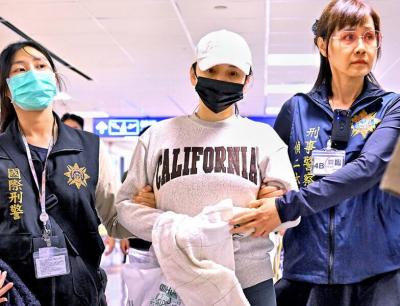
Johanne Liou (劉喬安), a Taiwanese woman who shot to unwanted fame during the Sunflower movement protests in 2014, returned to Taiwan last night after being deported from the US. She is to stand trial in Taiwan for charges involving embezzlement, fraud and drug crimes. The Criminal Investigation Bureau (CIB) said it took her into custody at Taiwan Taoyuan International Airport and would first question her before transferring her to the New Taipei District Prosecutors’ Office. She was arrested upon disembarking a flight from San Francisco that landed shortly before 7pm. Liou absconded to the US in 2019 after jumping bail


 RSS
RSS