


While the congestion pricing scheme appears to have failed to ease the heavy traffic on the Chiang Wei-Shui Freeway (Freeway No. 5) on the first weekend of its trial, the National Freeway Bureau said yesterday that it would make an assessment from the data collected in the four-week test operation before deciding whether it would continue implementing the policy.
The bureau is testing different toll-pricing schemes for peak and off-peak hours because the limited capacity of the Hsuehshan Tunnel connecting New Taipei City and Yilan County has led to constant congestion during holiday periods.
During the trial, motorists driving on Freeway No. 5 pay a 50 percent higher toll if they drive south during the peak hours between 6am and 12pm on Saturdays.
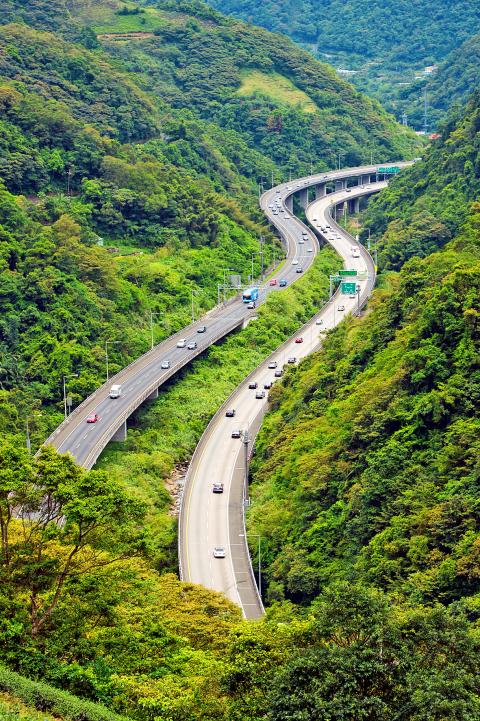
Photo: CNA
Those driving north during the off-peak hours between 6am and 12pm on Sundays are to pay a toll 50 percent lower.
People driving south during off-peak hours on Saturdays, as well as those driving north during peak hours on Sundays, pay the usual tolls.
The assumption was that some drivers might be motivated to travel during off-peak hours because they would pay less in freeway tolls.
Though the bureau previously estimated — from a pre-trial survey — that the differential pricing scheme could divert 3 to 19 percent of the traffic from peak hours to off-peak hours, results on the first weekend of the trial were disappointing.
Statistics from the bureau showed the new scheme helped divert only 3 to 5 percent of the traffic from peak hours to off-peak hours on Saturday, with vehicles still queuing up on the southbound lanes of Freeway No. 5 on Saturday morning.
While drivers were told they could pay 50 percent less on toll fees if they chose to return north on Sunday morning, the traffic volume increased by just 5 percent yesterday morning.
The bureau’s traffic control center also showed that northbound traffic was relatively smoother before 10am yesterday, with the average driving speed exceeding 80kph.
However, the traffic began to slow down after 10am.
By 11:30am, cars driving from Toucheng (頭城) to Pinglin (坪林) had slowed down to less than 50kph.
Bureau Traffic Management Department Director Leu Wen-yuh (呂文玉) said it would analyze the traffic data after the four-week trial and determine whether the new pricing scheme makes any difference.
Facing questions on the effectiveness of the pricing scheme in diverting traffic flow, the bureau said that Freeway No. 5 reaches its maximum capacity when the average speed drops to between 40kph and 50kph. This means that some drivers would still get on the freeway even if that means they would be stuck in traffic.
Aside from the congestion pricing scheme, the bureau added that the Yilan County Government and other transport systems should offer drivers incentives to reduce traffic on the freeways.
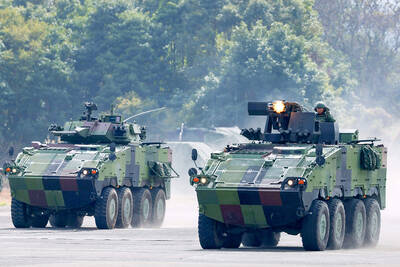
Taiwan must first strengthen its own national defense to deter a potential invasion by China as cross-strait tensions continue to rise, multiple European lawmakers said on Friday. In a media interview in Taipei marking the conclusion of an eight-member European parliamentary delegation’s six-day visit to Taiwan, the lawmakers urged Taipei to remain vigilant and increase defense spending. “All those who claim they want to protect you actually want to conquer you,” Ukrainian lawmaker Serhii Soboliev said when asked what lessons Taiwan could draw from Russia’s invasion of Ukraine. Soboliev described the Kremlin as a “new fascist Nazi regime” that justified
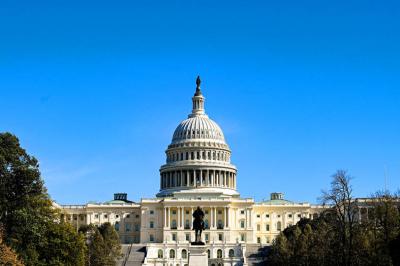
The US House of Representatives yesterday passed the PROTECT Taiwan Act, which stipulates that Washington would exclude China from participating in major global financial organizations if its actions directly threaten Taiwan’s security. The bill, proposed by Republican US Representative Frank Lucas, passed with 395 votes in favor and two against. It stipulates that if China’s actions pose any threat to Taiwan’s security, economic or social systems, the US would, “to the maximum extent practicable,” exclude China from international financial institutions, including the G20, the Bank for International Settlements and the Financial Stability Board. The bill makes it clear that China

‘T-DOME’: IBCS would increase Taiwan’s defense capabilities, enabling air defense units to use data from any sensor system and cut reaction time, a defense official said A defense official yesterday said that a purported new arms sale the US is assembling for Taiwan likely includes Integrated Battle Command Systems (IBCS). The anonymous official’s comments came hours after the Financial Times (FT) reported that Washington is preparing a US$20 billion arms sale encompassing “Patriot missiles and other weapons,” citing eight sources. The Taiwanese official said the IBCS is an advanced command and control system that would play a key role in President William Lai’s (賴清德) flagship defense program, the “T-Dome,” an integrated air defense network to counter ballistic missiles and other threats. The IBCS would increase Taiwan’s
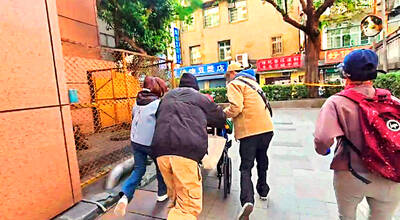
NOMINAL NEWLYWEDS: A man’s family and his wife — his long-term caregiver — are engaged in a legal dogfight over the propriety and validity of the recent union A centenarian’s marriage to his caregiver unbeknownst to his children has prompted legal action, as the caregiver accuses the man’s children of violating her personal liberty and damaging her reputation, while the children have sought a legal option to have the marriage annulled. According to sources, the 102-year-old man surnamed Wang (王) lives in Taipei’s Zhongshan District (中山) and previously worked as a land registration agent. Wang reportedly owns multiple properties and parcels of land worth several hundred million New Taiwan dollars and has ten children. His caregiver, a 69-year-old surnamed Lai (賴), has been caring for him since about 1999,


 RSS
RSS