

Chinese cyberattacks on Taiwan persist even as ties across the Taiwan Strait have improved, the head of Taiwan’s Ministry of Science and Technology said yesterday.
Chinese hackers attack Taiwan on almost a daily basis, in part to steal confidential information on the government’s bottom line in cross-strait negotiations, Minister of Science Simon Chang (張善政) said during an interview with a local radio station.
Taiwan has also become a testing ground for Chinese hackers to experiment with new hacking technologies, he said.
Although cross-strait ties appear to have improved, there is a major cyberattack by Chinese hackers once every few months, with the perpetrators hoping to crash Taiwanese Web sites and steal information, he said.
Chang, who is also the Cabinet’s chief information officer, was responding to questions on the nation’s information security.
Meanwhile, addressing the gas pipeline explosions in Greater Kaohsiung reportedly caused by a leaky propene pipeline, Chang said that a task force should be set up to collect and compile information on underground pipelines so that the information is easily accessible to governments at every level.
The blasts on July 31 and Aug. 1, which left 30 people dead and 310 injured, drew attention to the issue of underground petrochemical pipes in highly populated parts of the city, which is the hub of the nation’s petrochemical industry.
Chang said the petrochemical industry has only a 17 percent profit margin, compared with 40 percent in Singapore, and companies in the sector need to realize that costs will only go up in the future given rising environmental awareness.
The companies should pay greater attention to operational safety and maintain a good relationship with residents in the neighborhoods near their factories, Chang said, adding that the ministry was ready to help producers develop innovative techniques to add value.
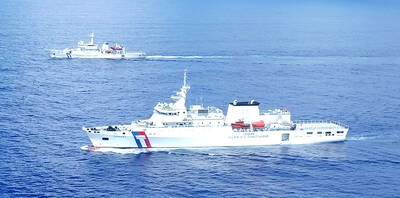
‘FRIENDSHIP FLEET’: A CGA official is scheduled to meet with the president of the Pacific nation, while one of the ships is to host a banquet and National Day event Two Coast Guard Administration (CGA) patrol vessels have docked at Malakal Harbor in Palau as part of an expedition exercise and diplomatic visit, during which a senior official is expected to meet with Palauan President Surangel Whipps Jr, the agency said yesterday. The two vessels, the 4,000-tonne-class Chiayi and the 1,000-tonne-class Penghu, set sail for Palau from Taiwan last week and arrived on Tuesday at Malakal Harbor, the CGA’s Fleet Branch said in a statement. The journey marks the second time the CGA has dispatched a “friendship fleet” to another country, after it sent its first-ever goodwill fleet, comprising the Hualien and
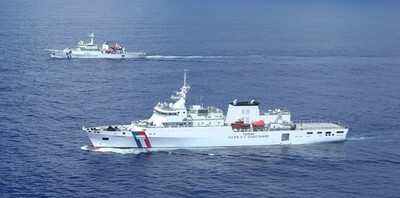
The Coast Guard Administration (CGA) today said that two of its patrol vessels have docked at Palau's Malakal Harbor as part of an expedition exercise and diplomatic visit, during which a senior official is expected to meet with the Palauan president. The two vessels, the 4,000-tonne-class Chiayi (嘉義) and the 1,000-tonne-class Penghu (澎湖), set sail for Palau from Taiwan last week and arrived at Malakal Harbor yesterday, the CGA's Fleet Branch said in a statement. The journey marked the second time the CGA has dispatched a "Friendship Fleet" to another country, after it sent its first-ever goodwill fleet, comprising the Hualien (花蓮)

Had I Not Seen the Sun (如果我不曾見過太陽), a coming-of-age mystery romance, yesterday won best series at the Seoul International Drama Awards in South Korea. The show's producer, Phoebe Ma (麻怡婷), accepted the award on behalf of the production team. "Telling this story was difficult," Ma said. "There were moments when I doubted my strength to keep going, but I never doubted the story itself." Ma went on to thank the cast and crew of the show for making the win possible. Released in two parts on Netflix at the end of last year, the 20-episode drama starred Tseng Jing-hua (曾敬驊) and Alice Ko (柯佳嬿). The
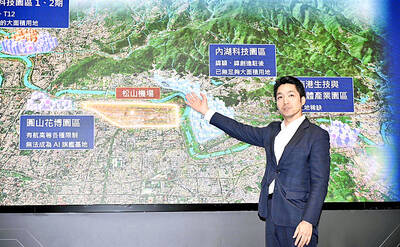
DETAILED PLAN NEEDED: Relocating the airport would affect not just travelers, but also undermine national defense and emergency medical services, a legislator said Taipei Mayor Chiang Wan-an (蔣萬安) yesterday proposed relocating Taipei International Airport (Songshan airport) and turning the site into an artificial intelligence (AI) park, drawing opposition from politicians across party lines. Chiang’s plan would turn the 300 hectares into an AI park featuring tech clusters, residential communities and green space. The industrial cluster would host 200 domestic enterprises, generate NT$12 trillion (US$376.47 billion) in output, and accommodate 65,000 jobs and 35,000 residents, he said. Cabinet spokeswoman Michelle Lee (李慧芝) said the Executive Yuan was surprised by the announcement, as the Taipei City Government did not discuss the proposal with the central government before making


 RSS
RSS