


Greater Kaohsiung has served as a hub for the petrochemical industry since the Japanese colonial era.
The city’s local industry employs 35,000 workers and is home to multiple petrochemical parks such as the state-run CPC Corp, Taiwan’s (CPC) Kaohsiung Refinery Plant, its Dalin (大林) Township Refinery Plant, the Dafa Industrial Area, the Linyuan (林園) Petrochemical Area, the Renwu (仁武) Petrochemical Industial Area and the Dashe (大社) Petrochemical Industrial Area.
The beginnings of the municipality’s petrochemical industry can be traced to 1936, when the former Japanese Imperial Navy established a fuel plant in what is now Nanzih District’s (楠梓) Houjin Township (後勁) to refine crude oil and fuel its fleet.
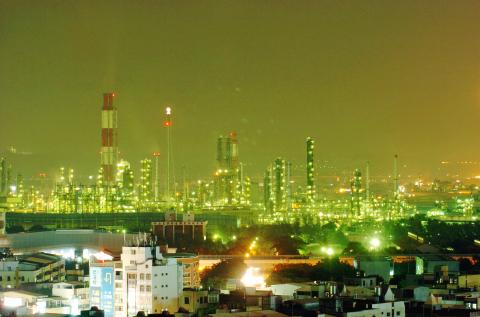
Photo: Chang Chung-yi, Taipei Time
After World War II ended in 1946, the then-Chinese Nationalist Party (KMT) government took over the plant, expanded on the Japanese-built infrastructure and refashioned it into CPC’s Kaohsiung fuel refinery.
In 1971, the plant expanded to include CPC’s first and second naphtha crackers, prompting other petrochemical giants to also set up facilities near Kaohsiung in Renwu and Dashe districts. Companies that have invested in these areas include the Formosa Plastics Group, Nanya Technology, USI Corp, Asia Polymer Corp, Taita Chemical Co and China Petrochemical Development Corp.
Currently, CPC’s Kaohsiung fuel refinery has 1,700 employees and churns out 200,000 barrels of oil a day.
However, its fifth naphtha cracker is facing an impending relocation and has been trying to boost its production quota to compensate for the period when it will not be operating during the move. The Renda (仁大) Industrial Area and more than 10 companies are to be impacted by the relocation, which could cost 2,500 workers their jobs.
The concentration of the petro-chemical industry in Greater Kaohsiung has prompted the saying: “If anything explodes at CPC’s plant, it would level Kaohsiung.”
However, prior to the pipeline explosions in the city’s Cianjhen (前鎮) and Lingya (苓雅) districts late on Thursday night and early on Friday morning, the expression had been said only in jest.
After seeing how a propene leak in a pipeline running underneath the middle of those districts wreaked massive damage, civic groups and academics are beginning to worry about Greater Kaohsiung’s status as a petrochemical hub.
As of 4pm yesterday, 28 people, including four firefighters, have been confirmed dead in the blasts, with two firemen still missing and 302 people reported as injured, according to figures compiled by the Central Disaster Emergency Operation Center.
Citizen of the Earth, Taiwan executive director Lee Ken-cheng (李根政) said that the network of pipes carrying petrochemical substances under the city is too dense, adding that some pipelines were even connected to one other.
After four decades in use, the pipes are all outdated, making them akin to dud bombs, Lee said.
Chang Jui-ren (張瑞仁), director of the Professional Geotechnical Engineers Association’s Kaohsiung-Pingtung Office, said the gas companies should have been more worried than the government about leaks depressurizing the flow of gas, adding that no one had a clue about which pipe was malfunctioning.
“How can the public feel safe with these people in charge of the pipelines running underneath them?” Chang asked.
Yang Ping-tsang (楊秉蒼), a professor at Cheng Shiu University’s department of civil engineering, said the problem lay in the nation’s lack of laws governing the oversight of pipelines’ security, so local governments build modern urban cities with no visible pipelines by putting them underground, which means no one knows what state they are in.
Former Kaohsiung Professional Civil Engineers Association president Ou Liang-kui (歐良規) said that despite recent fears, the continued security and transformation Greater Kaohsiung must not exclude the petrochemical industry.
The Greater Kaohsiung City Government’s plan for the “New Asia Bay Area” happens to pass over Chenggong Road, under which run oil and petrochemical pipelines, Ou said.
If anything were to happen to that line, the “cream of the cream” of Greater Kaohsiung may be subject to explosion, Ou said.
Though the petrochemical industry provides for tens of thousands of families, a recent string of safety incidents including the blasts led the director of the city government’s Economic Development Bureau, Tseng Wen-sheng (曾文生), to say that while the city welcomes investors, it also hopes they will uphold their social responsibilities.
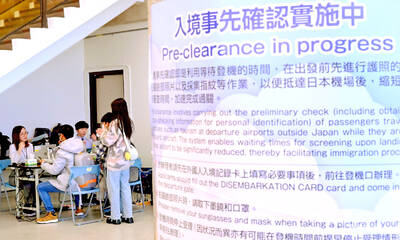
A preclearance service to facilitate entry for people traveling to select airports in Japan would be available from Thursday next week to Feb. 25 at Taiwan Taoyuan International Airport, Taoyuan International Airport Corp (TIAC) said on Tuesday. The service was first made available to Taiwanese travelers throughout the winter vacation of 2024 and during the Lunar New Year holiday. In addition to flights to the Japanese cities of Hakodate, Asahikawa, Akita, Sendai, Niigata, Okayama, Takamatsu, Kumamoto and Kagoshima, the service would be available to travelers to Kobe and Oita. The service can be accessed by passengers of 15 flight routes operated by
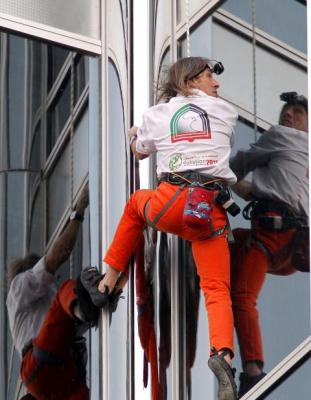
Alain Robert, known as the "French Spider-Man," praised Alex Honnold as exceptionally well-prepared after the US climber completed a free solo ascent of Taipei 101 yesterday. Robert said Honnold's ascent of the 508m-tall skyscraper in just more than one-and-a-half hours without using safety ropes or equipment was a remarkable achievement. "This is my life," he said in an interview conducted in French, adding that he liked the feeling of being "on the edge of danger." The 63-year-old Frenchman climbed Taipei 101 using ropes in December 2004, taking about four hours to reach the top. On a one-to-10 scale of difficulty, Robert said Taipei 101
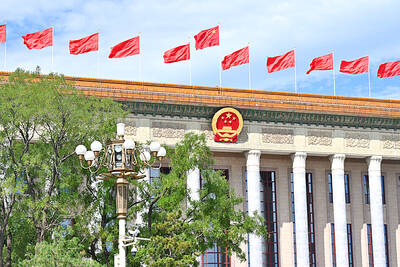
MORE FALL: An investigation into one of Xi’s key cronies, part of a broader ‘anti-corruption’ drive, indicates that he might have a deep distrust in the military, an expert said China’s latest military purge underscores systemic risks in its shift from collective leadership to sole rule under Chinese President Xi Jinping (習近平), and could disrupt its chain of command and military capabilities, a national security official said yesterday. If decisionmaking within the Chinese Communist Party has become “irrational” under one-man rule, the Taiwan Strait and the regional situation must be approached with extreme caution, given unforeseen risks, they added. The anonymous official made the remarks as China’s Central Military Commission Vice Chairman Zhang Youxia (張又俠) and Joint Staff Department Chief of Staff Liu Zhenli (劉振立) were reportedly being investigated for suspected “serious
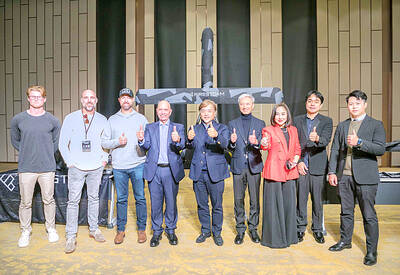
Taiwanese and US defense groups are collaborating to introduce deployable, semi-autonomous manufacturing systems for drones and components in a boost to the nation’s supply chain resilience. Taiwan’s G-Tech Optroelectronics Corp subsidiary GTOC and the US’ Aerkomm Inc on Friday announced an agreement with fellow US-based Firestorm Lab to adopt the latter’s xCell, a technology featuring 3D printers fitted in 6.1m container units. The systems enable aerial platforms and parts to be produced in high volumes from dispersed nodes capable of rapid redeployment, to minimize the risk of enemy strikes and to meet field requirements, they said. Firestorm chief technology officer Ian Muceus said


 RSS
RSS