


In light of the explosions caused by gas leaking from underground pipelines in Greater Kaohsiung last week, which killed at least 28 people and injured more than 300, lawmakers are denouncing what they say is the longstanding unfairness of the city’s residents bearing the risks of living near petrochemical plants, while the companies’ Taipei headquarters enjoy the tax revenue generated by those facilities.
One of these critics is Democratic Progressive Party (DPP) Legislator Lee Kun-tse (李昆澤), who yesterday called on LCY Chemical Corp and the state-owned CPC Corp, Taiwan (CPC) to move their head offices to Greater Kaohsiung.
Lee said this would bridge the gap between the amount of central government-funded tax revenue allocated to the companies’ Taipei headquarters and that received by their Greater Kaohsiung units, which receive only about half the funds that their Taipei affiliates do.
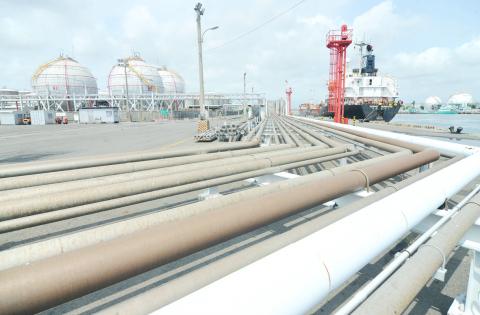
Photo: Huang Chih-yuan, Taipei Times
Citing the Regulations for Allocation of Centrally Funded Tax Revenues (中央統籌分配稅款分配辦法), Lee said that since the system assigns a 50 percent value to the revenue generated by each municipality and allocates central government-funded tax revenue accordingly, the petrochemical companies’ Taipei headquarters acquire the lion’s share of state-funded revenues, leaving their under-funded Kaohsiung units to deal with the pollution and public safety issues that come with operating a petrochemical facility.
Citing LCY as an example, he said the company’s head office is in Taipei, but five of its six plants are based in the southern municipality, including its Kaohsiung, Siaogang (小港), Dashe (大社) and Linyuan plants (林園), as well as a fuel storage and transfer station it operates in the seaport of Cianjhen District (前鎮), the site of the explosions.
Similarly, CPC has two smelters in the municipality, its Kaohsiung and Dalin (大林) smelters, as well as a refinery in Linyuan and a Cianjhen storage and transfer station, Lee said.
Both LCY and CPC, whose revenues totaled NT$49.7 billion (US$1.67 billion) and NT$1.15 trillion respectively last year, put their Taipei headquarters in charge when filing business taxes, Lee said, adding that as a result, all their business taxes are filed with the National Taxation Bureau of Taipei.
The companies’ practice of establishing plants in Greater Kaohsiung while letting their Taipei offices handle tax filing duties is against the principle of fair taxation, because Greater Kaohsiung residents have to live with the pollution and safety concerns caused by the plants, while those in Taipei receive most of the profits, he said.
“[Greater] Kaohsiung has carried too heavy a burden for the sake of Taiwan’s economic development,” he said.
Lee said he would submit a request to CPC asking it to move its head office to Kaohsiung, a move he said would raise the tax revenue allocated to the municipality by NT$3 billion a year.
An official at the Greater Kaohsiung Government’s Finance Bureau, who declined to be named, said the taxes shouldered by CPC’s facilities in the south are about NT$500 million to NT$600 million, adding that the bureau is not privy to the amount the facilities pay in business tax since the National Taxation Bureau says that information is “confidential.”
When reached for comment, independent Greater Kaohsiung City Councilor Huang Shih-lung (黃石龍) said: “Since CPC’s president lives in Taipei, why not ask him to move the plants there to make his managing them more efficient? Would Taipei residents approve of that?”
He said the bottom line should be people’s quality of life, not tax revenues, adding that petrochemical companies should establish their facilities away from densely populated areas.
DPP Legislator Chen Chi-mai (陳其邁) said on Facebook that setting up petrochemical facilities in a busy city is no different than planting a time bomb there, since both put residents’ lives at risk.
He urged the central government to perform its duties and move underground pipelines out of densely populated areas, while calling on CPC to move its headquarters south to enable Greater Kaohsiung residents to benefit from the municipality receiving a higher amount of centrally funded tax revenues.

Actor Darren Wang (王大陸) was sentenced to six months in prison, commutable to a fine, by the New Taipei District Court today for contravening the Personal Data Protection Act (個人資料保護法) in a case linked to an alleged draft-dodging scheme. Wang allegedly paid NT$3.6 million (US$114,380) to an illegal group to help him evade mandatory military service through falsified medical documents, prosecutors said. He transferred the funds to Chen Chih-ming (陳志明), the alleged mastermind of a draft-evasion ring, although he lost contact with him as he was already in detention on fraud charges, they said. Chen is accused of helping a

SECURITY: Starlink owner Elon Musk has taken pro-Beijing positions, and allowing pro-China companies to control Taiwan’s critical infrastructure is risky, a legislator said Starlink was reluctant to offer services in Taiwan because of the nation’s extremely high penetration rates in 4G and 5G services, the Ministry of Digital Affairs said yesterday. The ministry made the comments at a meeting of the legislature’s Transportation Committee, which reviewed amendments to Article 36 of the Telecommunications Management Act (電信管理法). Article 36 bans foreigners from holding more than 49 percent of shares in public telecommunications networks, while shares foreigners directly and indirectly hold are also capped at 60 percent of the total, unless specified otherwise by law. The amendments, sponsored by Chinese Nationalist Party (KMT) Legislator Ko

NON-RED SUPPLY: Boosting the nation’s drone industry is becoming increasingly urgent as China’s UAV dominance could become an issue in a crisis, an analyst said Taiwan’s drone exports to Europe grew 41.7-fold from 2024 to last year, with demand from Ukraine’s fight against Russian aggression the most likely driver of growth, a study showed. The Institute for Democracy, Society and Emerging Technology (DSET) in a statement on Wednesday said it found that many of Taiwan’s uncrewed aerial vehicle (UAV) sales were from Poland and the Czech Republic. These countries likely transferred the drones to Ukraine to aid it in its fight against the Russian invasion that started in 2022, it said. Despite the gains, Taiwan is not the dominant drone exporter to these markets, ranking second and fourth

The eastern extension of the Taipei MRT Red Line could begin operations as early as late June, the Taipei Department of Rapid Transit Systems said yesterday. Taipei Rapid Transit Corp said it is considering offering one month of free rides on the new section to mark its opening. Construction progress on the 1.4km extension, which is to run from the current terminal Xiangshan Station to a new eastern terminal, Guangci/Fengtian Temple Station, was 90.6 percent complete by the end of last month, the department said in a report to the Taipei City Council's Transportation Committee. While construction began in October 2016 with an


 RSS
RSS