


A leading member of the US Congress has condemned China for sending a spy ship to the ongoing Rim of the Pacific (RIMPAC) naval exercises, saying that in the future participation in the biennial drills should be reserved for US allies and partners such as Taiwan.
“Given China’s recent disregard for principles like freedom of navigation and the peaceful resolution of territorial disputes, it was already a stretch to reward Beijing with an invite to such a prestigious event like RIMPAC,” Randy Forbes, chairman of the US House of Representatives’ Armed Services Subcommittee on Sea Power, told reporters on Friday.
In an e-mail exchange with the Taipei Times, Forbes added: “Now, they have chosen to disrespect the 20 other international participants by sailing an intelligence-gathering ship directly into the middle of the exercise.”
“RIMPAC participation should be reserved for US allies and partners like Taiwan, who share our interests in a free, stable and prosperous Asia-Pacific region,” he wrote.
In October last year, the Republican congressman said he pleaded with US Secretary of Defense Charles Hagel to invite Taiwan to RIMPAC.
Forbes said that while Beijing had been invited, Taipei “remains uninvited, despite the opportunity to enhance its humanitarian assistance and disaster-relief capabilities.”
US President Barack Obama’s administration reportedly decided not to invite Taiwan largely because of objections from China.
Forty-nine ships from 22 countries are currently taking part in RIMPAC drills off the coast of Hawaii, with China represented by four ships and 1,100 personnel. It is the first time since the exercise was launched in 1971 that China has been involved.
This is one of the reasons military experts have been “extremely surprised” that Beijing chose to send a Dongdiao-class Auxiliary General Intelligence spy ship to monitor the other participants, observers say.
US Naval War College associate professor Andrew Erickson said the vessel has radar antennae, surveillance equipment and tracking capabilities.
Writing in the National Interest this week, Erickson said the Chinese spy ship “monitoring RIMPAC right now is no camouflaged, converted fishing trawler like the Soviet spy ships of the Cold War era: It is a clearly dedicated surveillance vessel.”
He wrote that civilian spectators and US government officials are calling the move “rude and aggressive — precisely the sort of technically legal, but politically irritating action that, if pursued by the US, China would publicly condemn as undermining strategic trust.”
Despite all of this, the Pentagon’s top military official in Asia, US Navy Admiral Samuel Locklear, appeared to play down the incident, saying that China’s actions had not stopped the exercise nor created any difficulties.
However, he added that: “RIMPAC is an opportunity to build trust and confidence and the introduction of the AGI [spy ship] kind of made it look a little odd.”

Actor Darren Wang (王大陸) was sentenced to six months in prison, commutable to a fine, by the New Taipei District Court today for contravening the Personal Data Protection Act (個人資料保護法) in a case linked to an alleged draft-dodging scheme. Wang allegedly paid NT$3.6 million (US$114,380) to an illegal group to help him evade mandatory military service through falsified medical documents, prosecutors said. He transferred the funds to Chen Chih-ming (陳志明), the alleged mastermind of a draft-evasion ring, although he lost contact with him as he was already in detention on fraud charges, they said. Chen is accused of helping a

SECURITY: Starlink owner Elon Musk has taken pro-Beijing positions, and allowing pro-China companies to control Taiwan’s critical infrastructure is risky, a legislator said Starlink was reluctant to offer services in Taiwan because of the nation’s extremely high penetration rates in 4G and 5G services, the Ministry of Digital Affairs said yesterday. The ministry made the comments at a meeting of the legislature’s Transportation Committee, which reviewed amendments to Article 36 of the Telecommunications Management Act (電信管理法). Article 36 bans foreigners from holding more than 49 percent of shares in public telecommunications networks, while shares foreigners directly and indirectly hold are also capped at 60 percent of the total, unless specified otherwise by law. The amendments, sponsored by Chinese Nationalist Party (KMT) Legislator Ko

The eastern extension of the Taipei MRT Red Line could begin operations as early as late June, the Taipei Department of Rapid Transit Systems said yesterday. Taipei Rapid Transit Corp said it is considering offering one month of free rides on the new section to mark its opening. Construction progress on the 1.4km extension, which is to run from the current terminal Xiangshan Station to a new eastern terminal, Guangci/Fengtian Temple Station, was 90.6 percent complete by the end of last month, the department said in a report to the Taipei City Council's Transportation Committee. While construction began in October 2016 with an
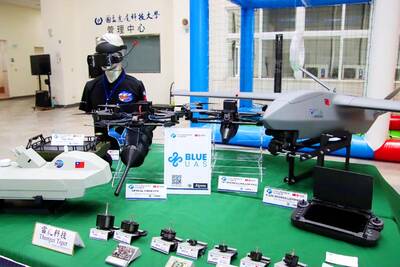
NON-RED SUPPLY: Boosting the nation’s drone industry is becoming increasingly urgent as China’s UAV dominance could become an issue in a crisis, an analyst said Taiwan’s drone exports to Europe grew 41.7-fold from 2024 to last year, with demand from Ukraine’s fight against Russian aggression the most likely driver of growth, a study showed. The Institute for Democracy, Society and Emerging Technology (DSET) in a statement on Wednesday said it found that many of Taiwan’s uncrewed aerial vehicle (UAV) sales were from Poland and the Czech Republic. These countries likely transferred the drones to Ukraine to aid it in its fight against the Russian invasion that started in 2022, it said. Despite the gains, Taiwan is not the dominant drone exporter to these markets, ranking second and fourth


 RSS
RSS