


Labor and civic groups yesterday called on the Ministry of Labor to scrap clauses on reviewing standards for foreign workers that relax restrictions on hiring blue-collar migrant workers, saying that with such clauses the government is allowing employers to exploit foreign workers and deprive local workers of job opportunities.
Since the amendment of the Reviewing Standards and Employment Qualifications for Foreigners Engaging in the Jobs Specified in Items 8 to 11, Paragraph 1 to Article 46 of the Employment Service Act (外國人從事就業服務法第四十六條第一項第八款至第十一款工作資格及審查標準) was passed by executive order in March last year, the total number of foreign workers in the manufacturing industries has surged from 233,000 in April last year to 283,000 in May, the Taiwan Labour Front (TLF) said.
The revisions made to the reviewing standards for blue-collar foreign workers have lowered the threshold for employers to hire migrant workers under the guise of encouraging overseas Taiwanese businesspeople to return or any enterprises to increase their investments, the groups protesting outside the ministry building said.
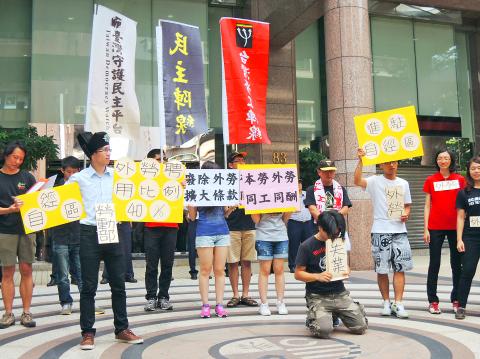
Photo: Huang Pang-ping, Taipei Times
The government has become the enterprises’ lackey, fulfilling every demand requested by the “insatiable capitalists,” TLF secretary-general Son Yu-liam (孫友聯) said.
“We are calling for both the abrogation of the employer-favoring clauses that allow larger quotas — 40 percent at maximum — of lower-paid foreigners on their payroll, and the implementation of a policy that ensures the blue-collar foreign workers’ rights of ‘equal pay for equal work,’” Son added.
While the government has constantly insisted, and did so again yesterday, that the free economic pilot zones special statute says nothing about the relaxations and accused the groups of “deliberately conflating the two,” the groups said the government is guilty of equivocation.
“The amendments have been aimed for the project of the free economic pilot zones, which, despite being touted for its potential to attract top-notch service industries, would have manufacturers coming in as well,” Democratic Front Against Cross-strait Trade in Services Agreement convener Lai Chung-chiang (賴中強) said, citing recent heatedly debated agricultural products processing businesses as an example.
Lai added that the “First Stage Plan of the free economic pilot zones” announced by the Executive Yuan explicitly includes the development of the free-trade port areas, to which various manufacturing enterprises plan to move.
“Together with the Ministry of Labor’s recent positive response to the capitalists’ demand to increase the maximum ratio of dispatch workers allowed in a company, the future of the free economic pilot zones is nothing but a pilot zone abounding with cheap labor from migrant workers and dispatched employees,” TLF Research Center director Hung Ching-shu (洪敬舒) said.
The groups are calling for the removal of the clauses granting the enterprises the right to hire more migrant workers before a review of the pilot zones special statute in the legislature.

The Centers for Disease Control (CDC) yesterday reported the first case of a new COVID-19 subvariant — BA.3.2 — in a 10-year-old Singaporean girl who had a fever upon arrival in Taiwan and tested positive for the disease. The girl left Taiwan on March 20 and the case did not have a direct impact on the local community, it said. The WHO added the BA.3.2 strain to its list of Variants Under Monitoring in December last year, but this was the first imported case of the COVID-19 variant in Taiwan, CDC Deputy Director-General Lin Ming-cheng (林明誠) said. The girl arrived in Taiwan on

South Korea is planning to revise its controversial electronic arrival card, a step Taiwanese officials said prompted them to hold off on planned retaliatory measures, a South Korean media report said yesterday. A Yonhap News Agency report said that the South Korean Ministry of Foreign Affairs is planning to remove the “previous departure place” and “next destination” fields from its e-arrival card system. The plan, reached after interagency consultations, is under review and aims to simplify entry procedures and align the electronic form with the paper version, a South Korean ministry official said. The fields — which appeared only on the electronic form

The Ministry of Foreign Affairs (MOFA) is suspending retaliation measures against South Korea that were set to take effect tomorrow, after Seoul said it is updating its e-arrival system, MOFA said today. The measures were to be a new round of retaliation after Taiwan on March 1 changed South Korea's designation on government-issued alien resident certificates held by South Korean nationals to "South Korea” from the "Republic of Korea," the country’s official name. The move came after months of protests to Seoul over its listing of Taiwan as "China (Taiwan)" in dropdown menus on its new online immigration entry system. MOFA last week
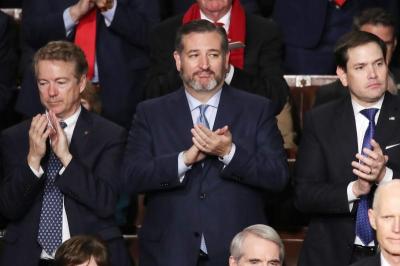
A bipartisan group of US senators has introduced a bill to enhance cooperation with Taiwan on drone development and to reduce reliance on supply chains linked to China. The proposed Blue Skies for Taiwan Act of 2026 was introduced by Republican US senators Ted Cruz and John Curtis, and Democratic US senators Jeff Merkley and Andy Kim. The legislation seeks to ease constraints on Taiwan-US cooperation in uncrewed aerial systems (UAS), including dependence on China-sourced components, limited access to capital and regulatory barriers under US export controls, a news release issued by Cruz on Wednesday said. The bill would establish a "Blue UAS


 RSS
RSS