


The so-called “inspection visits” made by National Security Council (NSC) Secretary-General King Pu-tsung (金溥聰) to other intelligence units not only lack legal backing, but also infringed on jurisdictional authority of the National Security Bureau (NSB) and may cause unforeseen results for national security in the future, former bureau director Ting Yu-chou (丁渝洲) said yesterday.
On June 6, King visited the National Police Agency (NPA) to sit in on the presentation of a report, after a visit on June 4 to the Ministry of Justice’s Investigation Bureau, prompting criticism from opposition legislators, as well as some Chinese Nationalist Party (KMT) lawmakers, who said the act was an overreach of authority.
President Ma Ying-jeou (馬英九) on Thursday last week defended King, saying “how could he [King] be my chief of staff [if he had not visited the agencies]? I would have thought that he had failed in his duty had he not done so.”
Ting said Ma demonstrated a lack consideration for adversity over the past six years, adding that he placed too much emphasis on opportunities to be had, but failed to realize the possible risks involved.
“This has directly led to the chaos in our society and the strong public discontent against the government,” Ting said.
Of the three people who have headed the council in the Ma administration’s six years, only King visited other intelligence units after assuming the position, Ting said.
Ting said King’s disrespect for established systems and an inordinate amount of trust placed in only one person by Ma is a direct reason the president would be unable to foster authority in the intelligence community.
First-hand information on national matters is a necessity for the job, Ting said of Ma’s comment in support of King, adding however that the NSB’s job parameters already provided adequate information.
Article 2 of the Organization Act for the National Security Bureau (國家安全局組織法) states the parameters of the bureau’s functions, ie, the integration, leading, coordination and support of all intelligence efforts by the General Political Warfare Bureau, the Military Intelligence Bureau, the Electronic Information Development Office, the Military Safety Office, the Military Police Headquarters, the Coast Guard Administration, the NPA, the National Immigration Agency and the justice ministry’s Investigation Bureau.
The NSB provided regular and special reports, both in writing and in person, to the president, and also has in place a system to ensure the president receives the most up to date information on the nation’s status and takes appropriate countermeasures should they be called for even when he is abroad, Ting said.
“I do not know how this does not count as first-hand information,” Ting said.
Ting added that King’s actions did not have legal backing, pointing to the Organization Law of the National Security Council (國家安全會議組織法).
The act states that the council is primarily an advisory unit for the president to consult and Article 6 states that the duty of the council secretary-general is to conduct his business as per the council’s decisions and the command and oversight of his subordinates, Ting said, adding that nowhere has it mentioned that the secretary-general can assume command over units outside of the council.
The NSB is only concerned with the gathering of intelligence and should not be overseeing the actual handling of security of the nation, Ting said.
Ting said the council was tasked with helping the president make decisions, while the NSB helped gather the data needed to make those decisions.
“It has been a system where the two helped each other and not one where the jurisdictions overlap,” Ting said.
With the council intervention it seemed that the distinction between gathering of intelligence and enforcing security has been blurred, and the NSB and other intelligence agencies would be inclined to edge closer to the council, Ting said.
Ting said he did not know if the planned general surveillance over all intelligence units by the council was a keystone in the council’s development or the beginning of a bad habit, adding that there would be unforeseen consequences if it did become a habit.
The relationship between the council and other intelligence agencies is a delicate and sensitive matter that has far-ranging repercussions, Ting said, adding that Ma, as a student of law, should know the importance of obeying the law.
Ting said that his opposition was not based on support for any political party, adding that he is solely concerned for the jurisdiction of the council and the NSB.
Ting, who was appointed as the council’s secretary-general in August 2001 and served until March 2002 under then-president Chen Shui-bian’s (陳水扁) administration, said the controversy was a grave matter that would impact directly on the system of national security.
Saying that he hoped everyone could put aside their differences and consider the issue from the vantage point of a nation, he added that the sooner the issue is resolved, the better it will be for the nation and the intelligence and security agencies.

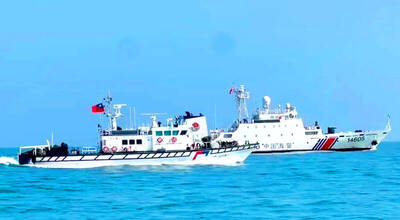
The military has spotted two Chinese warships operating in waters near Penghu County in the Taiwan Strait and sent its own naval and air forces to monitor the vessels, the Ministry of National Defense (MND) said. Beijing sends warships and warplanes into the waters and skies around Taiwan on an almost daily basis, drawing condemnation from Taipei. While the ministry offers daily updates on the locations of Chinese military aircraft, it only rarely gives details of where Chinese warships are operating, generally only when it detects aircraft carriers, as happened last week. A Chinese destroyer and a frigate entered waters to the southwest
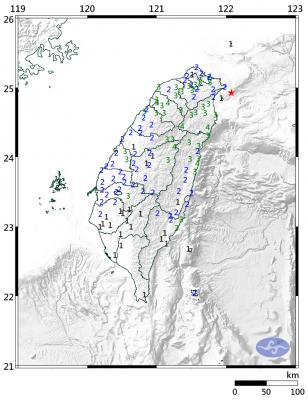
A magnitude 6.1 earthquake struck off the coast of Yilan County at 8:39pm tonight, the Central Weather Administration (CWA) said, with no immediate reports of damage or injuries. The epicenter was 38.7km east-northeast of Yilan County Hall at a focal depth of 98.3km, the CWA’s Seismological Center said. The quake’s maximum intensity, which gauges the actual physical effect of a seismic event, was a level 4 on Taiwan’s 7-tier intensity scale, the center said. That intensity level was recorded in Yilan County’s Nanao Township (南澳), Hsinchu County’s Guansi Township (關西), Nantou County’s Hehuanshan (合歡山) and Hualien County’s Yanliao (鹽寮). An intensity of 3 was
Instead of focusing solely on the threat of a full-scale military invasion, the US and its allies must prepare for a potential Chinese “quarantine” of Taiwan enforced through customs inspections, Stanford University Hoover fellow Eyck Freymann said in a Foreign Affairs article published on Wednesday. China could use various “gray zone” tactics in “reconfiguring the regional and ultimately the global economic order without a war,” said Freymann, who is also a nonresident research fellow at the US Naval War College. China might seize control of Taiwan’s links to the outside world by requiring all flights and ships entering or leaving Taiwan
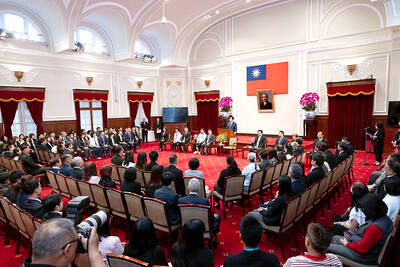
The next minimum wage hike is expected to exceed NT$30,000, President William Lai (賴清德) said yesterday during an award ceremony honoring “model workers,” including migrant workers, at the Presidential Office ahead of Workers’ Day today. Lai said he wished to thank the awardees on behalf of the nation and extend his most sincere respect for their hard work, on which Taiwan’s prosperity has been built. Lai specifically thanked 10 migrant workers selected for the award, saying that although they left their home countries to further their own goals, their efforts have benefited Taiwan as well. The nation’s industrial sector and small businesses lay


 RSS
RSS