


The government’s free economic pilot zones (FEPZs) project is an “empty” policy that showcases the fundamental error that President Ma Ying-jeou’s (馬英九) administration has made in its move to revive the nation’s economy, Democratic Progressive Party Chairperson Tsai Ing-wen (蔡英文) said yesterday in Greater Taichung.
“The FEPZ project could serve as a policy tool and a supplementary measure to stimulate the domestic economy, but it should be goal-oriented and selective,” Tsai said in her opening remarks at a party policy meeting aimed at discussing key agenda for the extra legislative session that begins on Friday.
In a nutshell, Tsai said the project, which aims to attract foreign — in particular Chinese — investments, lacks substance and is only focused on deregulation and further market opening.
The policy aims to set up free economic pilot zones in Keelung Port, Suao Port in Yilan County, Taipei Port, Taichung Port, Anping Port in Greater Tainan, Kaohsiung Port, the Taoyuan Aerotropolis in Taoyuan County and the Pingtung Agricultural Biotechnology Park to serve as models for business convenience and liberalization.
However, not only was the plan hastily drafted, but it would also invest a planned administrative authority with too much power — including environmental protection, labor affairs, construction, commercial registration, licensing, taxation and personnel — without regard for national security and its environmental impact, Tsai said.
Moreover, the planning for various sectors are questionable, Tsai said, adding that liberalizing Chinese agricultural imports would be a grave mistake.
“The DPP argues that the grand strategy for Taiwan’s economy should be promoting industrial upgrading and transformation, and developing several core industries with national resources, not encouraging the establishment of FEPZs across the country,” she said.
The DPP also reached a consensus on two issues on the first day of the two-day meeting, which brought together party officials and more than 20 lawmakers to discuss policies and a unified position for the extra legislative session.
On the reviews of nominees for the Control Yuan and Examination Yuan, DPP Secretary-General Joseph Wu (吳釗燮) said the party would try to resolve the issue on several fronts, including proposing an amendment to reduce the number of Examination Yuan members and a constitutional amendment to eliminate the two branches of government.
With regards to the monitoring mechanism for cross-strait agreements, Wu said the DPP would submit its own version to rival the Chinese Nationalist Party’s (KMT) and insist on a clause-by-clause screening.
The extra session could be “the toughest extra session in history” because the KMT might try to push through several major legislations and policies, DPP caucus whip Ker Chien-ming (柯建銘) said, adding that it might take more than two extra sessions to handle those agenda.
Mayors and commissioners of DPP-governed administrative zones or their deputies are expected to join the meeting today to discuss the cross-strait service trade agreement and the pilot zones — a pair of thorny yet important issues awaiting to be resolved in the legislature.
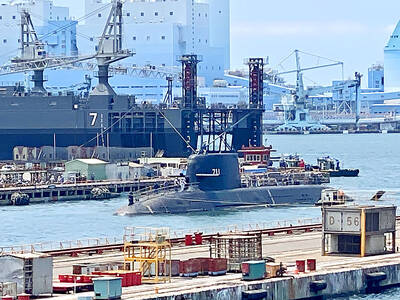
AGING: While Japan has 22 submarines, Taiwan only operates four, two of which were commissioned by the US in 1945 and 1946, and transferred to Taiwan in 1973 Taiwan would need at least 12 submarines to reach modern fleet capabilities, CSBC Corp, Taiwan chairman Chen Cheng-hung (陳政宏) said in an interview broadcast on Friday, citing a US assessment. CSBC is testing the nation’s first indigenous defense submarine, the Hai Kun (海鯤, Narwhal), which is scheduled to be delivered to the navy next month or in July. The Hai Kun has completed torpedo-firing tests and is scheduled to undergo overnight sea trials, Chen said on an SET TV military affairs program. Taiwan would require at least 12 submarines to establish a modern submarine force after assessing the nation’s operational environment and defense

A white king snake that frightened passengers and caused a stir on a Taipei MRT train on Friday evening has been claimed by its owner, who would be fined, Taipei Rapid Transit Corp (TRTC) said yesterday. A person on Threads posted that he thought he was lucky to find an empty row of seats on Friday after boarding a train on the Bannan (Blue) Line, only to spot a white snake with black stripes after sitting down. Startled, he jumped up, he wrote, describing the encounter as “terrifying.” “Taipei’s rat control plan: Release snakes on the metro,” one person wrote in reply, referring
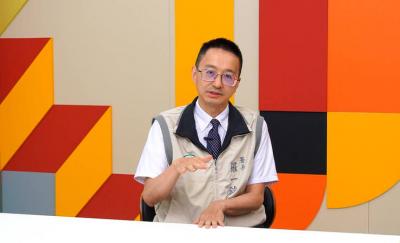
Taiwan’s two cases of hantavirus so far this year are on par with previous years’ case numbers, and the government is coordinating rat extermination work, so there should not be any outbreaks, Centers for Disease Control (CDC) Director-General Philip Lo (羅一鈞) said today in an interview with the Liberty Times (the Taipei Times’ sister newspaper). An increase in rat sightings in Taipei and New Taipei City has raised concerns about the spread of hantavirus, as rats can carry the disease. In January, a man in his 70s who lived in Taipei’s Daan District (大安) tested positive posthumously for hantavirus, Taiwan’s
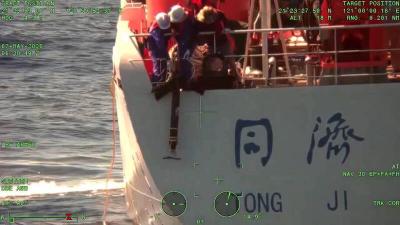
The coast guard today said that it had disrupted "illegal" operations by a Chinese research ship in waters close to the nation and driven it away, part of what Taipei sees a provocative pattern of China's stepped up maritime activities. The coast guard said that it on Thursday last week detected the Chinese ship Tongji (同濟號), which was commissioned only last year, 29 nautical miles (54km) southeast of the southern tip of Taiwan, although just outside restricted waters. The ship was observed lowering ropes into the water, suspected to be the deployment of scientific instruments for "illegal" survey operations, and the coast


 RSS
RSS