


Young Taiwanese voters have a “sense of hopelessness about the direction their country is taking,” a US congressional commission was told on Thursday.
There were also concerns that Taiwanese politics could become radicalized, US-Taiwan Business Council president Rupert Hammond-Chambers said.
Young voters were worried, he said, about the long-term viability of democratic institutions in which they have great pride.
These institutions, Hammond-Chambers said, are being threatened by “increasing and very heavy Chinese coercion.”
Addressing a hearing on recent developments in China’s relations with Taiwan — held on Capitol Hill by the US-China Economic and Security Review Commission, Hammond-Chambers said that Taiwan is an integral part of the US’ role in the Asia-Pacific region.
In his 20 years in Taiwan affairs this was the first time friends in Taiwan said they were “genuinely concerned about political violence” in the elections, he said.
Hammond-Chambers said that while the administration of President Ma Ying-jeou (馬英九) has achieved relative economic success in its dealings with China, it has failed to open substantial trade doors with other countries.
Taiwan needs to negotiate a Bilateral Investment Agreement (BIA) with the US as a bridge to gaining membership to the negotiations of the Trans-Pacific Partnership (TPP), Hammond-Chambers said.
He said he hopes the administration of US President Barack Obama will announce this summer that it had reached a consensus with Taiwan on launching a BIA and that over the next 12 to 18 months, negotiations can position Taiwan as a credible second-round TPP member.
However, Hammond-Chambers stressed that the US and Taiwan were experiencing the longest period since 1979 without brokering an arms deal.
“This is an unprecedented moment in the arms sales relationship,” he said.
The Obama administration has accepted one letter of request for significant military equipment since 2009, when it agreed to upgrade Taiwan’s existing fleet of F-16 jets.
Hammond-Chambers said China would “bank” this “time out” in the modernization of Taiwan’s military force and try to make it a new “status quo” and make it much more difficult to restart the arms sales process. At the same time, budgets would make it difficult for Taiwan to play “catch-up.”
He said the US-Taiwan relationship appeared to be running smoothly, but this was predicated on the notion that Taiwan asked for very little, which “we are happy to give them.”
“We are pocketing peace and security in the Taiwan Strait and putting the relationship on autopilot before peace and security in the Taiwan Strait has broken out,” Hammond-Chambers said.
He said there was a feeling in Taiwan that people had less and less control of their own fortunes.
University of Richmond professor Vincent Wei-cheng Wang (王維正) and Brookings Institution visiting fellow JoAnn Fan also participated on the cross-strait economic and political panel.
Wang said some analysts were asking whether the US should now be more concerned about Taiwan willingly joining China or being economically absorbed by China.
“Cross-strait relations have indeed entered uncharted waters,” Wang said.
He said Washington should closely monitor developments in cross-strait relations, and assess the risks and opportunities to US interests.
Fan said that US Congress should advise the White House to conduct a comprehensive policy review on Taiwan on a periodic basis.
“This year marks the 20th anniversary of the Taiwan Policy Review done under the [former US president Bill] Clinton administration in 1994,” she said. “The dynamics in the Taiwan Strait, as well as within Taiwan and its people, have evolved greatly over the past two decades. It is important to update and incorporate current trends in policy planning to ensure effectiveness going forward.”
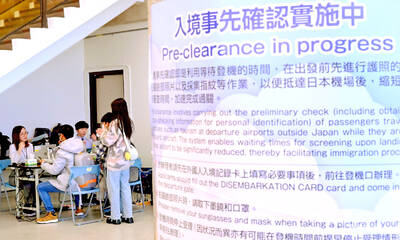
A preclearance service to facilitate entry for people traveling to select airports in Japan would be available from Thursday next week to Feb. 25 at Taiwan Taoyuan International Airport, Taoyuan International Airport Corp (TIAC) said on Tuesday. The service was first made available to Taiwanese travelers throughout the winter vacation of 2024 and during the Lunar New Year holiday. In addition to flights to the Japanese cities of Hakodate, Asahikawa, Akita, Sendai, Niigata, Okayama, Takamatsu, Kumamoto and Kagoshima, the service would be available to travelers to Kobe and Oita. The service can be accessed by passengers of 15 flight routes operated by

Chinese spouse and influencer Guan Guan’s (關關) residency permit has been revoked for repeatedly posting pro-China videos that threaten national security, the National Immigration Agency confirmed today. Guan Guan has said many controversial statements in her videos posted to Douyin (抖音), including “the red flag will soon be painted all over Taiwan” and “Taiwan is an inseparable part of China,” and expressing hope for expedited reunification. The agency last year received multiple reports alleging that Guan Guan had advocated for armed reunification. After verifying the reports, the agency last month issued a notice requiring her to appear and explain her actions. Guan

GIVE AND TAKE: Blood demand continues to rise each year, while fewer young donors are available due to the nation’s falling birthrate, a doctor said Blood donors can redeem points earned from donations to obtain limited edition Formosan black bear travel mugs, the Kaohsiung Blood Center said yesterday, as it announced a goal of stocking 20,000 units of blood prior to the Lunar New Year. The last month of the lunar year is National Blood Donation Month, when local centers seek to stockpile blood for use during the Lunar New Year holiday. The blood demand in southern Taiwan — including Tainan and Kaohsiung, as well as Chiayi, Pingtung, Penghu and Taitung counties — is about 2,000 units per day, the center said. The donation campaign aims to boost
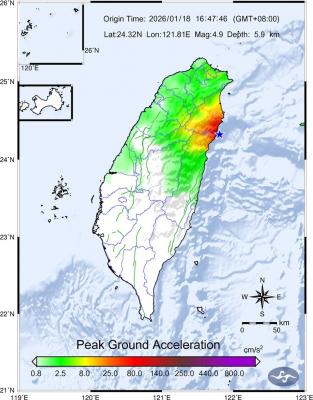
The Central Weather Administration (CWA) said a magnitude 4.9 earthquake that struck off the coast of eastern Taiwan yesterday was an independent event and part of a stress-adjustment process. The earthquake occurred at 4:47pm, with its epicenter at sea about 45.4km south of Yilan County Hall at a depth of 5.9km, the CWA said. The quake's intensity, which gauges the actual effects of a temblor, was highest in several townships in Yilan and neighboring Hualien County, where it measured 4 on Taiwan's seven-tier intensity scale, the CWA said. Lin Po-yu (林柏佑), a division chief at the CWA's Seismological Center, told a news conference


 RSS
RSS