


Children with attention deficit hyperactivity disorder (ADHD) are often branded “trouble-makers,” and their behavior leads parents or teachers to use harsh language or physical punishment in disciplining them, experts have said.
However, child psychiatrists warn against that approach, saying that ADHD is a psychiatric disorder that has to be dealt with in accordance with each child’s unique needs and personality.
“A delay in the development of the prefrontal cortex is often observed in children with ADHD, which is why it takes a longer time for these kids to learn to make plans, override their impulsive urges and handle things rationally,” Taiwanese Society of Child and Adolescent Psychiatry director-general Chang Hsueh-tsen (張學岑) said.
Chang said that the condition could render them susceptible to unfair and improper treatment from their peers, depending on the severity of their symptoms.
“Young patients with mild ADHD symptoms are generally more accepted by society and may only require behavioral therapies. On the other hand, those whose symptoms are more visible often require both behavioral and medical treatments to make their conduct more socially acceptable,” Chang said.
Chang divides the parents of ADHD children into four types: the “hermit crab,” who is reluctant to accept their children’s diagnosis; the “octopus,” who is keen on exploring unorthodox methods to cure their children; the “seahorse,” who looks after their children around-the-clock; and the “shark,” who keeps a strict hand over their children.
The mother of a young man with ADHD, who requested anonymity, acknowledged that she used to be a “shark parent.”
“My son started exhibiting ADHD symptoms in kindergarten. Whenever I went to pick him up, I was cornered by other parents who accused my son of pushing or hitting their kids,” she said.
“I was so mortified that I later decided to pick up my son after his classmates all left with their parents,” she added.
She tried softer approaches to deal with her son’s condition, such as teaching him meditation.
“To my astonishment, meditation did not calm my son, but rather made him more hyperactive. I had no choice but to take a more rigorous approach, which included me hitting my son 100 times each time he used foul language,” the mother said.
“Even to this day, my son, who is now a senior-high school student, still complains to me about my parenting style,” she said.
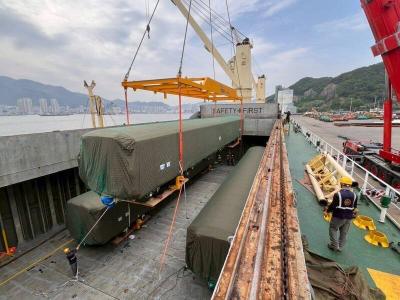
The first of 10 new high-capacity trains purchased from South Korea’s Hyundai Rotem arrived at the Port of Taipei yesterday to meet the demands of an expanding metro network, Taipei Rapid Transit Corp (TRTC) said yesterday. The train completed a three-day, 1,200km voyage from the Port of Masan in South Korea, the company said. Costing NT$590 million (US$18.79 million) each, the new six-carriage trains feature a redesigned interior based on "human-centric" transportation concepts, TRTC said. The design utilizes continuous longitudinal seating to widen the aisles and optimize passenger flow, while also upgrading passenger information displays and driving control systems for a more comfortable
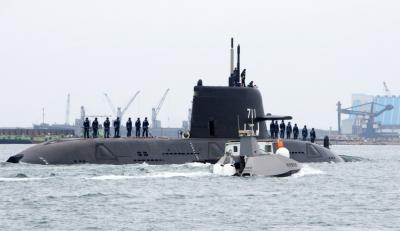
Taiwan's first indigenous defense submarine, the SS-711 Hai Kun (海鯤, or Narwhal), departed for its 13th sea trial at 7am today, marking its seventh submerged test, with delivery to the navy scheduled for July. The outing also marked its first sea deployment since President William Lai (賴清德) boarded the submarine for an inspection on March 19, drawing a crowd of military enthusiasts who gathered to show support. The submarine this morning departed port accompanied by CSBC Corp’s Endeavor Manta (奮進魔鬼魚號) uncrewed surface vessel and a navy M109 assault boat. Amid public interest in key milestones such as torpedo-launching operations and overnight submerged trials,
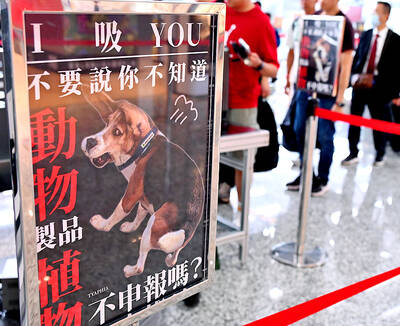
Quarantine awareness posters at Taiwan Taoyuan International Airport have gone viral for their use of wordplay. Issued by the airport branch of the Animal and Plant Health Inspection Agency, the posters feature sniffer dogs making a range of facial expressions, paired with advisory messages built around homophones. “We update the messages for holidays and campaign needs, periodically refreshing materials to attract people’s attention,” quarantine officials said. “The aim is to use the dogs’ appeal to draw focus to quarantine regulations.” A Japanese traveler visiting Taiwan has posted a photo on X of a poster showing a quarantine dog with a
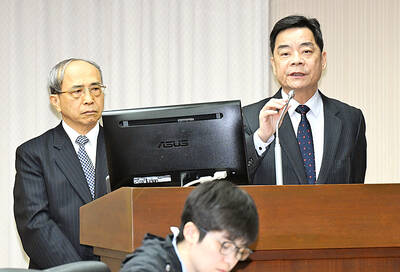
SECURITY RISK: A university student sent a general alarm signal to THSRC’s control center on April 5, causing four operating trains to temporarily halt services The Ministry of Transportation and Communications yesterday pledged to submit a report on ways to harden the communication security of railway systems after a university student hacked into Taiwan High Speed Rail Corp’s (THSRC) radio communications system and disrupted operations of four high-speed rail trains last month. Investigation by the police and prosecutors found that the university student and radio enthusiast, surnamed Lin (林), first used a software-defined radio (SDR) filter to analyze THSRC signals, downloaded the data to a computer, cracked the parameters and then programmed the codes into his radio devices. Lin then sent a general alarm signal to


 RSS
RSS