


The skills gap between graduates and the job market has reached an alarming level, according to a recent survey released by National Taiwan University’s (NTU) Center for Public Policy and Law, with three out of seven college graduates encountering difficulties landing a job that matches their education.
The poll shows that while nearly 70 percent of young people are enrolled in universities, only 40 percent of the available jobs need a higher degree.
Lee Yan-yi (李彥儀), director of the Ministry of Education’s Department of Technological and Vocational Education, said there is a skills gap, but attributed it to “non-educational” factors.
“Taiwan’s economy is heavily reliant on original equipment manufacturers and small and medium-sized enterprises [SMEs],” Lee said. “Rapid changes in the market mean that many young job seekers often face very different job prospects after they complete six years of education in pursuit of a college diploma and a postgraduate degree.”
In an effort to bridge the gap, Lee said the education ministry, the Ministry of Labor and the Ministry of Economic Affairs have joined hands to establish an interministerial communication platform for their deputies.
“The Ministry of Education has also submitted a draft bill called the Technical and Vocational Education Law (技術及職業教育法) to the Executive Yuan for review. It seeks to include career exploration courses into the elementary-school curriculum and offer occupational preparation training to senior-high school and university students,” Lee said.
“We intend to assist the younger generation in expanding its expertise and developing more practical skills,” she added.
NTU Institute of Applied Mechanics professor Wang Li-sheng (王立昇) said the nation is facing a shortage of manual workers and operators, as SMEs make up nearly 90 percent of all businesses, but most college graduates are reluctant to take this kind of job.
“Take the manufacturing and service industries as an example, less than 40 percent of the job vacancies in these industries require a college degree,” Wang said.
“I believe the biggest problem with our education system is the overemphasis on academic qualifications and credentials,” he said.
Machine tool manufacturer Hiwin Technologies Corp chairman Eric Chuo (卓永財) said the gap was a result of a lack of practical training courses offered by universities.
“It has led to an increase in the number of students who, despite being a mechanics major, have never touched an actual motor in their lives,” Chuo said.
Lai Shu-li (賴樹立), deputy director of the labor ministry’s Workforce Development Agency, said the widening gap could be seen in the ages of participants in the ministry’s vocational training programs.
“Most of the participants in the past were middle-aged people, but over the past three years, 90 percent of them were young adults,” Lai said.
Yang Tsung-pin (楊宗斌), deputy director of online job bank yes123’s public relations department, said universities had mushroomed over the past decade, which had depreciated the value of a university diploma and further worsened the skills gap.
“Our past surveys show that most employers place more emphasis on the job seekers’ employable skills rather than their education level,” Yang said, urging students to work to develop multiple job-related skill sets and obtain as many skill certificates as possible to increase their chances of finding employment.

The Ministry of Finance this afternoon announced the winning numbers for the March-April uniform invoice lottery. The winning number for the NT$10 million (US$318,060) special prize is 19531471, and the winning number for the NT$2 million grand prize is 85941329. Three numbers were drawn for the NT$200,000 first prize: 07225810, 20231230 and 83518781. Those with receipts matching the last seven digits of any of the first-prize numbers will win the NT$40,000 second prize, while those matching the last six digits will win the NT$10,000 third prize. Those whose receipts match the last five digits of the first-prize numbers can claim the NT$4,000 fourth prize,

NATIONAL SECURITY: Authorities are working to confirm the identities of the military personnel involved and investigating possible illegal conduct and regulatory violations Authorities are probing possible national security implications after Kinmen police and immigration officers on Sunday found a Chinese woman allegedly posing as a tourist while engaging in prostitution involving more than 10 military personnel. The woman, surnamed Chen (陳), has since been deported, authorities said, adding that investigators are still working to confirm the identities of those implicated, as the records only listed code names and aliases. The case stemmed from a report received by the Kinmen District Prosecutors’ Office on Friday last week from the Jinhu Precinct of the Kinmen County Police Bureau. On Sunday, police, along with the National Immigration

SIX SUBSIDIES: The monthly allowance for older farmers is to increase to NT$10,000, and NT$5,000 is to be given to homemakers under the national pension system, Lai said The government is to implement major welfare policies for disadvantaged groups, including raising the monthly allowance for older farmers to NT$10,000 and providing homemakers with NT$5,000 per month, President William Lai (賴清德) said yesterday. Lai made the remarks during a visit to Wangling Temple in Chiayi County, saying that the planned increases were being introduced amid economic growth and an increase in tax revenue. Touting a policy, in which the government plans to provide a monthly allowance of NT$5,000 for every child under the age of 18 in a bid to address Taiwan’s low birthrate, Lai said that if received for the
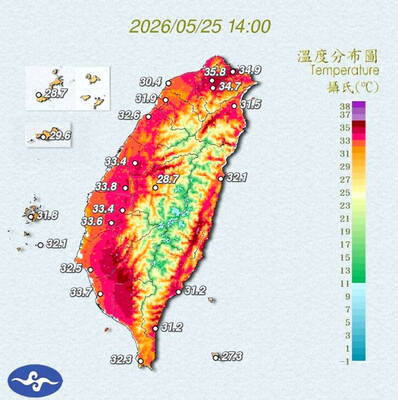
STAY COOL: The HPA recommended that people stay hydrated, use air-conditioning or fans while indoors, wear loose-fitting clothes and walk in the shade while outdoors Employers must implement measures such as installing cooling equipment, and providing drinking water and rest breaks for outdoor workers starting from Monday next week, the Taipei Department of Labor said on Sunday. Employers who fail to comply could face fines of NT$30,000 to NT$300,000 under the Occupational Safety and Health Act (職業安全衛生法), the department said. Businesses in Taipei employing fewer than 100 workers, as well as registered self-employed workers with labor insurance coverage, could receive on-site assessments and guidance from occupational safety consultants to help them apply for central government subsidies to implement or improve heat-protection measures, it said. Under the Ministry of


 RSS
RSS