


Democratic Progressive Party (DPP) Legislator Pasuya Yao (姚文智) has won the party’s first-stage primary for the Taipei mayoral election and will enter the second stage, in which he and independent hopefuls will compete for the final candidacy of the pan-green camp, the DPP said yesterday.
DPP Secretary-General Lin Hsi-yao (林錫耀) at a press conference yesterday morning announced Yao’s victory in a public opinion poll conducted by three institutions on Tuesday night, but did not release the poll results, citing a pre-survey agreement among the three contenders.
However, Yao’s office later released the final tally, which showed that Yao received an average support rate of 30.7 percent, beating lawyer Wellington Koo’s (顧立雄) 27.1 percent and Legislator Hsu Tain-tsair’s (許添財) 24.2 percent.
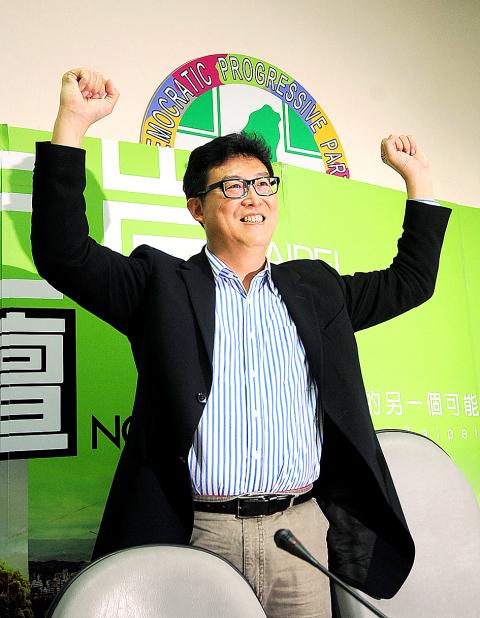
Photo: Fan Pin-chao, Taipei times
The survey, which pitted each contender against the Chinese Nationalist Party (KMT) candidate, former Taipei EasyCard Co chairman Sean Lien (連勝文), was the first part of a two-stage primary mechanism approved by the DPP.
Lien led every DPP hopeful in the three separate surveys — which collected 3,743 valid samples — with support rates from 38.5 percent to 41.7 percent.
For the second-stage primary, another public opinion poll to decide the final candidate is to be conducted before June 13 between Yao, National Taiwan University Hospital physician Ko Wen-je (柯文哲) — whose support rate has been leading all pan-green camp aspirants — and possibly Neil Peng (馮光遠), an award-winning screenwriter.
The DPP could organize debates between second-stage contenders before the public opinion poll is held, party spokesperson Lin Chun-hsien (林俊憲) said.
A three-member task force has established to handle the “integration talks” between Yao and Ko about a campaign platform, political values and follow-up cooperation after the primary is decided, Lin said.
The first-stage primary between DPP aspirants became a three-way race after former vice president Annette Lu (呂秀蓮) dropped out on Saturday.
After hearing the result, Yao said that he was surprised at how well he has done as an “underdog.”
Judging from past election results in Taipei, he has a chance at defeating the favored Lien as he is trailing by such a small margin with the election still six months away, Yao said.
“Again, I would have to say that the mayoral election in November will be a battle between the privileged class and ordinary citizens,” he said, referring to how he would campaign against Lien.
Koo, who finished second in the first-stage primary, said in a statement released yesterday that he pledged full support to Yao and would keep working for the people.

FUKUOKA SITUATION: Japanese media reported that the pathogen is expected to be identified by the summer, while the CDC downplayed the idea that it was hMPV A “mysterious cold-like illness” reported in Japan’s Fukuoka Prefecture does not seem to be a new disease, but Japanese authorities have been asked about the situation, the Centers for Disease Control (CDC) said yesterday. The Fukuoka Prefectural Medical Association on Wednesday told a news conference that a “mystery cold” that has become a hot topic on social media is “highly likely to be caused by some kind of viral infection,” Japan’s KBC News reported. “Many people are experiencing symptoms starting with a sore throat, followed by a runny nose, phlegm and a severe cough,” KBC News reported, citing association officials. Health authorities are

Nvidia Corp CEO Jensen Huang (黃仁勳) arrived in Taiwan yesterday ahead of upcoming AI and technology events, saying he plans to meet with clients and Taiwan Semiconductor Manufacturing Co Chairman C.C. Wei (魏哲家) during his visit. After landing at Taipei Songshan Airport, Huang posed for photos with fans and handed out Yakult drinks to reporters and supporters waiting at the scene, saying he has “a lot to do” during the trip. Asked about reports that Nvidia’s planned headquarters site in Taipei’s Beitou Shilin Technology Park could break ground on May 27, Huang said that if the company holds an event, he would

The Ministry of Finance this afternoon announced the winning numbers for the March-April uniform invoice lottery. The winning number for the NT$10 million (US$318,060) special prize is 19531471, and the winning number for the NT$2 million grand prize is 85941329. Three numbers were drawn for the NT$200,000 first prize: 07225810, 20231230 and 83518781. Those with receipts matching the last seven digits of any of the first-prize numbers will win the NT$40,000 second prize, while those matching the last six digits will win the NT$10,000 third prize. Those whose receipts match the last five digits of the first-prize numbers can claim the NT$4,000 fourth prize,
Former president Ma Ying-jeou (馬英九) yesterday expressed “shock and regret” over a statement issued by his wife without his consent, and rejected her assertion that his eldest sister, Ma Yi-nan (馬以南), would manage his medical care or act as his spokesperson amid an ongoing embezzlement probe into his foundation. Ma Ying-jeou in a statement said he was shocked by a statement by his wife, Chou Mei-ching (周美青), regarding his affairs. Ma Yi-nan “must not” be in charge of his healthcare and other personal affairs, nor can she be allowed to represent the Ma family, the former president said. He said he was also


 RSS
RSS