


The elegant works of porcelain design artist Lili Yang (楊莉莉) grace mural walls at Taiwan Taoyuan International Airport and at Yingge’s (鶯歌) Creative Culture Park, while her signature design Blue Butterflies Dancing Among Flowers adorn state banquet dinnerware.
Her works are also on display at the Pingtung Winery.
Yang, known as the Queen of Porcelain Art, is one of the few porcelain design artists in the country who has received international acclaim.
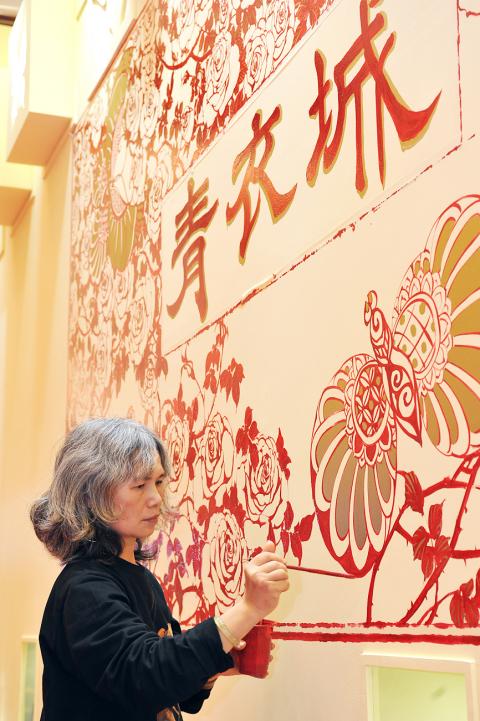
Photo provided by Lily Yang’s Blue Porcelain Studio
Recently, she was commissioned to create a showpiece mural at Hong Kong’s Maritime Square shopping complex.
Yang came from an impoverished background and did not receive a higher education, yet she has earned a top-notch reputation after overcoming difficulties throughout her life.
Born in Taipei, she gave up pursuing education after high school, when her father passed away.
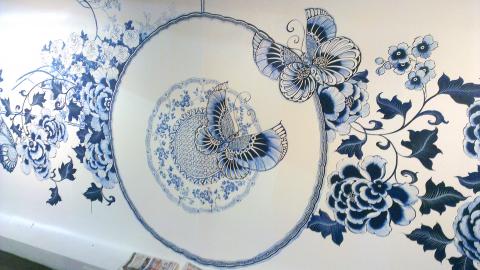
Photo provided by Lily Yang’s Blue Porcelain Studio
The family’s economic burden fell on Yang’s shoulders, and at the age of 19 she entered the job market.
She began at the China Pottery and Porcelain Arts Co, which was near her home, beginning as an apprentice.
Here she learned to copy patterns and designs from master craftsmen to decorate the Blue-White Porcelain product lines at the company’s factory.
For eight months, she learned the techniques and skills required to paint designs on porcelain.
Afterward, she became an understudy to master painter Yu Chung-lin (喻仲林), who was famous for works using birds and flowers in the classic Chinese style.
At that time, Yang also prepared to publish a collection of her paintings.
“When you master a craft, it becomes yours. Others cannot steal it from you,” she said.
At 20, she went to work at a colored-paper factory, where her design and art compositions have been put to good use.
In the next five years, Yang became a promising star in the art world as her drawings of birds, flowers and natural scenes won awards at painting competitions in Taipei, Kaohsiung and at other big national events.
Her rising fame was capped off with a solo exhibition, at the age of 25, organized by a leading art gallery.
At the age of 38, she had presented a dozen solo exhibitions at major art institutions, including the National Taiwan Museum of Fine Arts in Greater Taichung.
However, that year was a turning point for Yang, as her marriage broke down in divorce.
Yang said the divorce left her with very little in her possession. Thus she decided to start her life anew, by relocating to Yingge, where she got a job at Tai-Hwa Pottery Co.
In Yingge, she began by decorating ceramics for other artists.
Yang moved in a new direction by completely abandoning bird and flower paintings, on which her earlier fame was based.
She revisited the Blue-White Porcelain style from her days as a 19-year-old apprentice, and used it to develop her own series of porcelain works called Chubby Dolls.
Chubby Dolls was initially met with derision by the art world, as critics likened her new design to children with Down’s syndrome.
Yet as galleries presented Yang’s solo exhibition of Chubby Dolls, she gained good reviews.
From that point on, Yang cemented her reputation as the Queen of Porcelain Art in Taiwan.
Chen Chun-lan (陳春蘭), director of the Yingge Ceramics Museum in New Taipei City, said Yang does not merely combine painting with porcelain art, but also has the ability to place art in people’s everyday life.
“Even with sundry day-to-day items, like staplers and coasters, Yang’s unique style of design shows through,” Chen said.
He added that Yang produces her own creative design, doing it through an independence of ideas and an originality that is all her own.
“Yang always insists on surpassing herself, by trying new things. This is one of the reasons that Yingge products continue to have a presence on the international stage,” Chen said.
Yang said she thinks it is unlikely that the past glory of Yingge, as the leading artisan town in Taiwan with large-scale production of pottery and ceramics for export, will return.
“For the future of Yingge, there are only two possible outcomes: a town for story-telling, or a decline into the sunset,” she said.
Yang offered some encouragement to younger generations.
“The life of an artist is simplistic compared with the lives of other people. Young artists must think outside of the box, and not be confined by school education,” she said.
“If they are willing to make new creative works by incorporating art media and elements from different fields, then young artists can survive in the market and still retain their self-worth,” she added.
Yang added that she is opposed to the government’s rush to implement the cross-strait service trade agreement.
“If the pact is approved, Chinese businesses can set up their factories and showrooms in Taipei and Taoyuan. Then visitors do not need to come to Yingge and artisans will not ply their trade here,” she said.
“However, we can link up Yingge’s pottery and ceramics production chain. We can set up workshops and showcase factories for people to experience the process from clay molding to firing in the kiln and delivery to customers’ homes,” Yang said.
“This way, story-telling about Yingge can continue, but be upgraded to new levels and sustained into the future,” she added.

FUKUOKA SITUATION: Japanese media reported that the pathogen is expected to be identified by the summer, while the CDC downplayed the idea that it was hMPV A “mysterious cold-like illness” reported in Japan’s Fukuoka Prefecture does not seem to be a new disease, but Japanese authorities have been asked about the situation, the Centers for Disease Control (CDC) said yesterday. The Fukuoka Prefectural Medical Association on Wednesday told a news conference that a “mystery cold” that has become a hot topic on social media is “highly likely to be caused by some kind of viral infection,” Japan’s KBC News reported. “Many people are experiencing symptoms starting with a sore throat, followed by a runny nose, phlegm and a severe cough,” KBC News reported, citing association officials. Health authorities are

Nvidia Corp CEO Jensen Huang (黃仁勳) arrived in Taiwan yesterday ahead of upcoming AI and technology events, saying he plans to meet with clients and Taiwan Semiconductor Manufacturing Co Chairman C.C. Wei (魏哲家) during his visit. After landing at Taipei Songshan Airport, Huang posed for photos with fans and handed out Yakult drinks to reporters and supporters waiting at the scene, saying he has “a lot to do” during the trip. Asked about reports that Nvidia’s planned headquarters site in Taipei’s Beitou Shilin Technology Park could break ground on May 27, Huang said that if the company holds an event, he would

The Ministry of Finance this afternoon announced the winning numbers for the March-April uniform invoice lottery. The winning number for the NT$10 million (US$318,060) special prize is 19531471, and the winning number for the NT$2 million grand prize is 85941329. Three numbers were drawn for the NT$200,000 first prize: 07225810, 20231230 and 83518781. Those with receipts matching the last seven digits of any of the first-prize numbers will win the NT$40,000 second prize, while those matching the last six digits will win the NT$10,000 third prize. Those whose receipts match the last five digits of the first-prize numbers can claim the NT$4,000 fourth prize,
Taiwan Travelogue (臺灣漫遊錄), which earlier this week became the first Taiwanese novel to win the International Booker Prize, is to be adapted into a television series through a Taiwan-Japan coproduction, producer Chang Chen-yu (張辰漁) said yesterday. Chang, a producer at World Softest Production Film Co, wrote on Facebook that the company had been searching for projects with international appeal that retain a strong Taiwanese identity after colleagues and Japanese partners strongly recommended the novel. After reading the book, Chang said he immediately decided to pursue the screen rights. “A great story has the power to transcend time and borders, and connect countless people,”


 RSS
RSS