


Agricultural experts yesterday called for more governmental engagement in revitalization of the family farming model to save the nation’s agricultural sector from the threat of the free-trade system and the failure of past policies.
With the UN’s Food and Agriculture Organization (FAO) designating this year the International Year of Family Farming, experts told a forum organized by the New Century Foundation that although Taiwan is not a UN member, it should take note of the organization’s ideas and make changes.
“Contrary to what many believe, family farming — rather than US-style large-scale farming — is more suitable for Taiwan for many reasons, including food security and public values, not only because it is our traditional model. Most importantly, it could re-establish the agricultural sector as the nation’s foundation,” said Warren Kuo (郭華仁), a professor at National Taiwan University’s Department of Agronomy.
According to the organization, family farming “preserves traditional food products, while contributing to a balanced diet and safeguarding the world’s agro-biodiversity and the sustainable use of natural resources” and it is able to boost local economies and the well-being of communities.
The organization said it is trying to reposition family farming at the center of agricultural, environmental and social policies in national agendas by identifying gaps and opportunities this year.
Family farming in Taiwan has been in a downward spiral after land reforms in 1953 as farmers went through a series of challenges, such as the impact of US aid, which included agricultural products, a decrease in the number of farmers due to urbanization and industrialization, fallow-land rules and, more recently, property developers and local governments converting farmland for other uses, Taiwan Rural Front secretary-general Frida Tsai (蔡培慧) said.
Between 15 and 18 percent of farming households in Taiwan — which once boasted strong agricultural product diversity, technology and production — are able to sustain their livelihood solely by income generated from agricultural activities, Tsai said, adding that farmland is decreasing by 4,000 hectares annually because of fallow-land rules and land-use conversion.
Products such as wheat, corn and soybean are almost no longer grown due to heavy dependence on imports, and the nation’s food self-sufficiency rate is a dismal 30 percent, one of the lowest among developed countries, she added.
As alarming as the situation is, the future appears to be more challenging as the nation pursues accession to the Trans-Pacific Partnership and has liberalized several agricultural sub-sectors in free economic pilot zones around the nation, which has mainly opened the market up to Chinese agricultural investors and services, experts said.
Jung Yi-ting (鍾怡婷), a professor at National Cheng Kung University, said it is time for Taiwan to promote the concept of food sovereignty, which is that people have the right to democratically determine how their own food and agricultural system works.
The German state of Bavaria could be a good example for Taiwan to follow, said Wu Chin-yi (吳勁毅), a National Dong Hwa University professor who studied in Germany for seven years.
The Bavarian government was determined as early as in the late 1970s that the state would thrive on its own family farming system instead of large-scale farming and it invested in infrastructure, training, supply and demand systems and data-mining and analysis, Wu said.
While the number of farmers in the state has dropped, following the global trend, farmland still accounts for 49 percent of Bavarian territory and its agricultural production remains strong, Wu said.
“Meanwhile, the state was also able to maintain its beautiful ‘family farming landscape,’ which has been Bavaria’s pride and what has brought millions of tourists to the state every year — another plus,” Wu said.

The Ministry of Finance this afternoon announced the winning numbers for the March-April uniform invoice lottery. The winning number for the NT$10 million (US$318,060) special prize is 19531471, and the winning number for the NT$2 million grand prize is 85941329. Three numbers were drawn for the NT$200,000 first prize: 07225810, 20231230 and 83518781. Those with receipts matching the last seven digits of any of the first-prize numbers will win the NT$40,000 second prize, while those matching the last six digits will win the NT$10,000 third prize. Those whose receipts match the last five digits of the first-prize numbers can claim the NT$4,000 fourth prize,

SIX SUBSIDIES: The monthly allowance for older farmers is to increase to NT$10,000, and NT$5,000 is to be given to homemakers under the national pension system, Lai said The government is to implement major welfare policies for disadvantaged groups, including raising the monthly allowance for older farmers to NT$10,000 and providing homemakers with NT$5,000 per month, President William Lai (賴清德) said yesterday. Lai made the remarks during a visit to Wangling Temple in Chiayi County, saying that the planned increases were being introduced amid economic growth and an increase in tax revenue. Touting a policy, in which the government plans to provide a monthly allowance of NT$5,000 for every child under the age of 18 in a bid to address Taiwan’s low birthrate, Lai said that if received for the
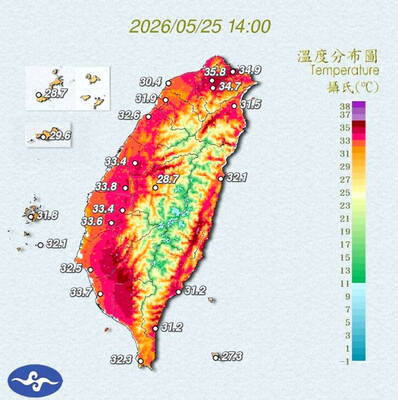
STAY COOL: The HPA recommended that people stay hydrated, use air-conditioning or fans while indoors, wear loose-fitting clothes and walk in the shade while outdoors Employers must implement measures such as installing cooling equipment, and providing drinking water and rest breaks for outdoor workers starting from Monday next week, the Taipei Department of Labor said on Sunday. Employers who fail to comply could face fines of NT$30,000 to NT$300,000 under the Occupational Safety and Health Act (職業安全衛生法), the department said. Businesses in Taipei employing fewer than 100 workers, as well as registered self-employed workers with labor insurance coverage, could receive on-site assessments and guidance from occupational safety consultants to help them apply for central government subsidies to implement or improve heat-protection measures, it said. Under the Ministry of

NATIONAL SECURITY: Authorities are working to confirm the identities of the military personnel involved and investigating possible illegal conduct and regulatory violations Authorities are probing possible national security implications after Kinmen police and immigration officers on Sunday found a Chinese woman allegedly posing as a tourist while engaging in prostitution involving more than 10 military personnel. The woman, surnamed Chen (陳), has since been deported, authorities said, adding that investigators are still working to confirm the identities of those implicated, as the records only listed code names and aliases. The case stemmed from a report received by the Kinmen District Prosecutors’ Office on Friday last week from the Jinhu Precinct of the Kinmen County Police Bureau. On Sunday, police, along with the National Immigration


 RSS
RSS