


Minister of Science and Technology Simon Chang (張善政) yesterday vowed that his newly formed ministry would make good use of the nation’s financial and human resources to serve as a catalyst for Taiwan’s technological development.
Chang made the remarks at the ministry’s inauguration ceremony, which was attended by President Ma Ying-jeou (馬英九), Vice Premier Mao Chi-kuo (毛治國) and Cyrus Chu (朱敬一), the former head of the ministry’s predecessor: the National Science Council.
Chang said he plans to continue the council’s policy of subsidizing academic programs and fostering collaboration between the technology and science industries and the education sector, but also pledged to have the ministry serve as a platform for assisting the technological development of other agencies.
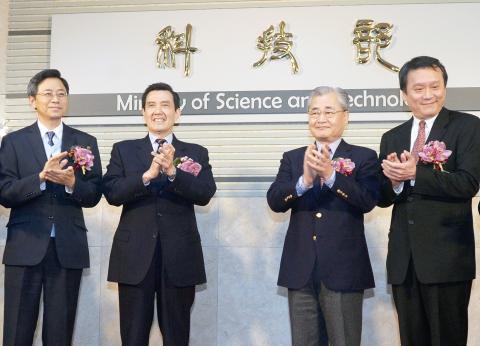
Photo: Wang Yi-sung, Taipei Times
“The ministry should serve as a foundation for the nation’s technological development, providing a platform for the reviewing of budgeting, expenditure and human resources for the benefit of other state agencies,” he said.
An academic research council is to be established to review and improve the subsidy mechanism under the leadership of Academia Sinica President Wong Chi-huey (翁啟惠), Chang added.
A university-industry collaboration promotion council will also be established, with National Taiwan University professor Lee Chih-kung (李世光) as its convener, that will aim to link research with the needs of related industries, he added.
The minister said he wants to focus on encouraging research and innovation, improving the linkages between the academic and industrial sectors, cultivating practical research talent, as well as on strengthening the application of technology in cultural and daily life.
At the ceremony, Chu said he wished to pass three features of the council on to Chang, with the first being that: “We never allowed ourselves to be lobbied or influenced by government officials or legislators. This is a good tradition that we hope the new minister can continue.”
The second feature Chu listed regarded basic and application research, with the last being balancing environmental protection with development at science parks.
A handover ceremony was also held at the Environmental Protection Administration (EPA) yesterday, with new EPA Minister Wei Kuo-yen (魏國彥) pledging to devote the expertise and experience that he has accumulated over the past 43 years to the nation.
“I grew up drinking Taiwan’s water, eating Taiwan’s rice, so I want to pay the nation back by devoting myself to mother Taiwan,” the former National Taiwan University geology professor said.
Wei said that the EPA’s establishment in 1987 marked a paradigm shift in national attitudes toward the relationship between humans and their environment, a shift that made sustainable development a national goal.
He vowed that under his stewardship, the environmental agency’s policies will be based on the principles of “thinking globally and acting locally.”
Wei said his first priority in his new role will be to complete the transformation of the EPA into the ministry of environment and natural resources.
The ceremony ended with a hug between Wei and his predecessor, Stephen Shen (沈世宏), who was bid farewell by more than 100 of his former staff as he head toward the nearest MRT station.

FUKUOKA SITUATION: Japanese media reported that the pathogen is expected to be identified by the summer, while the CDC downplayed the idea that it was hMPV A “mysterious cold-like illness” reported in Japan’s Fukuoka Prefecture does not seem to be a new disease, but Japanese authorities have been asked about the situation, the Centers for Disease Control (CDC) said yesterday. The Fukuoka Prefectural Medical Association on Wednesday told a news conference that a “mystery cold” that has become a hot topic on social media is “highly likely to be caused by some kind of viral infection,” Japan’s KBC News reported. “Many people are experiencing symptoms starting with a sore throat, followed by a runny nose, phlegm and a severe cough,” KBC News reported, citing association officials. Health authorities are

Nvidia Corp CEO Jensen Huang (黃仁勳) arrived in Taiwan yesterday ahead of upcoming AI and technology events, saying he plans to meet with clients and Taiwan Semiconductor Manufacturing Co Chairman C.C. Wei (魏哲家) during his visit. After landing at Taipei Songshan Airport, Huang posed for photos with fans and handed out Yakult drinks to reporters and supporters waiting at the scene, saying he has “a lot to do” during the trip. Asked about reports that Nvidia’s planned headquarters site in Taipei’s Beitou Shilin Technology Park could break ground on May 27, Huang said that if the company holds an event, he would

Carrefour Taiwan is to begin using a new name from the start of July, but it cannot divulge the name until then, the chairman of the supermarket chain's parent company said today. President Chain Store Co chairman Lo Chih-hsien (羅智先) was asked by reporters after a shareholders' meeting to confirm whether the company has settled on a new name for the supermarket brand. In March, the government-registered name of two Carrefour Taiwan branches was quietly changed to "Le Chia Kang" (樂家康) in Chinese, raising speculation that has been selected as the name. Lo said that because of local regulations and contractual obligations, the
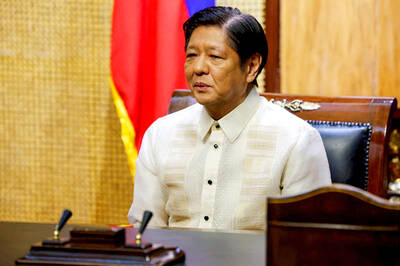
The Philippines would likely be involved in any conflict over Taiwan due to its proximity to the democracy claimed by China, President Ferdinand Marcos Jr said, reiterating a stance that risks angering Beijing. “In the Philippines, we do not have a choice because Taiwan is so close to the Philippines and we have almost 200,000 Filipino nationals living and working in Taiwan,” Marcos said in an interview with Japanese media in Manila on Monday. The Philippine leader’s comments come ahead of a state visit to Japan next week, where he is to meet with Japanese Prime Minister Sanae Takaichi to discuss security


 RSS
RSS