


Chinese President Xi Jinping (習近平) and other Chinese Communist Party leaders are concerned about what might happen if the Democratic Progressive Party (DPP) wins Taiwan’s 2016 presidential election, a leading US analyst said.
In a paper that might help calm Chinese fears, Alan Romberg, director of the Asia program at the Washington-based Stimson Center, said it is “fanciful” to think the DPP would move toward independence.
“In my judgement, the idea that moving to formal Taiwan independence could become a goal of a future DPP administration is fanciful,” Romberg said.
Taiwan experts in China “understand” it is not going to happen, he added.
What is not fanciful is that the DPP is unlikely to come up with a policy that is based on the “one China” framework, Romberg said.
Thus, if the DPP wins in 2016, Beijing would have to deal with “authorities who had not accepted the required framework for smooth cross-strait relations,” he said.
Romberg said that he “presumes” that China’s more urgent push for political dialogue with the administration of President Ma Ying-jeou (馬英九) is meant to lock in a relationship based on a “one China” framework that cannot be reversed.
It will be interesting to see how the DPP plans to gain the support of the crucial electoral center if it became clear that China will not accept the party’s current approach as a basis for advancing relations, he said.
Romberg’s latest paper, published by the Hoover Institution at Stanford University, said it is “doubtful” Beijing will ease off on its push for political dialogue.
Over the past few months, Xi may have gathered a clearer understanding of Taiwan’s political realities, he said.
However, Xi remains focused on achieving further development, including in the political realm, which “clearly continues to be high on his agenda,” Romberg said.
The Ma administration wants to maintain momentum in cross-strait relations and to make progress to the degree that it is possible, Romberg said.
However, public opinion must be taken into consideration in determining the pace of cross-strait exchanges and it is still too early to talk about political issues, he said.
Romberg says that both sides are interested in a Xi-Ma summit, but at this point their visions of the necessary conditions needed to pull it off remain “far apart.”
There has been speculation that in his new job as secretary-general of the National Security Council, outgoing Representative to the US King Pu-tsung (金溥聰) will focus on year-end local elections.
More likely, King will manage Taiwan’s entry into regional economic organizations and promote Taipei’s bilateral relationships, Romberg said.
“King’s responsibilities will also, however, relate importantly to advancing cross-strait relations, including the possibility of a Ma-Xi meeting,” Romberg said.

The Ministry of Finance this afternoon announced the winning numbers for the March-April uniform invoice lottery. The winning number for the NT$10 million (US$318,060) special prize is 19531471, and the winning number for the NT$2 million grand prize is 85941329. Three numbers were drawn for the NT$200,000 first prize: 07225810, 20231230 and 83518781. Those with receipts matching the last seven digits of any of the first-prize numbers will win the NT$40,000 second prize, while those matching the last six digits will win the NT$10,000 third prize. Those whose receipts match the last five digits of the first-prize numbers can claim the NT$4,000 fourth prize,

NATIONAL SECURITY: Authorities are working to confirm the identities of the military personnel involved and investigating possible illegal conduct and regulatory violations Authorities are probing possible national security implications after Kinmen police and immigration officers on Sunday found a Chinese woman allegedly posing as a tourist while engaging in prostitution involving more than 10 military personnel. The woman, surnamed Chen (陳), has since been deported, authorities said, adding that investigators are still working to confirm the identities of those implicated, as the records only listed code names and aliases. The case stemmed from a report received by the Kinmen District Prosecutors’ Office on Friday last week from the Jinhu Precinct of the Kinmen County Police Bureau. On Sunday, police, along with the National Immigration

SIX SUBSIDIES: The monthly allowance for older farmers is to increase to NT$10,000, and NT$5,000 is to be given to homemakers under the national pension system, Lai said The government is to implement major welfare policies for disadvantaged groups, including raising the monthly allowance for older farmers to NT$10,000 and providing homemakers with NT$5,000 per month, President William Lai (賴清德) said yesterday. Lai made the remarks during a visit to Wangling Temple in Chiayi County, saying that the planned increases were being introduced amid economic growth and an increase in tax revenue. Touting a policy, in which the government plans to provide a monthly allowance of NT$5,000 for every child under the age of 18 in a bid to address Taiwan’s low birthrate, Lai said that if received for the
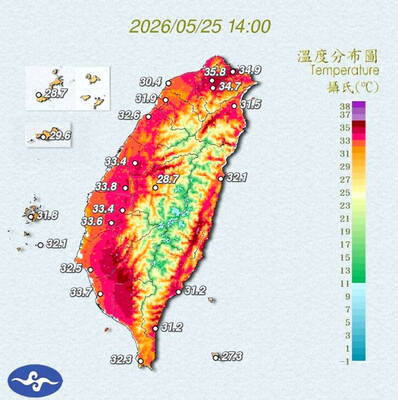
STAY COOL: The HPA recommended that people stay hydrated, use air-conditioning or fans while indoors, wear loose-fitting clothes and walk in the shade while outdoors Employers must implement measures such as installing cooling equipment, and providing drinking water and rest breaks for outdoor workers starting from Monday next week, the Taipei Department of Labor said on Sunday. Employers who fail to comply could face fines of NT$30,000 to NT$300,000 under the Occupational Safety and Health Act (職業安全衛生法), the department said. Businesses in Taipei employing fewer than 100 workers, as well as registered self-employed workers with labor insurance coverage, could receive on-site assessments and guidance from occupational safety consultants to help them apply for central government subsidies to implement or improve heat-protection measures, it said. Under the Ministry of


 RSS
RSS