


The government has staged a joint military-Coast Guard Administration (CGA) protection and rescue exercise in an area where China’s controversial air defense identification zone overlaps with those of Taiwan and Japan in the East China Sea.
The multipurpose drill on Monday last week was seen as an indication that Taiwan is pursuing its own national interests, despite China’s announcement in November last year of a new air defense identification zone that heightened tensions in the region.
The vessels and aircraft involved in the drill moved north toward the nation’s “provisional law enforcement boundary” 270 nautical miles (500km) off the northern tip of Taiwan.
They crossed the air defense identification zones of both China and Japan and moved toward China’s Chunxiao gas field, which is located within the enforcement boundary.
Two coast guard patrol vessels, the Hsin Bei and the Ho-shin, were joined by the navy’s Kang Ding frigate off Keelung and first headed toward Pengchia Islet, about 30 nautical miles away.
Once there, they conducted simulated firings of 20mm and 40mm guns.
They were then joined by an air force S-70C helicopter, which cooperated with the Hsin Bei in a drill simulating the rescue of people from the sea.
As the ships headed further north, they were joined by an S-2T marine patrol aircraft and two F-16 fighter jets, which flew over the Hsin Bei and Kang Ding at an altitude of 152m in an identification and communication drill.
When the vessels and the aircraft reached the northernmost line of the nation’s air defense identification zone, about 133 nautical miles north of Keelung, the Kang Ding and the Feng Yang — another navy frigate — remained to stand guard while the Hsin Bei and the Ho-shin continued north on a patrol mission to protect Taiwanese fishing boats operating nearby.
At 6am the next day, the two coast guard vessels were passing near the Chunxiao gas fields and approaching the 270 nautical mile boundary when they encountered a Japan Coast Guard patrol boat, the 1,000 tonne PL-120 Kurisaki.
There was a tense moment when the crew aboard the Japanese ship tried to observe the Ho-shin at a short distance, and the crew on the Ho-shin did the same to the Kurisaki, bringing the two vessels within 0.5 nautical miles of each other at 6:12am.
However, the Japan Coast Guard patrol boat then sailed off.
At 6:20am, the coast guard ships conducted a series of checks and patrols around wellheads in the Chunxiao gas field, drawing the attention of China’s Hai Yang Shi You 603 tug and supply ship.
The Chinese ship made radio contact with the Hsin Bei, which responded by explaining that the coast guard was carrying out its mission to protect its fishermen.
The Chinese tug did not try to gather information on the Hsin Bei, instead anchoring quite a distance away.
As the Taiwanese vessels began their voyage back to Taiwan on Tuesday last week, Japan sent several SH-60K choppers and P-3C surveillance aircraft to monitor the Hsin Bei and the Ho-shin at low altitude before flying away.
The two coast guard vessels were then escorted home by navy ships that had been on standby, returning to Keelung at 6am on Wednesday last week.

The Ministry of Finance this afternoon announced the winning numbers for the March-April uniform invoice lottery. The winning number for the NT$10 million (US$318,060) special prize is 19531471, and the winning number for the NT$2 million grand prize is 85941329. Three numbers were drawn for the NT$200,000 first prize: 07225810, 20231230 and 83518781. Those with receipts matching the last seven digits of any of the first-prize numbers will win the NT$40,000 second prize, while those matching the last six digits will win the NT$10,000 third prize. Those whose receipts match the last five digits of the first-prize numbers can claim the NT$4,000 fourth prize,

NATIONAL SECURITY: Authorities are working to confirm the identities of the military personnel involved and investigating possible illegal conduct and regulatory violations Authorities are probing possible national security implications after Kinmen police and immigration officers on Sunday found a Chinese woman allegedly posing as a tourist while engaging in prostitution involving more than 10 military personnel. The woman, surnamed Chen (陳), has since been deported, authorities said, adding that investigators are still working to confirm the identities of those implicated, as the records only listed code names and aliases. The case stemmed from a report received by the Kinmen District Prosecutors’ Office on Friday last week from the Jinhu Precinct of the Kinmen County Police Bureau. On Sunday, police, along with the National Immigration

SIX SUBSIDIES: The monthly allowance for older farmers is to increase to NT$10,000, and NT$5,000 is to be given to homemakers under the national pension system, Lai said The government is to implement major welfare policies for disadvantaged groups, including raising the monthly allowance for older farmers to NT$10,000 and providing homemakers with NT$5,000 per month, President William Lai (賴清德) said yesterday. Lai made the remarks during a visit to Wangling Temple in Chiayi County, saying that the planned increases were being introduced amid economic growth and an increase in tax revenue. Touting a policy, in which the government plans to provide a monthly allowance of NT$5,000 for every child under the age of 18 in a bid to address Taiwan’s low birthrate, Lai said that if received for the
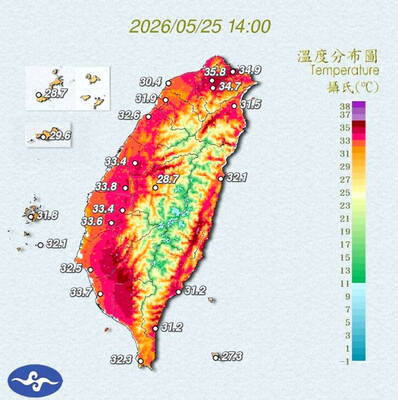
STAY COOL: The HPA recommended that people stay hydrated, use air-conditioning or fans while indoors, wear loose-fitting clothes and walk in the shade while outdoors Employers must implement measures such as installing cooling equipment, and providing drinking water and rest breaks for outdoor workers starting from Monday next week, the Taipei Department of Labor said on Sunday. Employers who fail to comply could face fines of NT$30,000 to NT$300,000 under the Occupational Safety and Health Act (職業安全衛生法), the department said. Businesses in Taipei employing fewer than 100 workers, as well as registered self-employed workers with labor insurance coverage, could receive on-site assessments and guidance from occupational safety consultants to help them apply for central government subsidies to implement or improve heat-protection measures, it said. Under the Ministry of


 RSS
RSS