


On Monday, Minister Without Portfolio Simon Chang (張善政) is to become the first head of the new ministry of science and technology, while National Taiwan University geology professor Wei Kuo-yen (魏國彥) is to assume the office of Environmental Protection Administration (EPA) minister, the Executive Yuan announced yesterday.
The ministry of science and technology will replace the National Science Council (NSC) on the same day, as part of the ongoing restructuring of the government.
Chang has a doctorate in civil engineering from Cornell University and worked as a civil engineering professor at National Taiwan University, in addition to serving as NSC director of planning and evaluation, vice president of the Acer e-Business group and regional director of hardware operations at Google.
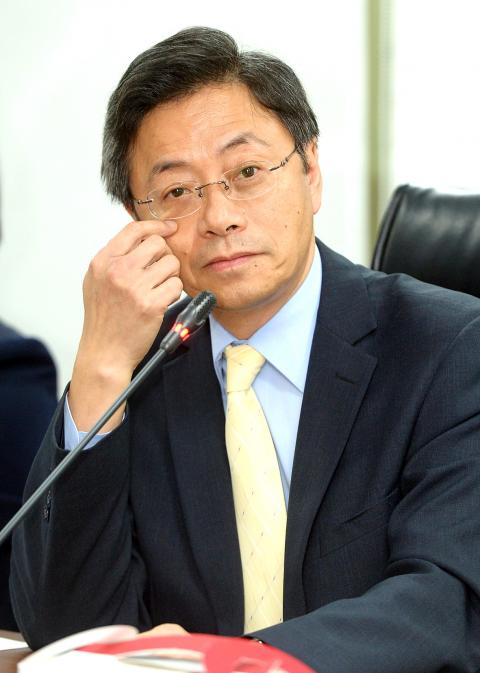
Photo: Wang Yi-sung, Taipei Times
At a press conference held yesterday to announce the Executive Yuan Board of Science and Technology’s Food Traceability in Cloud Project, Chang said no secret rivalry exists between him and NSC Minister Cyrus Chu (朱敬一), adding that he thinks Chu is very creative and interesting to work with.
Chang said that Premier Jiang Yi-huah (江宜樺) approached him late last year to ask if he would like to head the new ministry, but that he had turned down the offer.
“Recently, Jiang asked me to reconsider taking the post, saying that he and President Ma Ying-jeou (馬英九) wanted to know why I didn’t want the job so they could try to find a solution,” he said. “Jiang added that if I still didn’t accept the offer, Ma would speak with me personally, so I knew there was no way out and took the position.”
Chang said that although he “has complicated feelings about being science minister, because there are many challenges ahead,” he is confident he will be able to execute his duties well with the help of his deputy ministers.
The deputy ministers will be: NSC Vice Minister Lin Yi-ping (林一平), Office of Science and Technology Deputy Executive Secretary Chien Chung-liang (錢宗良) and Committee of Appeals chairman Chen Ter-shin (陳德新).
Chu said that after two years of “operating under high-density rotation gearing” at the council, he feels it is time to “take a break” and return to his previous position, and wished Chang all the best in his new role.
Meanwhile, EPA Minister Stephen Shen (沈世宏) said Jiang only informed him on Monday that he was to be replaced by Wei.
Wei holds a doctorate in Oceanography from the University of Rhode Island and worked most recently as a National Taiwan University professor and an adjunct senior researcher at Academia Sinica’s Institution of Earth Sciences.
He has also been an assistant professor at Yale University’s Department of Geology and Geophysics and served as deputy minister of the Executive Yuan’s Research, Development and Evaluation Commission.
Shen said that during the five years, nine months and 12 days that he has been in charge of the administration, he has always given 100 percent to the job, so he has no regrets about leaving.
He joked that perhaps his “talents have been used up by being the longest-serving EPA minister of all time” and that appointing a new person to lead the administration may benefit it and the country in general.
Wei said that the environmental agency has a long history, during which it has accumulated abundant experience and knowledge evidenced by its successes in air, water and soil protection. Given this, Wei said that the next logical step for the agency is to work on initiatives in geology, which is his area of expertise.
Wei also said that he hopes to help facilitate the EPA’s planned transformation into the ministry of environment and natural resources as soon as possible.
The reshuffle also saw National Security Council (NSC) Secretary-General John Deng (鄧振中) tapped to replace Schive Chi (薛琦) as the new minister without portfolio in charge of financial and economic matters.
During his time as vice minister of the Ministry of Economic Affairs, Deng dealt with affairs concerning domestic industry; commerce and trade; small and medium-sized businesses; investment; and state-owned corporations, making him ideal for his new position, the Executive Yuan said.
Deng said yesterday Jiang had told him to focus on regional economic integration and trying to get Taiwan into the Trans-Pacific Partnership and the Regional Comprehensive Economic Partnership.
The Executive Yuan also said that New Taipei City Deputy Mayor Lee Shu-chuan (李四川) would be succeeding Executive Yuan Secretary-General Chen Wei-zen (陳威仁).
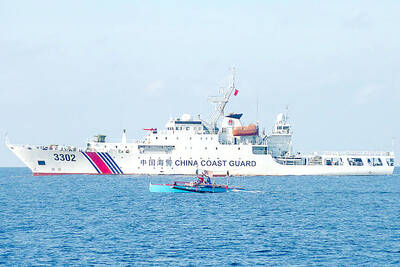
EXPANSIONIST: China deploys an average of 40 to 50 warships and coast guard vessels daily in the South China Sea, despite pledges not to militarize the region, an official said China is attempting to expand its influence across the First Island Chain and increase pressure on Japan by sending coast guard vessels into waters off of Taiwan under the pretext of maritime negotiations with Japan and the Philippines, a national security official said yesterday. China’s recent actions in the waters east of Taiwan and Japan and the Philippines’ exclusive economic zones (EEZ) are attempts to establish dominance in First Island Chain waters, said the official who declined to be named, adding that this is “expansion disguised as law enforcement.” Framing China’s actions solely as a cross-strait issue is a serious misjudgment that
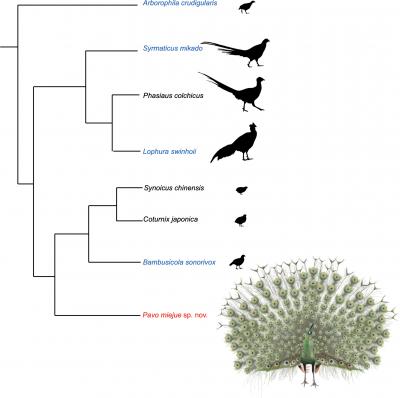
Through analyzing fossil evidence, a research team at National Taiwan University (NTU) discovered the largest endemic bird to have lived in Taiwan, naming it Pavo miejue, or extinct peafowl (滅絕孔雀). The Mikado pheasant, which is printed on the back of the NT$1,000 bank note, was previously believed to be the biggest endemic bird to Taiwan. The research team’s findings suggest that Pavo miejue lived during the Pleistocene epoch tens of thousands of years ago. It is the first endemic extinct bird species discovered and formally named in Taiwan. The study was coauthored by NTU Institute of Ecology and Evolutionary Biology professor Tsai Cheng-hsiu (蔡政修),
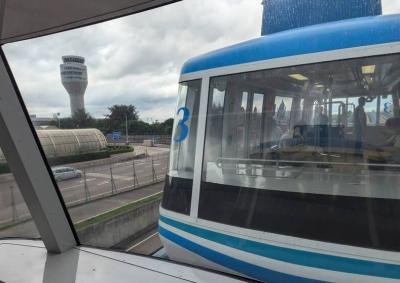
Taiwan Taoyuan International Airport is to suspend its automated Skytrain service connecting Terminal 1 and Terminal 2 starting on July 1 to facilitate connection works for the upcoming Terminal 3, the airport operator said today. Passengers and staff who need to travel between the two terminals after the suspension can instead use the Taoyuan MRT or the airport's 24-hour shuttle bus service, Taoyuan International Airport Corp said. The Taoyuan MRT Airport Line directly links the two terminals, while the shuttle buses are to operate around the clock, the company added. The Skytrain provides free transportation between the airport’s two terminals for travelers and
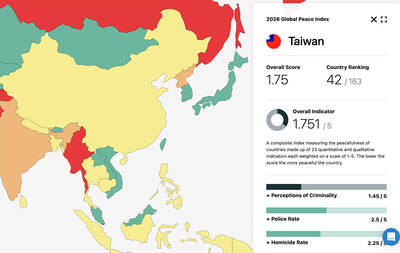
Taiwan ranked 42nd in terms of peacefulness among 163 countries, down five places from last year, according to this year’s Global Peace Index. With an overall score of 1.751, Taiwan dropped from 37th last year, the report published by the global Institute for Economics and Peace showed. The overall score measures a country’s level of peacefulness using 23 quantitative and qualitative indicators across three domains — ongoing domestic and international conflict, societal safety and security, and militarization. While Taiwan ranked 42nd worldwide, it was listed in ninth place among the 19 Asian-Pacific countries in the report, after New Zealand, Singapore, Japan, Malaysia,


 RSS
RSS