


Gao Yaojie (高耀潔), an exiled Chinese obstetrician who has dedicated herself to exposing the problem of HIV/AIDS caused by blood-selling in China, has published her fourth book on the health crisis and chose Taipei to hold the book launch yesterday.
Gao, who now lives in the US, first uncovered the problem of the so-called “plasma economy” and the tragedy it caused in China in the late 1990s.
During her investigation she found a large number of peasants from Henan Province were persuaded by local officials to sell their blood in the early 1980s.
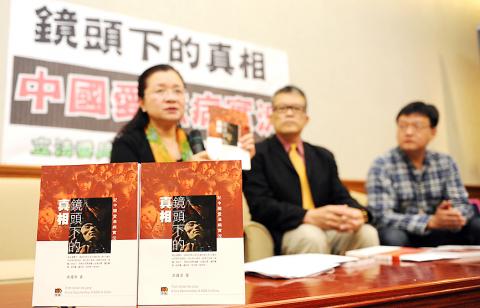
Photo: Liu Hsin-de, Taipei Times
Due to a poor blood handling process, many were infected with HIV.
She worked hard to help the victims whose illness was denied government recognition and care and to publicize the scandal, actions which caused her to be placed under government surveillance and eventually driven out of China in 2009.
Truth Under the Lens: A Live Documentary of AIDS in China is a collection of photos, depicting the HIV patients’ lives and sufferings and making a powerful statement about the Chinese government led by Chinese Premier Li Keqiang (李克強), who at the time of the “plasma economy” served as Henan Province Communist Party secretary.
“The book is a testimony to my 17 years of dedicated work recording China’s HIV/AIDS epidemic. Every photo deals with an AIDS patient’s blood and tears; every picture would pain people with a noble heart,” Gao said in a video recording.
At 85 and afflicted with illness, Gao could not be present in person.
“Not one official has been held accountable for the epidemic. All they do is try to cover up its spread. I’ve always abhorred this kind of deed,” she said.
Democratic Progressive Party Legislator Tien Chiu-chin (田秋堇) said the Chinese government’s persecution of Gao was intended as a warning to others who dare to show interests in probing the matter.
“Not only did the Chinese authorities fail to help the victims, it also oppressed those who offered support to them,” Tien said.
Hugh Lin (林郁修), the chief executive of Harmony Home Foundation Taiwan, an organization that helps set up shelters in China for abandoned HIV-positive children, said many of the children they work with are denied the opportunity to attend school.
He added that since helathcare in China is restricted by household registration rules, many from the countryside, where healthcare is generally less developed, have to pay high prices if they choose to seek medical attention in the cities.
While the Chinese government’s evasive attitude has been castigated, Adam Lee (李志德), the Mandarin correspondent of Radio Free Asia, expressed his concern over the self-censorship of the Taiwanese media that is becoming more evident in the past few years.
“Reports about China on issues considered as sensitive are diminishing. China’s political influence in Taiwanese media is palpable and getting more serious,” Lee said.
“It’s been said that Mainland Affairs Council Minister Wang Yu-chi (王郁琦) is meeting up with the Taiwan Affairs Office director early next year to discuss the mutual establishment of representative offices and permanent offices for news agencies. I hope that Wang does not rush into signing any agreement with China concerning the press,” he said, adding that since many foreign news outlets are also experiencing China’s suppression, “it is a good opportunity for us to forge an alliance against China’s encroachment upon media freedom.”

NATIONAL SECURITY: Authorities are working to confirm the identities of the military personnel involved and investigating possible illegal conduct and regulatory violations Authorities are probing possible national security implications after Kinmen police and immigration officers on Sunday found a Chinese woman allegedly posing as a tourist while engaging in prostitution involving more than 10 military personnel. The woman, surnamed Chen (陳), has since been deported, authorities said, adding that investigators are still working to confirm the identities of those implicated, as the records only listed code names and aliases. The case stemmed from a report received by the Kinmen District Prosecutors’ Office on Friday last week from the Jinhu Precinct of the Kinmen County Police Bureau. On Sunday, police, along with the National Immigration

GLOBALGIVING: ‘ Caving to external pressure is not acceptable for an organization that has cultivated justice reform and human rights for 30 years,’ one NGO said A slew of non-government organizations (NGOs) have withdrawn from the GlobalGiving fundraising platform after it announced it would use “Chinese Taipei” instead of “Taiwan” from next month. The Taiwan Good Rice Association wrote on Facebook on Friday that it was informed on April 28 via a teleconference call of the change, which was made because the platform wanted to operate in China. Taiwan Good Rice is to terminate all cooperative relationships with GlobalGiving in response to the platform’s “unilateral and non-negotiable” decision to remove references to Taiwan, the NGO said. “Taiwan is in the official name of Taiwan Good Rice Association and the

HEAVY WEATHER: Typhoon Jangmi is due to crash straight into the Ryukyus as airlines look to shift flights to larger aircraft or cancel flights to Okinawa entirely Taiwan’s international air carriers announced flight adjustments over the weekend as Typhoon Jangmi is forecast to hit the Ryukyu Islands today and tomorrow. The Central Weather Administration (CWA) upgraded Jangmi from a tropical storm to a typhoon at 8am yesterday, with the eye located 580km south of Naha city. It was moving north at 19kph. Today, China Airlines’ CI-120, CI-121, CI-122 and CI-123 flights between Taoyuan and Naha, Okinawa, have been canceled as well as CI-132 and CI-133 between Kaohsiung and Naha. EVA Air’s BR-112, BR-113, BR-186 and BR-185 flights between Taoyuan and Naha are also canceled. Low-cost carrier Tigerair Taiwan canceled IT-230,

REASONS FOR TRAVEL: An assistant professor said that proposed amendments to penalize drivers if they used drugs overseas would not deter people from traveling People who operate a motor vehicle under the influence of marijuana would have their driver’s license revoked, even if they used the substance while overseas, the Ministry of Transportation and Communications said yesterday, citing proposed amendments to the Road Traffic Management and Penalty Act (道路交通管理處罰條例). The amendments would also authorize the government to revoke the licenses of people determined to have used Category 1 or Category 2 narcotics, even if they were not operating a vehicle while under the influence of drugs, as well as ban them from taking the license test for three years, the ministry said. People aged 18 or


 RSS
RSS