


Taiwan is coordinating public and private resources to assist the Philippines after Typhoon Haiyan devastated parts of the Southeast Asian country last week, the Ministry of Foreign Affairs said yesterday.
“Our representative office in Manila conveyed a message of sympathy on behalf of our government and people to the Philippines right after the storm hit on Nov. 8,” ministry spokeswoman Anna Kao (高安) said in an interview.
The government is donating US$200,000 to the post-disaster relief efforts in the Philippines, Kao said.
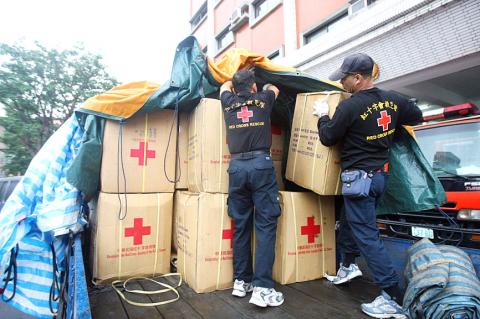
Photo: CNA
She added that the ministry was coordinating with local non-governmental organizations (NGOs) and charities to work out how best to help with the relief efforts in the Philippines.
Meanwhile, the Democratic Progressive Party (DPP) donated US$10,000 to the Philippine government for disaster relief.
DPP Chairman Su Tseng-chang (蘇貞昌) instructed Department of International Affairs Director Liu Shih-chung (劉世忠), who was in Manila for a Council of Asian Liberals and Democrats (CALD) meeting, to make the donation.
DPP Legislator Hsiao Bikhim (蕭美琴) also donated US$1,000.
In related news, a Taiwanese man who has been teaching at a Chinese-language school in Tacloban, one of the hardest-hit regions, has reported that he is safe.
The man, surnamed Tseng (曾), who has been teaching at the school as alternative military service, was quoted by a school administrator as saying that he had telephoned his family to let them know that he was safe.
Taiwan Root Medical Peace Corps (TRMPC) president Liu Chi-chun (劉啟群) yesterday said that his group would provide free medical services from Thursday through Nov. 21 in the hardest-hit areas of the Philippines.
Liu said volunteers from his group would travel to the storm-battered regions in the central Philippines with assistance from the local Rotary Club and Taiwanese businesspeople operating there.
TRMPC, one of the nation’s best-known medical NGOs, has been offering medical services or emergency humanitarian aid to disadvantaged Filipino citizens annually since 2000, with the exception of 2003, when Taiwan was hit by an outbreak of SARS, Liu said.
He said that the upcoming emergency relief work in the Philippines would not affect the group’s scheduled medical service trip to Haiti from Sunday through Nov. 29.
Volunteers from the corps’ branch in the US will also join the Hati mission, he added.

Yangmingshan National Park authorities yesterday urged visitors to respect public spaces and obey the law after a couple was caught on a camera livestream having sex at the park’s Qingtiangang (擎天崗) earlier in the day. The Shilin Police Precinct in Taipei said it has identified a suspect and his vehicle registration number, and would summon him for questioning. The case would be handled in accordance with public indecency charges, it added. The couple entered the park at about 11pm on Thursday and began fooling around by 1am yesterday, the police said, adding that the two were unaware of the park’s all-day live

Fast food chain McDonald's is to raise prices by up to NT$5 on some products at its restaurants across Taiwan, starting on Wednesday next week, the company announced today. The prices of all extra value meals and sharing boxes are to increase by NT$5, while breakfast combos and creamy corn soup would go up by NT$3, the company said in a statement. The price of the main items of those meals, if ordered individually, would remain the same. Meanwhile, the price of a medium-sized lemon iced tea and hot cappuccino would rise by NT$3, extra dipping sauces for chicken nuggets would go up

Yangmingshan National Park’s Qingtiangang (擎天崗) nature area has gone viral after a park livestream camera observed a couple in the throes of intimate congress, which was broadcast live on YouTube, drawing large late-night crowds and sparking a backlash over noise, bright lights and disruption to wildlife habitat. The area’s livestream footage appeared to show a couple engaging in sexual activity on a picnic table in the park on Friday last week, with the uncensored footage streamed publicly online. The footage quickly spread across social media, prompting a tide of visitors to travel to the site to “check in” and recreate the

Minister of Digital Affairs Lin Yi-ching (林宜敬) yesterday cited regulatory issues and national security concerns as an expert said that Taiwan is among the few Asian regions without Starlink. Lin made the remarks on Facebook after funP Innovation Group chief executive officer Nathan Chiu (邱繼弘) on Friday said Taiwan and four other countries in Asia — China, North Korea, Afghanistan and Syria — have no access to Starlink. Starlink has become available in 166 countries worldwide, including Ukraine, Malaysia, the Philippines and Vietnam, in the six years since it became commercial, he said. While China and North Korea block Starlink, Syria is not


 RSS
RSS