

A new technical report from RAND Corp argues that low-cost, readily available anti-ship missiles (ASMs) based on Taiwan and other islands could be used to bottle up China in the case of a war.
“The ability to cut off Chinese seaborne access beyond the first island chain would serve as a major deterrent and have a significant effect on China’s ability to attack its overseas neighbors and wage a prolonged war,” the report said.
It would not require the permanent stationing of new missile batteries in the Western Pacific — the missiles would only be rushed into place if China initiated a conflict.
Cutting off Chinese sea routes using land-based ASMs would have a “significant effect” on China’s ability to project power and would “vastly expand” the military problems faced by China’s People’s Liberation Army (PLA).
“Because these missile systems are relatively easy to operate and are strategically and tactically mobile, the PLA would have to search across a huge number of locations and have assets within range to locate and interdict them,” it said.
“Missile systems that could be placed in many locations over thousands of miles of island chains would significantly dilute the effectiveness of PLA missile and air forces,” the report said.
Titled Employing Land-Based Anti-Ship Missiles in the Western Pacific, the report appears to offer one US tactic to stop Beijing invading Taiwan.
Attempting to justify the decision by the administration of US President Barack Obama not to sell F-16C/D jets to Taiwan, senior Pentagon officials have told the Taipei Times in the past that the island would be better off spending its defense dollars on ASMs.
Ground-launched ASMs stationed in Taiwan with a range of no more than 100km, along with missiles with an effective range of 200km in Okinawa, could effectively cover all naval traffic south of Okinawa, the report said.
Another possibility would be to position missiles with a 200km range solely on the Ryukyu Islands, which would also effectively close the area south of Okinawa, Japan.
“The area between Okinawa and mainland Japan could be effectively covered by ASMs with a 100km range in Japanese territory alone,” RAND said in the report.
At the same time, said the report, the missiles would prevent the Chinese from capturing targets in the first island chain by targeting amphibious forces.
Similarly, the report said the Luzon Strait between the Philippines and Taiwan, as well as the waterways between the Philippines and Borneo, could be covered by 100km-range missiles positioned in the Philippines, Taiwan and Malaysia and by 200km-range missiles fired solely from Philippine islands.
“Should China use or threaten to use force against US allies or partners in the region, the US might want such assets available,” said the report. “It would need to be able to rapidly move ASMs into the region from US territory or from other prepositioned stocks in Asia.”
The report said that the ASM approach is “particularly appealing” because it does not require the stationing or projecting of large-scale forces inside the first island chain “with all the implications that such a measure would have for Chinese security.
“The US would not want to position these types of forces in the region unless tensions with China were very high,” it said. “These modest scale forces could be moved quickly into place if Chinese aggression indicated a need and if countries in the region were willing to accept them.”

The donation of offshore patrol vessel Kinmen to the Philippines includes provisions that protect Taiwanese fishers and facilitate security cooperation across the First Island Chain, officials said yesterday. The comment was made during the Cabinet’s comprehensive administrative report at the legislature after Chinese Nationalist Party (KMT) Legislator Hsu Yu-chen (許宇甄) expressed concerns about the decision to give a ship to a country whose coast guard had in 2013 fired on a Taiwanese trawler and killed its captain without provocation. The Cabinet should lay out the safeguards that have been established to prevent the Philippine government from using the Kinmen to harass, expel
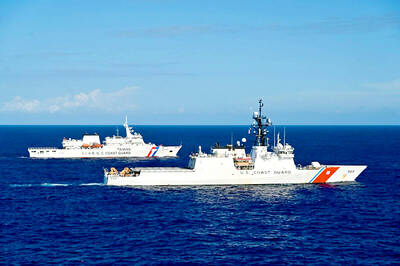
GROWING TIES: The CGA is planning a goodwill mission to the Philippines, in what would be the first time since 1975 a Taiwanese paramilitary vessel has visited the country The Coast Guard Administration (CGA) plans to significantly expand its participation in international security cooperative frameworks and its operational capabilities, a budget proposal for next year showed. The budget indicates a transformation of the CGA from a maritime law enforcement arm into a national defense and intelligence gathering entity capable of tackling larger regional security matters. The proposal showed that personnel from the coast guard’s Intelligence Division and Special Action Support Center are to participate in high-level national security talks with the US. As the CGA has dealt with China’s rising “gray zone” threats around Taiwan, it has become a valuable asset to
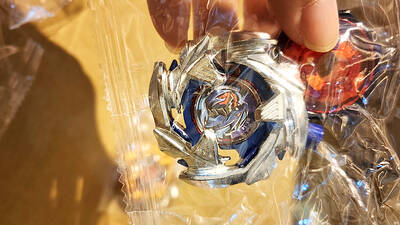
The National Police Agency’s Third Special Police Corps yesterday said that from May to July, it intercepted five smuggling operations from China, seizing more than 70,000 counterfeit Beyblades with an estimated infringement value of NT$34.45 million (US$1.08 million). It added that any bootleg unit that reached the local market could present hidden health hazards to players. Beyblades, a line of spinning toy tops used in competitive gaming and developed in Japan by toy company Takara Tomy, have become popular in Taiwan, making them a target for fraudsters. The Third Special Police Corps, dedicated to safeguarding maritime borders and trade lines,
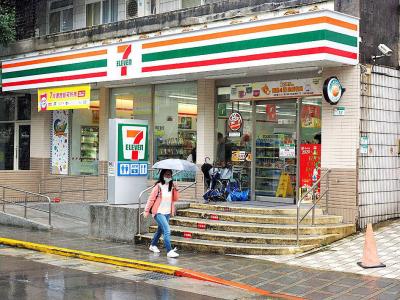
Five customers who made purchases at 7-Eleven stores across Taiwan won the top NT$10 million (US$313,716) special prize in the July-August uniform invoice lottery, including one who spent just NT$27 on photocopying, the convenience store chain said today. The five special prize winners made their purchases at stores in Taoyuan, Taipei, Taichung and Kaohsiung, 7-Eleven operator President Chain Store Corp said. The five winning purchases included NT$29 spent on snacks at a store in Taoyuan's Zhongli District (中壢), NT$27 on photocopying at a store in Taipei's Zhongzheng District (中正), NT$139 on City Cafe coffee and daily necessities at a store in Taipei's


 RSS
RSS