


Members and former members of the China Unification Promotion Party have been arrested over the past two years for direct involvement in organized crime-related incidents, showing that it may still have strong ties with local organized crime groups, police said.
Founded in 2005 by former leading Bamboo Union member Chang An-le (張安樂), commonly known as “White Wolf” (白狼), the party’s main objective is unification with China.
Chang, who had been on the run in China for more than 17 years, returned to Taiwan in June.
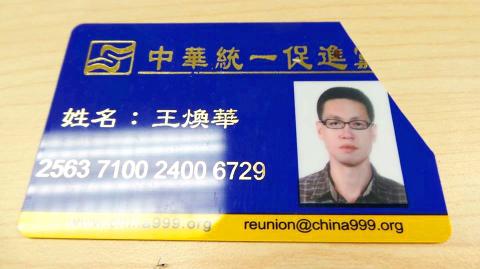
Photo: Facebook
Though it boasts a total membership of close to 20,000, it is not one of the more active political parties. Each party branch is named after a Chinese person of note from antiquity, such as Zilu (子路), one of Confucius’ 72 most renowned disciples, and Yeh Shih (葉適), an official in the Southern Song Dynasty from Wenzhou in Zhejiang Province.
Taoyuan County police department’s criminal investigation division raided the party’s Yeh Shih party headquarters branch early on Wednesday and arrested Wang Huan-hua (王煥華) and four other party members.
The division said that Wang claimed to be the chief of the Yeh Shih branch office, which was located at a local car-washing lot, adding that while he seemed to just be a businessman on the surface, he had used Chang’s support to secure his “turf,” obtain illegal guns and used them to “settle” disputes, and engaged in racketeering across Taipei, Taoyuan and Greater Taichung.
Wang, who had also been on a government list of gang figures to be cracked down on, had met Chang in China in 2010, the division said, adding that Chang had tasked Wang to become the head of the Yeh Shih branch after learning that Wang’s family originated in Wenzhou.
The division also said that Wang had ordered two gang members to rob an art collector surnamed Tseng (曾) in Taipei City after learning that Tseng had various valuable paintings in his house.
The gang members had not succeeded in the attempt, but the Vietnamese girlfriend of Tseng’s son had been pushed from the fourth floor of the building as she was in the process of calling the police during the robbery, the division said.
The police said Wang had also hosted a drug party in June and raped a woman who went by the pseudonym “shuiling” (水靈) who worked at a bar and had also severely beaten her in the bar where she worked, as well as uploading audio files of the rape.
Wang was arrested on Wednesday and sent to Taoyuan District Prosecutor’s Office on charges of organized crime, extortion, obstruction of liberty, obstruction of sexual autonomy and illegal ownership of guns and drugs.
Meanwhile, the China Unification Promotion Party said on Wednesday night that Wang had applied to leave the party in July, which had been approved following his breaking of party regulations.
The announcement, made on Facebook, included an image of Wang’s party membership card with a corner cut off as a sign of its invalidation.
Hsinchu police said that during an anti-crime operation in February last year, one of the prime suspects, You Chia-how (游家豪) had been a deputy director of the China Unification Promotion Party’s Zilu branch.
New Taipei City (新北市) police department said that during a raid on a local Bamboo Union branch they discovered that the union was using the party as a cover, and even handing out party membership cards to absorb students into the gang.
Additional reporting by Chiang Hsiang

REASONS FOR TRAVEL: An assistant professor said that proposed amendments to penalize drivers if they used drugs overseas would not deter people from traveling People who operate a motor vehicle under the influence of marijuana would have their driver’s license revoked, even if they used the substance while overseas, the Ministry of Transportation and Communications said yesterday, citing proposed amendments to the Road Traffic Management and Penalty Act (道路交通管理處罰條例). The amendments would also authorize the government to revoke the licenses of people determined to have used Category 1 or Category 2 narcotics, even if they were not operating a vehicle while under the influence of drugs, as well as ban them from taking the license test for three years, the ministry said. People aged 18 or

UPGRADE: The Kang Ding-class frigate is replacing its Chaparall missiles with Tien Chien II and Hua Yang VLS, which would provide it with long-range, 360° air defense Taiwan plans to produce 1,200 to 1,376 Hai Chien II missiles (海劍二, Sea Sword II) — also known as TC-2N — to serve as the standard air defense system of the navy’s surface combatant fleet, a source said yesterday. Last week, the Hai Chien II, the naval version of the Tien Kung II missile (天劍二, Sky Sword II), completed a live-fire test in waters off the National Chungshan Institute of Science and Technology’s Jiupeng facility (九鵬) in Pingtung County’s Manjhou Township (滿州). The MIM72 Chaparral and other dated air defense missiles that currently arm Taiwanese ships have inadequate range to combat Chinese

GLOBALGIVING: ‘ Caving to external pressure is not acceptable for an organization that has cultivated justice reform and human rights for 30 years,’ one NGO said A slew of non-government organizations (NGOs) have withdrawn from the GlobalGiving fundraising platform after it announced it would use “Chinese Taipei” instead of “Taiwan” from next month. The Taiwan Good Rice Association wrote on Facebook on Friday that it was informed on April 28 via a teleconference call of the change, which was made because the platform wanted to operate in China. Taiwan Good Rice is to terminate all cooperative relationships with GlobalGiving in response to the platform’s “unilateral and non-negotiable” decision to remove references to Taiwan, the NGO said. “Taiwan is in the official name of Taiwan Good Rice Association and the

HEAVY WEATHER: Typhoon Jangmi is due to crash straight into the Ryukyus as airlines look to shift flights to larger aircraft or cancel flights to Okinawa entirely Taiwan’s international air carriers announced flight adjustments over the weekend as Typhoon Jangmi is forecast to hit the Ryukyu Islands today and tomorrow. The Central Weather Administration (CWA) upgraded Jangmi from a tropical storm to a typhoon at 8am yesterday, with the eye located 580km south of Naha city. It was moving north at 19kph. Today, China Airlines’ CI-120, CI-121, CI-122 and CI-123 flights between Taoyuan and Naha, Okinawa, have been canceled as well as CI-132 and CI-133 between Kaohsiung and Naha. EVA Air’s BR-112, BR-113, BR-186 and BR-185 flights between Taoyuan and Naha are also canceled. Low-cost carrier Tigerair Taiwan canceled IT-230,


 RSS
RSS